CodeExecute PythonExecution
Complete guide to how RevitDevTool executes Python scripts with automatic dependency management.
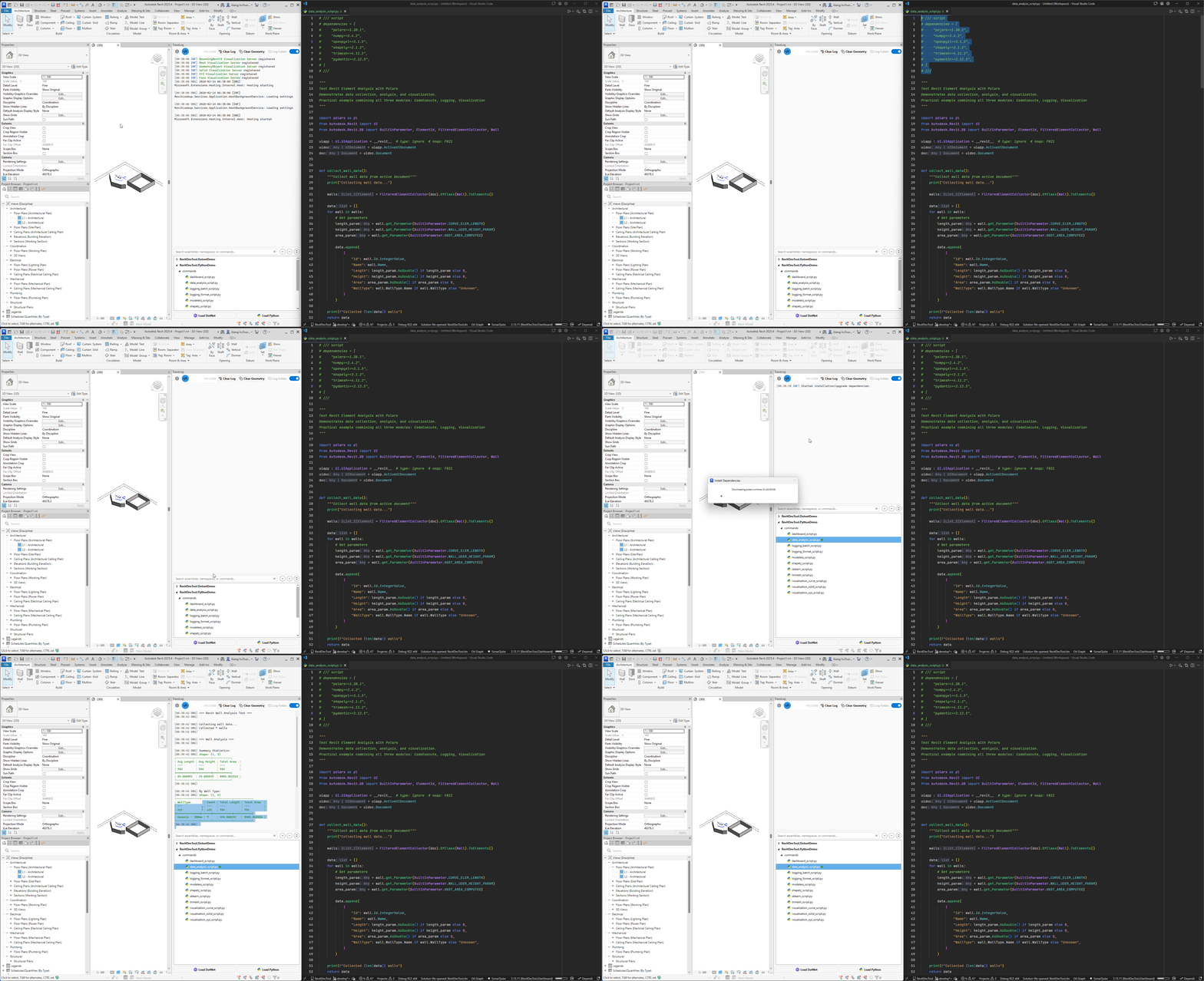
flowchart TD
    A[Write script + Declare dependencies] --> B[Click Execute]
    B --> C[1. Parse PEP 723 block]
    C --> D[2. Check with UV<br/>what needs installing?]
    D --> E{Dependencies<br/>needed?}
    E -->|Yes| F[3. Install with progress dialog]
    E -->|No| G[4. Create Python scope]
    F --> G
    G --> H[5. Inject __revit__, __file__, __root__]
    H --> I[6. Setup environment<br/>Revit API, output redirection]
    I --> J[7. Execute script]
    J --> K[8. Cleanup<br/>clear module cache]
Key advantage: User just declares dependencies in script. System handles everything else automatically.
Declare dependencies directly in your Python script:
# /// script
# dependencies = [
#     "pandas==1.5.3",
#     "numpy>=1.24",
# ]
# ///

import pandas as pd
import numpy as np

# Your code here- Block must be in first 50 lines of file
- Start with
# /// script - End with
# /// - Inside:
dependencies = [...]with quoted package names - Empty array if no packages:
dependencies = []
| Pattern | Example | Meaning |
|---|---|---|
== |
pandas==1.5.3 |
Exact version |
>= |
numpy>=1.24 |
Version 1.24 or later |
> |
matplotlib>3.0 |
Greater than 3.0 |
< |
torch<2.0 |
Less than 2.0 |
~= |
scipy~=1.9.0 |
1.9.x series |
!= |
scikit-learn!=0.24 |
Any except 0.24 |
Combine constraints: "pandas>=1.5,<2.0"
No dependencies (Revit API only):
# /// script
# dependencies = []
# ///

from Autodesk.Revit import DB

doc = __revit__.ActiveUIDocument.Document
walls = DB.FilteredElementCollector(doc).OfClass(DB.Wall).ToElements()
print(f"Found {len(walls)} walls")
With packages:
# /// script
# dependencies = [
#     "pandas==1.5.3",
#     "numpy>=1.24",
#     "scikit-learn~=1.3.0",
# ]
# ///

import pandas as pd
from Autodesk.Revit import DB

doc = __revit__.ActiveUIDocument.Document
walls = DB.FilteredElementCollector(doc).OfClass(DB.Wall).ToElements()

data = [{"Name": w.Name, "Level": w.LevelName} for w in walls]
df = pd.DataFrame(data)
print(df.groupby("Level").size())RevitDevTool uses UV as the dependency resolver backend.
Speed:
- UV is 10-15x faster than pip
- Uses CDCL SAT solver (intelligent resolution)
- pip uses greedy algorithm (can fail)
Safety:
- Detects version conflicts before installation
- Guarantees all packages are compatible
- pip can silently install incompatible versions
flowchart TD
    A["User declares:<br/>pandas==1.5.3, numpy>=1.24"] --> B[UV reads package<br/>metadata from PyPI]
    B --> C[SAT solver checks<br/>all combinations]
    C --> D[pandas 1.5.3 requires:<br/>numpy, python-dateutil, pytz]
    D --> E{All packages<br/>compatible?}
    E -->|Yes| F[Install exact versions:<br/>• pandas 1.5.3<br/>• numpy 1.24.0<br/>• python-dateutil 2.8.2<br/>• pytz 2023.3<br/>• six 1.16.0]
    E -->|No| G[❌ Error:<br/>Version conflict]
Scenario: Installing packages with conflicting dependencies
With pip (greedy):
pip install package-a==1.0
  → Installs conflicting-lib 2.5 ✓

pip install package-b==1.0
  → Needs conflicting-lib <2.0
  → ❌ CONFLICT (silent failure or broken install)
With UV (SAT solver):
uv pip install package-a==1.0 package-b==1.0
  → Analyzes all dependencies
  → Detects conflict immediately
  → ❌ STOPS with clear error message
  → User fixes conflict before install
For specific benchmarks, see:
- UV official benchmarks - Shows 10-100x faster than pip
- UV blog post - Detailed performance analysis
Speed varies by network connection and package size. UV is consistently faster due to:
- Parallel downloads
- Better caching
- Optimized resolution algorithm
flowchart LR
    A[1. Discovery<br/>Find *.script.py files] --> B[2. Parse Metadata<br/>Extract PEP 723 block]
    B --> C[3. Check Environment<br/>UV dry-run]
    C --> D[4. Resolve<br/>UV SAT solver]
    D --> E{Packages<br/>needed?}
    E -->|Yes| F[5. Install<br/>Show dialog + UV install]
    E -->|No| G[6. Execute<br/>Create scope + Run script]
    F --> G
    G --> H[7. Output<br/>Capture to Trace panel]
# Script file content
"""
# /// script
# dependencies = [
#     "pandas==1.5.3",
#     "numpy>=1.24",
# ]
# ///
"""

# Parser extracts:
dependencies = ["pandas==1.5.3", "numpy>=1.24"]
Implementation:
- Reads first 50 lines
- Finds
# /// script...# ///block - Parses TOML array inside
- Validates version specifiers
UV dry-run checks what's installed:
uv pip install pandas==1.5.3 numpy>=1.24 --dry-runOutput:
Would install:
  - pandas==1.5.3 (already satisfied)
  - numpy==1.24.0 (not installed)

Dependencies to install: numpy==1.24.0
UV's SAT solver calculates all transitive dependencies:
flowchart TD
    A[pandas==1.5.3 specified] --> B[pandas requires:<br/>numpy, python-dateutil, pytz]
    B --> C[SAT solver finds<br/>compatible versions]
    C --> D[numpy 1.23.5<br/>compatible with pandas]
    C --> E[python-dateutil 2.8.2]
    C --> F[pytz 2023.3]
    C --> G[six 1.16.0<br/>transitive dependency]
    D --> H[✅ All versions<br/>guaranteed compatible]
    E --> H
    F --> H
    G --> H
If packages needed:
Show modal dialog:
  "Installing Dependencies"
  Progress bar (UV reports progress)

UV command:
  uv pip install <packages> --python C:\path\to\python.exe

Installation completes
  → Dialog closes
  → Execution continues
If all present:
Dry-run shows all satisfied
  → Skip installation
  → Continue directly to execution
1. Create Python scope (isolated environment)
2. Inject global variables:
   - __revit__ = UIApplication
   - __file__ = script path
   - __root__ = scripts folder
3. Inject Setup.py:
   - Load Revit namespaces
   - Redirect print() to Trace
4. Clear module cache (Reset.py)
5. Execute user script
6. Capture output
All print() statements captured:
print("Starting analysis...")          # → Trace panel
print(f"Found {len(walls)} walls")     # → Trace panel
print(dataframe)                       # → Trace panel (formatted)
Geometry objects visualized:
from Autodesk.Revit.DB import *

face = GetSomeFace()
print(face) # → Trace panel + 3D visualization in RevitFirst execution with new dependencies:
- Parse PEP 723 block
- UV dry-run check
- Show dialog + install (depends on network)
- Execute script
Subsequent executions (same dependencies):
- Parse PEP 723 block
- UV dry-run (all present, skip install)
- Execute immediately
Installation speed varies by network connection and package size.
Phase 2 errors (Parse):
[ERROR] PEP 723 block not found or invalid
Check: Block in first 50 lines? Correct syntax?
Phase 4 errors (Resolve):
[ERROR] Could not resolve dependencies
Cause: Version conflict detected
Fix: Update package versions or remove conflicting package
Phase 5 errors (Install):
[ERROR] Installation failed
Cause: Network error, package not found, or permission denied
Fix: Check internet connection, verify package name on PyPI
Phase 6 errors (Execute):
[ERROR] Traceback (most recent call last):
  File "script.py", line 10, in <module>
    result = walls[0].Area
AttributeError: 'Wall' object has no attribute 'Area'
When your script runs, these are automatically available:
# __revit__ = UIApplication (Revit's main API object)
doc = __revit__.ActiveUIDocument.Document

# __file__ = path to current script
import os
script_dir = os.path.dirname(__file__)

# Import from same folder automatically works
from my_shared_module import some_functionPrint statements automatically appear in Trace panel:
print("Hello")        # → Appears in Trace
print(some_object)    # → Converted to string, appears in Trace
No manual setup needed - it's automatic.
Module cache is cleared automatically between script runs:
# Run Script A:
import shared_config
shared_config.MODE = "A"

# Run Script B (cache cleared first):
import shared_config  # Fresh load from disk, not previous run's "A"
shared_config.MODE = "B"  # Now starts fresh
Why this matters:
- No state pollution between scripts
- Each execution starts clean
- Reload works correctly (unlike pyRevit CPython)
All Revit namespaces are available automatically:
from Autodesk.Revit import DB, UI

doc = __revit__.ActiveUIDocument.Document
collector = DB.FilteredElementCollector(doc)
walls = collector.OfClass(DB.Wall).ToElements()# /// script
# dependencies = ["pandas==1.5.3"]
# ///
import pandas as pd
from Autodesk.Revit import DB
doc = __revit__.ActiveUIDocument.Document
elements = DB.FilteredElementCollector(doc).OfClass(DB.Wall).ToElements()
data = [{"Name": el.Name, "Level": el.LevelName} for el in elements]
df = pd.DataFrame(data)
print(df.groupby("Level").size())# /// script
# dependencies = []
# ///
# Import from same folder (automatic)
from utils import get_all_walls, export_to_csv
doc = __revit__.ActiveUIDocument.Document
walls = get_all_walls(doc)
export_to_csv(walls, "output.csv")# /// script
# dependencies = [
# "pandas==1.5.3",
# "numpy>=1.24",
# "scikit-learn~=1.3.0",
# "matplotlib>=3.5",
# ]
# ///
import pandas as pd
import numpy as np
from sklearn.linear_model import LinearRegression
import matplotlib.pyplot as plt
# All packages installed automatically
# No manual pip install neededCheck:
- Block in first 50 lines?
- Correct delimiters:
# /// scriptand# ///? - Correct syntax:
dependencies = [...]with double quotes?
Check:
- Package name correct on pypi.org?
- Version exists for Python 3.x?
Two packages need incompatible versions:
- Update package versions
- Remove one conflicting package
- Check PyPI compatibility
Likely causes:
- Package name ≠ import name (e.g.,
scikit-learninstalls,import sklearn) - Package not compatible with Windows
- Missing system dependencies (rare with pure Python packages)
RevitDevTool's Python mechanism:
- PEP 723 - Declare dependencies in script
- UV Resolver - Fast, safe dependency resolution (10-15x faster than pip)
- Automatic Installation - User confirms, system installs
- Isolated Execution - Clean scope, injected variables, cleared cache
- Output Capture - Print to Trace, visualize geometry
No manual setup required. Just declare dependencies and click execute.
RevitDevTool supports live debugging of Python scripts using VSCode's debugger via debugpy integration.
Revit starts
    ↓
RevitDevTool initializes Python runtime
    ↓
Automatically installs debugpy
    ↓
Starts debugpy listener on configured port (default: 5678)
    ↓
VSCode attaches to the debugger
    ↓
Set breakpoints in your Python scripts
    ↓
Execute script → Debugger pauses at breakpoints
Open RevitDevTool Settings and configure the debug port (default is 5678):

The debugger status indicator appears in the Trace panel toolbar:
- 🔴 Red dot - Debugger not connected
- 🟢 Green dot - VSCode debugger attached
Add this configuration to your .vscode/launch.json:
{
  "version": "0.2.0",
  "configurations": [
    {
      "name": "Attach to Revit Python",
      "type": "debugpy",
      "request": "attach",
      "connect": {
        "host": "localhost",
        "port": 5678
      },
      "pathMappings": [
        {
          "localRoot": "${workspaceFolder}",
          "remoteRoot": "${workspaceFolder}"
        }
      ],
      "justMyCode": false
    }
  ]
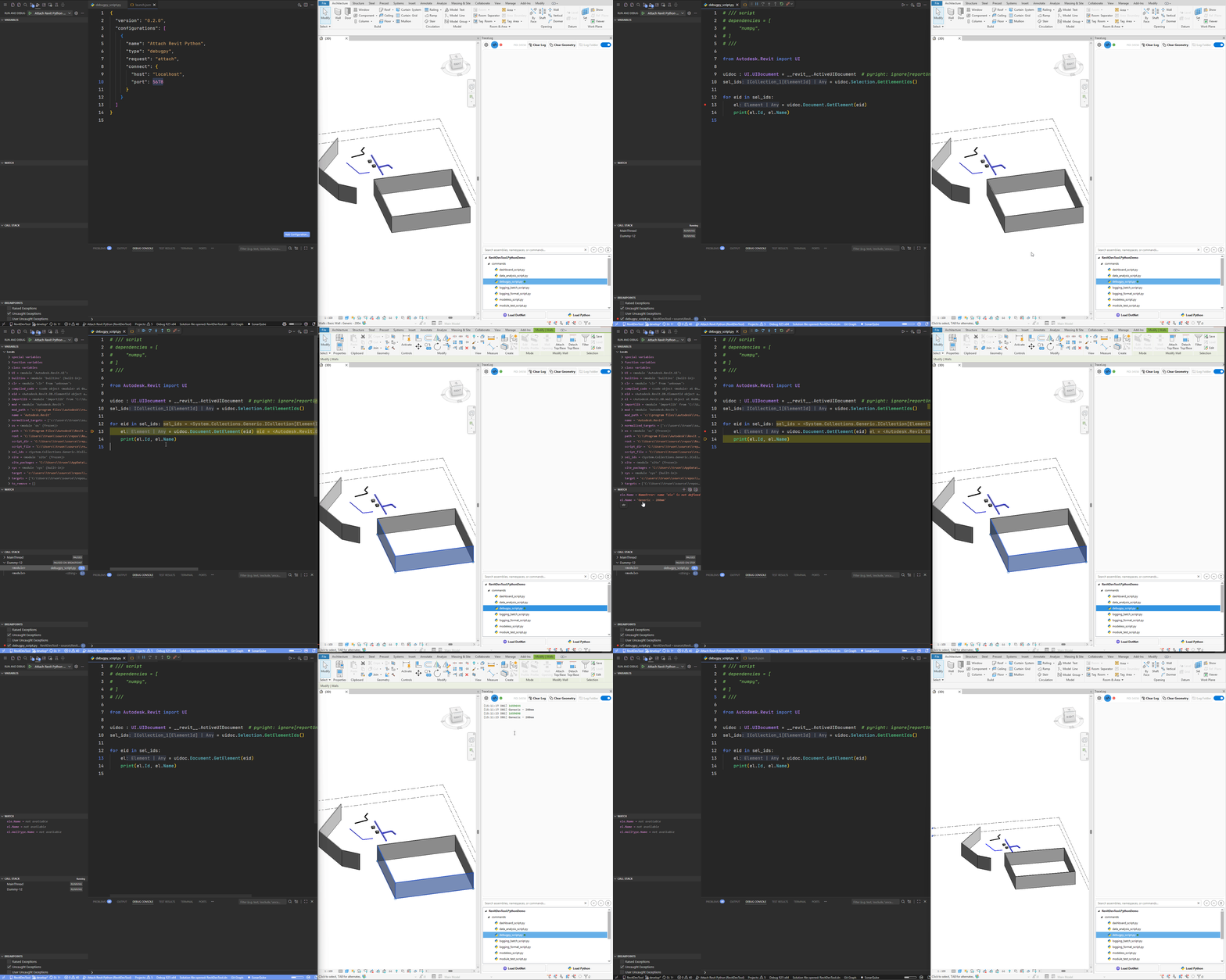
}- Launch Revit with RevitDevTool installed
- Open your script folder in VSCode
- Set breakpoints in your Python scripts (click left margin)
- Press F5 in VSCode (or Run → Start Debugging)
- Check status indicator in Trace panel (should turn green 🟢)
- Execute your script in RevitDevTool
- Debugger pauses at breakpoints
Full VSCode debugging capabilities:
- ✅ Breakpoints - Pause execution at specific lines
- ✅ Step through code - Step over, step into, step out
- ✅ Variable inspection - Hover to see values, watch expressions
- ✅ Call stack - Navigate execution stack
- ✅ Debug console - Evaluate expressions during debugging
- ✅ Conditional breakpoints - Break only when condition is true
- ✅ Revit API inspection - Inspect
__revit__,doc, elements, etc.
Script with breakpoint:
# /// script
# dependencies = ["numpy"]
# ///

import numpy as np
from Autodesk.Revit import DB

doc = __revit__.ActiveUIDocument.Document

# Set breakpoint on next line in VSCode
walls = DB.FilteredElementCollector(doc).OfClass(DB.Wall).ToElements()

for wall in walls:
    # Set breakpoint here to inspect each wall
    curve = wall.Location.Curve
    length = curve.Length
    print(f"Wall {wall.Id}: {length:.2f} ft")
When debugger pauses:
- Inspect
wallscollection - Hover over
wallto see properties - Check
curve.Lengthvalue - Evaluate expressions in Debug Console:
wall.Name,wall.LevelId, etc.
flowchart TD
    subgraph VSCode["VSCode (Debugger)"]
        VS1[Set breakpoints]
        VS2[Attach to Revit - F5]
        VS3[Step through code]
        VS4[Inspect variables]
        VS1 --> VS2 --> VS3 --> VS4
    end

    subgraph Revit["Revit + RevitDevTool"]
        R1[Start debugpy listener on port 5678]
        R2[Wait for VSCode to attach]
        R3[Execute script with debugpy active]
        R4[Pause at breakpoints]
        R5[Send variable data to VSCode]
        R1 --> R2 --> R3 --> R4 --> R5
    end

    VSCode <-->|debugpy protocol| Revit
Debugger won't connect:
- Check port 5678 is not blocked by firewall
- Verify debugpy is installed (check Trace panel logs)
- Restart Revit if port is in use
- Change port in Settings if 5678 conflicts with other apps
Breakpoints not hit:
- Ensure VSCode is attached (green dot 🟢 in Trace panel)
- Check
pathMappingsin launch.json matches your folder structure - Verify script file path is correct
- Try
justMyCode: falsein launch.json
Variables not showing:
- Use Debug Console to evaluate expressions
- Check call stack to ensure you're at correct frame
- Some Revit API objects may show as
<PyObject>- access properties directly
Debugging overhead:
- Minimal impact when debugger not attached
- Slight slowdown when stepping through code (expected)
- No impact on production scripts (debugging is optional)
Best practices:
- Attach debugger only when needed
- Remove breakpoints for production runs
- Use conditional breakpoints for large loops
- Detach debugger when done (Shift+F5 in VSCode)
- vs pyRevit - Comparison with pyRevit
- Stub Generation - IDE autocomplete setup
- .NET Runtime - C# execution mechanism