Collections vs Arrays
Array is of Fixed Size
Collection is a Re-sizable Array
The core collection interfaces encapsulate different types of collections, which are shown in the figure below. These interfaces allow collections to be manipulated independently of the details of their representation. Core collection interfaces are the foundation of the Java Collections Framework. As you can see in the following figure, the core collection interfaces form a hierarchy.
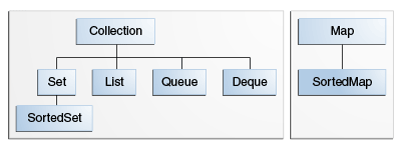
Collection — the root of the collection hierarchy. A collection represents a group of objects known as its elements. The Collection interface is the least common denominator that all collections implement and is used to pass collections around and to manipulate them when maximum generality is desired. Some types of collections allow duplicate elements, and others do not. Some are ordered and others are unordered. The Java platform doesn't provide any direct implementations of this interface but provides implementations of more specific subinterfaces, such as Set and List.
List — an ordered collection (sometimes called a sequence). Lists can contain duplicate elements. The user of a List generally has precise control over where in the list each element is inserted and can access elements by their integer index (position). If you've used Vector, you're familiar with the general flavor of List.
Integer[] elements = {25, 77 , 66};

List<Integer> list = new ArrayList<>();
Collections.addAll( list, elements ); //Since:1.5

// List allows duplicates, Set contains unique values
List<Integer> distinctList = new ArrayList<>( new LinkedHashSet<>( list ) );
distinctList.add( 77 );-
add(Element);Make a new array of 's runtime type and coppies the prevous elements to new Array.<Object, Object> Object[] java.util.Arrays.copyOf(Object[] original, int newLength, Class<? extends Object[]> newType)
Copies the specified array, truncating or padding with nulls (if necessary)so the copy has the specified length.
-
add(index, Element);void java.lang.System.arraycopy(Object src, int srcPos, Object dest, int destPos, int length)
Copies an array from the specified source array, beginning at the specified position, to the specified position of the destination array.A sub-sequence of array components are copied from the source array referenced by
srcto the destination array referenced bydest. The number of components copied is equal to the length argument.
To get the values from the List and display:
ArrayList<Integer> list = new ArrayList<>(); // DEFAULT_CAPACITY
for (int i = 0; i < 10; i++) {
    list.add(i);
}
// Using Iterator Since 1.2
Iterator<Integer> iterator = list.iterator();
while (iterator.hasNext()) {
    Integer integer = (Integer) iterator.next();
    System.out.println(integer);
}

// Advanced for each Since 1.5
for (Integer integer : list) {
    System.out.println(integer);
}

// Stream API - Lambda Expression Since 8
list.forEach(System.out::println);
Because of Memory We go for ArrayList instead of Vector.
ArrayList<>(); // JDK1.2 Initial Capacity 10, Increase Capacity 50%
Vector<>();    // JDK1.0 Initial Capacity 10, Increase Capacity 100%, Theoretically Thread Safe.
Stack<>();     // JDK1.0 Initial Capacity 10, Increase Capacity 100%, Push(), Pop(), extera funcitons.
LinkedList<E>extends AbstractSequentialList
implements List, Deque, Cloneable, java.io.Serializable
private static class Node<E> {
    E item;
    Node<E> next;
    Node<E> prev;

    Node(Node<E> prev, E element, Node<E> next) {
        this.item = element;
        this.next = next;
        this.prev = prev;
    }
}

add(E e)
add(int index, E element)
addAll(Collection<? extends E> c)
addAll(int index, Collection<? extends E> c)
remove(Object o)
remove(int index)
get(int index)
set(int index, E element)

getFirst()
getLast()
removeFirst()
removeLast()
addFirst(E e)
addLast(E e)
contains(Object o)
size()
clear()

// Search Operations
indexOf(Object o)
lastIndexOf(Object o)

// Queue operations. @since 1.5
peek()        - Retrieves, but does not remove, the head
element()     - Retrieves, but does not remove, the head
                @throws NoSuchElementException if this list is empty
poll()        - Retrieves and removes the head
remove()      - Retrieves and removes the head
offer(E e)    - Adds the specified element as the tail

// Deque operations. @since 1.6
offerFirst(E e)  - Inserts the specified element at the front
offerLast(E e)   - Inserts the specified element at the end
peekFirst()      - Retrieves, but does not remove, the first element
peekLast()       - Retrieves, but does not remove, the last element
pollFirst()      - Retrieves and removes the first element
pollLast()       - Retrieves and removes the last element
push(E e)        - Pushes an element onto the stack (front)
pop()            - Pops an element from the stack (front)
removeFirstOccurrence(Object o) - when traversing the list from head to tail removes the first occred element
removeLastOccurrence(Object o)  - when traversing the list from head to tail removes the last occred element

listIterator(int index)
descendingIterator() // @since 1.6

clone()
toArray()
toArray(T[] a)

spliterator()       // @since 1.8
Set — a collection that cannot contain duplicate elements. This interface models the mathematical set abstraction and is used to represent sets, such as the cards comprising a poker hand, the courses making up a student's schedule, or the processes running on a machine.
Map — an object that maps keys to values. A Map cannot contain duplicate keys; each key can map to at most one value. If you've used Hashtable, you're already familiar with the basics of Map.