Perceptual Similarity Metric and Dataset [Project Page]
This repository contains the (1) Learned Perceptual Image Patch Similarity (LPIPS) metric and (2) Berkeley-Adobe Perceptual Patch Similarity (BAPPS) dataset proposed in the paper below. It can also be used as an implementation of the "perceptual loss".
The Unreasonable Effectiveness of Deep Networks as a Perceptual Metric
Richard Zhang, Phillip Isola, Alexei A. Efros, Eli Shechtman, Oliver Wang.
In CVPR, 2018.
This repository uses Python 2 or 3, with the following libraries: PyTorch, numpy, scipy, skimage.
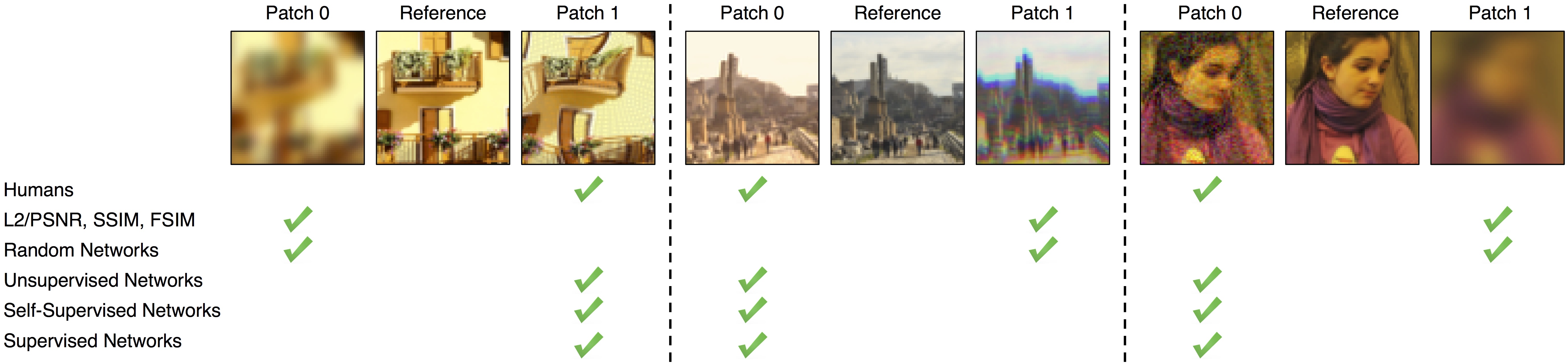
We found that deep network activations work surprisingly well as a perceptual similarity metric. This was true across network architectures (SqueezeNet [2.8 MB], AlexNet [9.1 MB], and VGG [58.9 MB] provided similar scores) and supervisory signals (unsupervised, self-supervised, and supervised all perform strongly). We slightly improved scores by linearly "calibrating" networks - adding a linear layer on top of off-the-shelf classification networks. We provide 3 variants, using linear layers on top of the SqueezeNet, AlexNet (default), and VGG networks. Using this code, you can simply call model.forward(im0,im1) to evaluate the distance between two image patches.
Script test_network.py contains example usage. Run python test_network.py to take the distance between example reference image ex_ref.png to distorted images ex_p0.png and ex_p1.png. Before running it - which do you think should be closer? A more detailed explanation is below.


Load a model with the following commands.
from models import dist_model as dm
model = dm.DistModel()
model.initialize(model='net-lin',net='alex',use_gpu=True)
Variable net can be squeeze, alex, vgg. Network alex is fastest, performs the best, and is the default. Set model=net for an uncalibrated off-the-shelf network (taking cos distance). Finally, to call the model, run
d = model.forward(im0,im1)where im0, im1 are PyTorch tensors with shape Nx3xHxW (N patches of size HxW, RGB images scaled in [-1,+1]). Variable d will be a length N numpy array.
File perceptual_loss.py shows how to iteratively optimize using the metric. Run python perceptual_loss.py for a demo. The code can also be used to implement vanilla VGG loss, without our learned weights. This was implemented by Angjoo Kanazawa.
Run bash ./scripts/get_dataset.sh to download and unzip the dataset. Dataset will appear in directory ./dataset. Dataset takes [6.6 GB] total.
- 2AFC train [5.3 GB]
- 2AFC val [1.1 GB]
- JND val [0.2 GB]
Alternatively, runbash ./scripts/get_dataset_valonly.shto only download the validation set (no training set).
Script test_dataset_model.py evaluates a perceptual model on a subset of the dataset.
Dataset flags
dataset_mode:2afcorjnd, which type of perceptual judgment to evaluatedatasets: list the datasets to evaluate- if
dataset_modewas2afc, choices are [train/traditional,train/cnn,val/traditional,val/cnn,val/superres,val/deblur,val/color,val/frameinterp] - if
dataset_modewasjnd, choices are [val/traditional,val/cnn]
- if
Perceptual similarity model flags
model: perceptual similarity model to usenet-linfor our LPIPS learned similarity model (linear network on top of internal activations of pretrained network)netfor a classification network (uncalibrated with all layers averaged)l2for Euclidean distancessimfor Structured Similarity Image Metric
net: choices are [squeeze,alex,vgg] for thenet-linandnetmodels (ignored forl2andssimmodels)colorspace: choices are [Lab,RGB], used for thel2andssimmodels (ignored fornet-linandnetmodels)
Misc flags
batch_size: evaluation batch size (will default to 1 )--use_gpu: turn on this flag for GPU usage
An example usage is as follows: python ./test_dataset_model.py --dataset_mode 2afc --datasets val/traditional val/cnn --model net-lin --net alex --use_gpu --batch_size 50. This would evaluate our model on the "traditional" and "cnn" validation datasets.
The dataset contains two types of perceptual judgements: Two Alternative Forced Choice (2AFC) and Just Noticeable Differences (JND).
(1) Two Alternative Forced Choice (2AFC) - Data is contained in the 2afc subdirectory. Evaluators were given a reference patch, along with two distorted patches, and were asked to select which of the distorted patches was "closer" to the reference patch.
Training sets contain 2 human judgments/triplet.
train/traditional[56.6k triplets]train/cnn[38.1k triplets]train/mix[56.6k triplets]
Validation sets contain 5 judgments/triplet.
val/traditional[4.7k triplets]val/cnn[4.7k triplets]val/superres[10.9k triplets]val/deblur[9.4k triplets]val/color[4.7k triplets]val/frameinterp[1.9k triplets]
Each 2AFC subdirectory contains the following folders:
refcontains the original reference patchesp0,p1contain the two distorted patchesjudgecontains what the human evaluators chose - 0 if all humans preferred p0, 1 if all humans preferred p1
(2) Just Noticeable Differences (JND) - Data is contained in the jnd subdirectory. Evaluators were presented with two patches - a reference patch and a distorted patch - for a limited time, and were asked if they thought the patches were the same (identically) or difference.
Each set contains 3 human evaluations/example.
val/traditional[4.8k patch pairs]val/cnn[4.8k patch pairs]
Each JND subdirectory contains the following folders:
p0,p1contain the two patchessamecontains fraction of human evaluators who thought the patches were the same (0 if all humans thought patches were different, 1 if all humans thought patches were the same)
If you find this repository useful for your research, please use the following.
@inproceedings{zhang2018perceptual,
  title={The Unreasonable Effectiveness of Deep Networks as a Perceptual Metric},
  author={Zhang, Richard and Isola, Phillip and Efros, Alexei A and Shechtman, Eli and Wang, Oliver},
  booktitle={CVPR},
  year={2018}
}
This repository borrows partially from the pytorch-CycleGAN-and-pix2pix repository. The average precision (AP) code is borrowed from the py-faster-rcnn repository.