Logistic map for monome crow.

The dynamical system
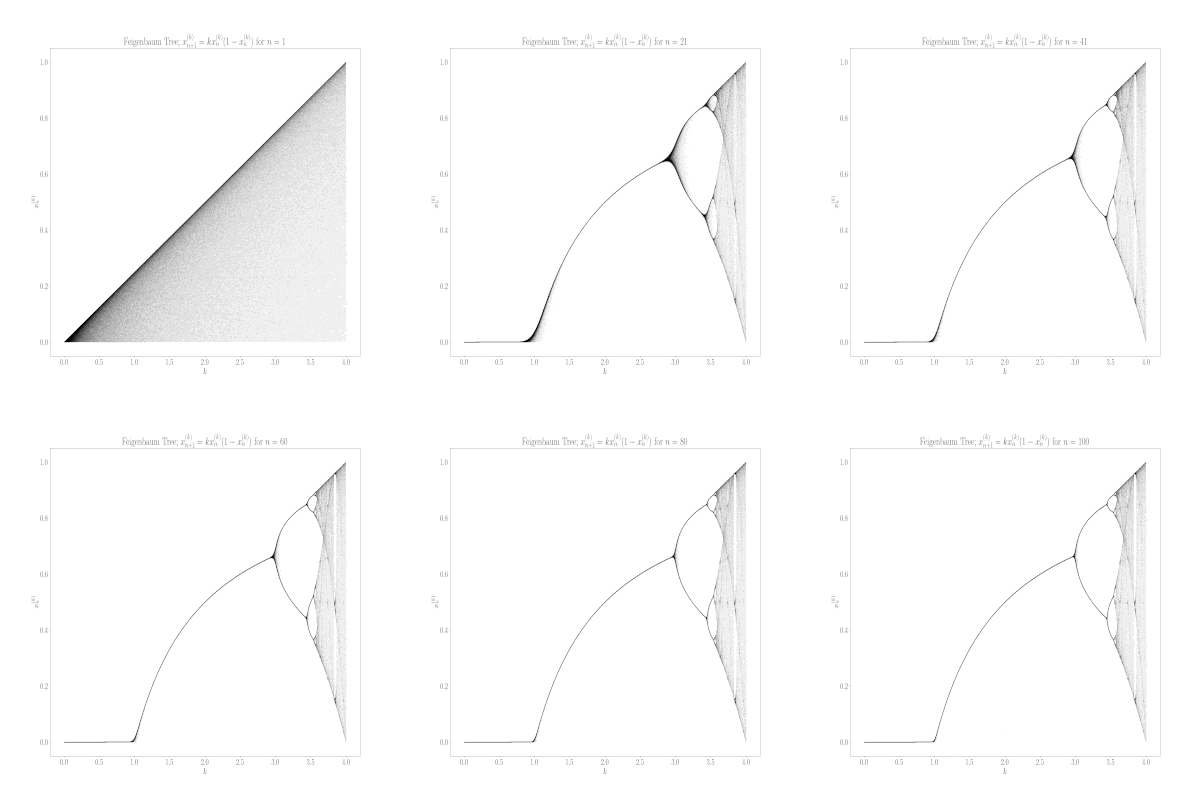
The function is a real classic in study of systems, and connected to early climate research and populations (of corvids too). I believe that is something crow people can appreciate. From Wikipedia:
The map was initially utilized by Edward Lorenz in the 1960s to showcase properties of irregular solutions in climate systems. It was popularized in a 1976 paper by the biologist Robert May in part as a discrete-time demographic model analogous to the logistic equation written down by Pierre François Verhulst.
This script exposes the interesting range of population-crowth.lua and population-crowth-pp.lua. The former is a more normal version. The latter is an extended version where
This is a druid script, ie. a script running directly on crow and not on norns. Run or upload to crow with druid, or use bowering from norns as I do.
In file population-crowth.lua
→ 1 clock
→ 2 r
  1 value x_n     →
  2 value x_{n-1} →
  3 value x_{n-2} →
  4 value x_{n-3} →
Give clock to crow input 1, and set
In file population-crowth-pp.lua you will find an extended, patch-programmable version of the logistic map. It implements the function
→ 1 x_n
→ 2 r
  1 value x_n           →
Self-patch output1 to input 1. Set
This version runs at 137 BPM, a tempo I like for techno music. You can change it by setting clock.tempo from druid or clock.clock.tempo from norns, and there is a clock divider public variable public.clockdiv you can set.
There are a few public variables if you are into that sort of thing. bowering visualizes then.
Inspired really by KlangauKöln’s Logistic Equation module. Also thank you Wikipedia.