Effektsystem #17
Effektsystem #17
Conversation


… speed modification.

api/effects.json
Outdated
| [ | ||
| { | ||
| "id": 1, | ||
| "name": "QuickEscape", |
There was a problem hiding this comment.
Erster, super simpler Effekt. Wird genutzt um Dodos einen kleinen Sprint zu geben, wenn sie geschlagen werden.
| // Parse effects | ||
| var effectsByEvent = &EffectsByEvent{} | ||
| var err error | ||
| if effectsByEvent.WhileCarried, err = effects.MapAndValidateEffects(r, "WhileCarried", i.Effects.WhileCarried); err != nil { |
There was a problem hiding this comment.
Gibt es eine Variante um das schöner zu lösen statt 3 Zeilen pro Event-Parsing zu haben?
There was a problem hiding this comment.
Ich würde das ganze ein wenig flexibler gestalten, wenn du jedoch deinen fixen struct befüllst kommst du wohl kaum um die Zeilen rum. Ev. könntest to ein bisschen reflect nutzen.
| @@ -1,4 +1,4 @@ | |||
| import {isDefined, removeElement} from "./Utils"; | |||
| import {isDefined, isUndefined, removeElement} from "./Utils"; | |||
There was a problem hiding this comment.
Kannst du ignorieren, das war nur ein Fehler den ich im Frontend gefixt habe

|
Meine Hauptfragen wären:
|


|
uiii, sexy! Ich führ mir das mal zu Gemüte am Wochenende 👍 |

api/_definitions/effects.json
Outdated
| "type": "integer", | ||
| "description": "Number of times this effect can be applied simultaneously to the same entity. Omitting this property means no limit to the stack size.", | ||
| "minimum": 1, | ||
| "default": "infinity" |
There was a problem hiding this comment.
sollte nicht 0 als 'infinity' gelten? typisierte Sprachen haben für int kaum ein infinity definiert ;)
There was a problem hiding this comment.
Da habe ich eine Weile überlegt. Ich habe es so implementiert, dass "Wert nicht definiert im JSON" als nil herumgereicht wird, und dann maxStacks ignoriert wird. Natürlich könnte man das auch als 0 annehmen, aber dann würde der Default mit dem Minimum kollidieren, daher meine Angabe "infinity" (die natürlich nicht als Integer.INFINITY gelöst ist, sondern eben als nil) an den User adressiert, von wegen "wenn du nichts angibt, kann der Effekt beliebig oft stacken"
 trichner
left a comment
trichner
left a comment
trichner
left a comment
There was a problem hiding this comment.
Cooles Ding!
Ich würde unbedingt das addieren/subtrahieren unterlassen, du hast eine gute Wahrscheinlichkeit dass a * x / x != a da die Operationen im Allgemeinen lossy sind. Ich würde die Effekte für jeden Tick wieder frisch aufaddieren, wenns zu hart ist für die performance liesse sich das dann auch einfach cachen...
Im Allgemeinen scheint mir die momentane Lösung skaliert relativ schlecht, wie du bereits selber gemerkt hast repetiert sich einiges relativ oft.
api/_definitions/effects.json
Outdated
| @@ -0,0 +1,188 @@ | |||
| { | |||
| "$schema": "http://json-schema.org/draft-07/schema#", | |||
| "$id": "https://berryhunter.io/schema/effects.json", | |||

| return Inventory{ | ||
| items: make([]*ItemStack, 0, 10), | ||
| cap: DEFAULT_INVENTORY_CAP, | ||
| effectEntity: p, |
There was a problem hiding this comment.
Warum sind effekte teil des inventars?!
There was a problem hiding this comment.
Weil das Inventar sonst nicht weiß, zu wem es gehört und wohin die Effekte der Items im Inventar zu applyen sind. Bin offen für eine bessere Lösung, aber sehe es nicht so recht, da diese Effect entity tatsächlich relativ oft gebraucht wird:
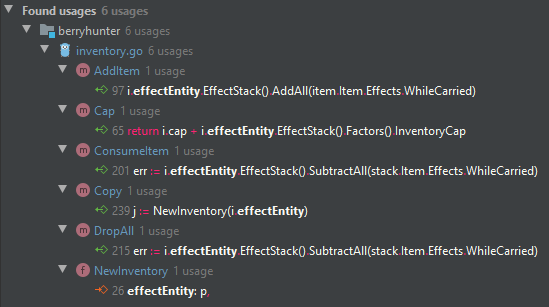
| // Cap returns the maximum amount of item slots | ||
| func (i *Inventory) Cap() int { | ||
| return i.cap | ||
| return i.cap + i.effectEntity.EffectStack().Factors().InventoryCap |
There was a problem hiding this comment.
Kannst du das nicht generischer lösen?
| // Parse effects | ||
| var effectsByEvent = &EffectsByEvent{} | ||
| var err error | ||
| if effectsByEvent.WhileCarried, err = effects.MapAndValidateEffects(r, "WhileCarried", i.Effects.WhileCarried); err != nil { |
There was a problem hiding this comment.
Ich würde das ganze ein wenig flexibler gestalten, wenn du jedoch deinen fixen struct befüllst kommst du wohl kaum um die Zeilen rum. Ev. könntest to ein bisschen reflect nutzen.
berryhunterd/sys/state.go
Outdated
| for _, p := range s.players { | ||
|
|
||
| if p.VitalSigns().Health == 0 { | ||
| if p.VitalSigns().Health <= 0 { |
There was a problem hiding this comment.
warum? Ziemlich sicher sind die VitalSigns gegen over- und underflow geschützt
There was a problem hiding this comment.
Da habe ich wohl rumgespielt, um den angesprochenen Bug zu beheben
Es gibt einen weirden Bug, dass das EffectSystem irgendwie dafür sorgt, dass sys.Update und sys.State nicht mehr richtig herum ausgeführt werden. Das führt sichtbar dazu, dass cheat: KILL nicht mehr funktioniert (da der Player leben regeneriert bevor er als tot aus dem Spiel entfernt wird), aber evtl gibt es noch weitere üble Nebenwirkungen. Ich kann mir leider absolut nicht erklären, warum - immerhin zählt das system nur die effekt durations herunter.


Details: https://trello.com/c/HSEQ3wJ5/433-effektsystem