



A high-performance implementation of LOESS (Locally Estimated Scatterplot Smoothing) in Rust. This crate provides a robust, production-ready implementation with support for confidence intervals, multiple kernel functions, and optimized execution modes.
Important
For parallelization or ndarray support, use fastLoess.
LOESS creates smooth curves through scattered data using local weighted neighborhoods:
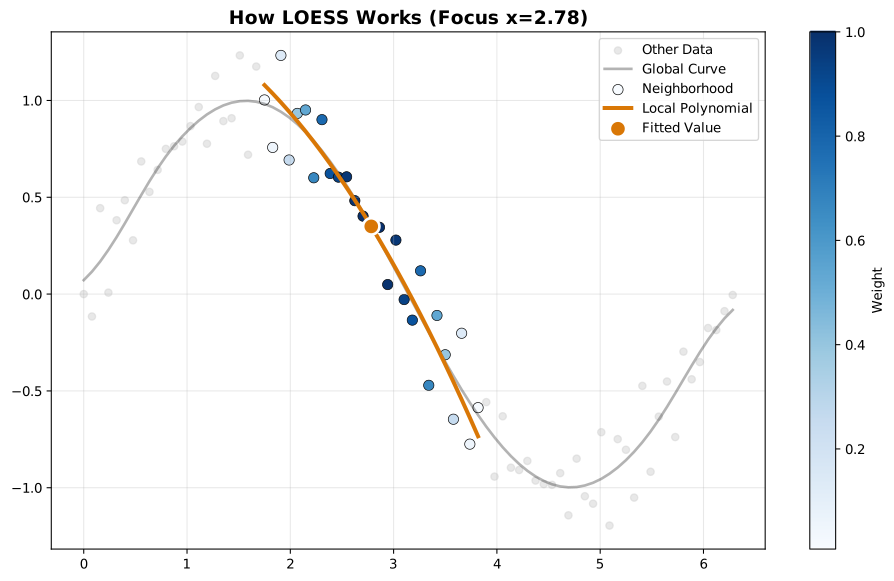
| Feature | LOESS (This Crate) | LOWESS |
|---|---|---|
| Polynomial Degree | Linear, Quadratic, Cubic, Quartic | Linear (Degree 1) |
| Dimensions | Multivariate (n-D support) | Univariate (1-D only) |
| Flexibility | High (Distance metrics) | Standard |
| Complexity | Higher (Matrix inversion) | Lower (Weighted average/slope) |
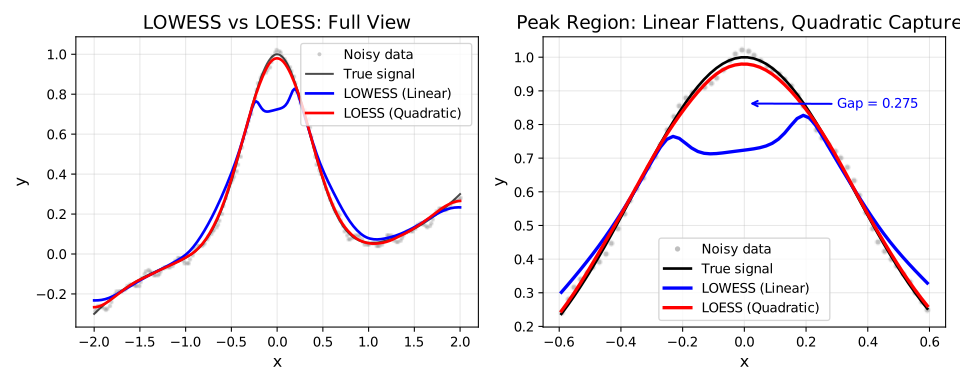
LOESS can fit higher-degree polynomials for more complex data:
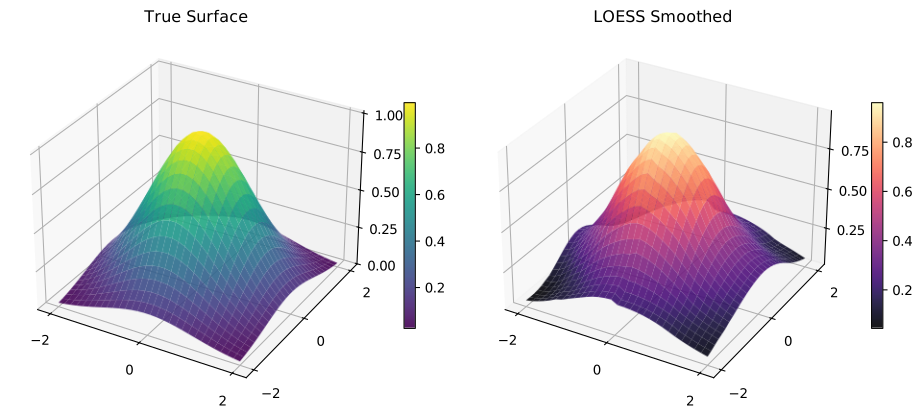
LOESS can also handle multivariate data (n-D), while LOWESS is limited to univariate data (1-D):
Tip
Note: For a simple, lightweight, and fast LOWESS implementation, use lowess crate.
- Robust Statistics: IRLS with Bisquare, Huber, or Talwar weighting for outlier handling.
- Multidimensional Smoothing: Support for n-D data with customizable distance metrics (Euclidean, Manhattan, etc.).
- Flexible Fitting: Linear, Quadratic, Cubic, and Quartic local polynomials.
- Uncertainty Quantification: Point-wise standard errors, confidence intervals, and prediction intervals.
- Optimized Performance: Interpolation surface with Tensor Product Hermite interpolation and streaming/online modes for large or real-time datasets.
- Parameter Selection: Built-in cross-validation for automatic smoothing fraction selection.
- Flexibility: Multiple weight kernels (Tricube, Epanechnikov, etc.) and
no_stdsupport (requiresalloc). - Validated: Numerical twin of R's
stats::loesswith exact match (< 1e-12 diff).
Benchmarked against R's loess. Achieves 4.4×–53× faster performance across all tested scenarios. No regressions observed.
| Category | Matched | Median Speedup | Mean Speedup |
|---|---|---|---|
| Polynomial Degrees | 2 | 21.67× | 21.67× |
| Fraction | 6 | 13.36× | 19.70× |
| Iterations | 6 | 16.35× | 15.90× |
| Pathological | 4 | 16.14× | 16.27× |
| Dimensions | 3 | 7.98× | 8.01× |
| Scalability | 2 | 5.86× | 5.86× |
| Genomic | 2 | 5.27× | 5.27× |
| Financial | 3 | 4.88× | 5.97× |
| Scientific | 3 | 4.46× | 5.28× |
| Benchmark | Rust | R | Speedup |
|---|---|---|---|
| fraction_0.67 | 0.83ms | 44.80ms | 53.71× |
| fraction_0.5 | 1.22ms | 32.25ms | 26.50× |
| degree_quadratic | 0.75ms | 19.21ms | 25.52× |
| high_noise | 1.60ms | 34.68ms | 21.68× |
| iterations_1 | 0.80ms | 15.88ms | 19.94× |
| iterations_0 | 0.75ms | 13.68ms | 18.25× |
| degree_linear | 0.78ms | 13.92ms | 17.81× |
| clustered | 1.15ms | 19.74ms | 17.17× |
| iterations_2 | 0.97ms | 16.63ms | 17.13× |
| iterations_3 | 1.13ms | 17.56ms | 15.57× |
Check Benchmarks for detailed results and reproducible benchmarking code.
This implementation includes several robustness features beyond R's loess:
Uses MAD-based scale estimation for robustness weight calculations:
s = median(|r_i - median(r)|)
MAD is a breakdown-point-optimal estimator—it remains valid even when up to 50% of data are outliers, compared to the median of absolute residuals used by some other implementations.
Median Absolute Residual (MAR), which is the default Cleveland's choice, is also available through the scaling_method parameter.
R's loess uses asymmetric windows at data boundaries, which can introduce edge bias. This implementation offers configurable boundary policies to mitigate this:
- Extend (default): Pad with constant values for symmetric windows
- Reflect: Mirror data at boundaries (best for periodic data)
- Zero: Pad with zeros (signal processing applications)
- NoBoundary: Original R behavior (no padding)
When using Interpolation mode with higher polynomial degrees (Quadratic, Cubic), vertices outside the tight data bounds can produce unstable extrapolation. This implementation offers a configurable boundary degree fallback:
true(default): Reduce to Linear fits at boundary vertices (more stable)false: Use full requested degree everywhere (matches R exactly)
The Rust loess-rs crate is a numerical twin of R's loess implementation:
| Aspect | Status | Details |
|---|---|---|
| Accuracy | ✅ EXACT MATCH | Max diff < 1e-12 across all scenarios |
| Consistency | ✅ PERFECT | 20/20 scenarios pass with strict tolerance |
| Robustness | ✅ VERIFIED | Robust smoothing matches R exactly |
Check Validation for detailed scenario results.
Add this to your Cargo.toml:
[dependencies]
loess-rs = "0.2"
For no_std environments:
[dependencies]
loess-rs = { version = "0.2", default-features = false }use loess_rs::prelude::*;
fn main() -> Result<(), LoessError> {
let x = vec![1.0, 2.0, 3.0, 4.0, 5.0];
let y = vec![2.0, 4.1, 5.9, 8.2, 9.8];
// Build and fit model
let result = Loess::new()
.fraction(0.5) // Use 50% of data for each local fit
.iterations(3) // 3 robustness iterations
.adapter(Batch)
.build()?
.fit(&x, &y)?;
println!("{}", result);
Ok(())
}Summary:
Data points: 5
Fraction: 0.5
Smoothed Data:
X Y_smooth
--------------------
1.00 2.00000
2.00 4.10000
3.00 5.90000
4.00 8.20000
5.00 9.80000
All builder parameters have sensible defaults. You only need to specify what you want to change.
use loess_rs::prelude::*;

Loess::new()
    // Smoothing span (0, 1] - default: 0.67
    .fraction(0.5)

    // Polynomial degree - default: Linear
    .degree(Quadratic)

    // Number of dimensions - default: 1
    .dimensions(2)

    // Distance metric - default: Euclidean
    .distance_metric(Manhattan)

    // Robustness iterations - default: 3
    .iterations(5)

    // Kernel selection - default: Tricube
    .weight_function(Epanechnikov)

    // Robustness method - default: Bisquare
    .robustness_method(Huber)

    // Boundary handling - default: Extend
    .boundary_policy(Reflect)

    // Boundary degree fallback - default: true
    .boundary_degree_fallback(true)

    // Confidence intervals (Batch only)
    .confidence_intervals(0.95)

    // Prediction intervals (Batch only)
    .prediction_intervals(0.95)

    // Include diagnostics
    .return_diagnostics()
    .return_residuals()
    .return_robustness_weights()

    // Cross-validation (Batch only)
    .cross_validate(KFold(5, &[0.3, 0.5, 0.7]).seed(123))

    // Auto-convergence
    .auto_converge(1e-4)

    // Interpolation settings
    .surface_mode(Interpolation)

    // Interpolation cell size - default: 0.2
    .cell(0.2)

    // Execution mode
    .adapter(Batch)

    // Build the model
.build()?;pub struct LoessResult<T> {
/// Sorted x values (independent variable)
pub x: Vec<T>,
/// Smoothed y values (dependent variable)
pub y: Vec<T>,
/// Point-wise standard errors of the fit
pub standard_errors: Option<Vec<T>>,
/// Confidence interval bounds (if computed)
pub confidence_lower: Option<Vec<T>>,
pub confidence_upper: Option<Vec<T>>,
/// Prediction interval bounds (if computed)
pub prediction_lower: Option<Vec<T>>,
pub prediction_upper: Option<Vec<T>>,
/// Residuals (y - fit)
pub residuals: Option<Vec<T>>,
/// Final robustness weights from outlier downweighting
pub robustness_weights: Option<Vec<T>>,
/// Detailed fit diagnostics (RMSE, R^2, Effective DF, etc.)
pub diagnostics: Option<Diagnostics<T>>,
/// Number of robustness iterations actually performed
pub iterations_used: Option<usize>,
/// Smoothing fraction used (optimal if selected via CV)
pub fraction_used: T,
/// RMSE scores for each fraction tested during CV
pub cv_scores: Option<Vec<T>>,
}Tip
Using with ndarray: While the result struct uses Vec<T> for maximum compatibility, you can effortlessly convert any field to an Array1 using Array1::from_vec(result.y).
For datasets that don't fit in memory:
let mut processor = Loess::new()
    .fraction(0.3)
    .iterations(2)
    .adapter(Streaming)
    .chunk_size(1000)
    .overlap(100)
    .build()?;

// Process data in chunks
let result1 = processor.process_chunk(&chunk1_x, &chunk1_y)?;
let result2 = processor.process_chunk(&chunk2_x, &chunk2_y)?;

// Finalize to get remaining buffered data
let final_result = processor.finalize()?;For real-time data streams:
let mut processor = Loess::new()
    .fraction(0.2)
    .iterations(1)
    .adapter(Online)
    .window_capacity(100)
    .build()?;

// Process points as they arrive
for i in 1..=10 {
    let x = i as f64;
    let y = 2.0 * x + 1.0;
    if let Some(output) = processor.add_point(&[x], y)? {
        println!("Smoothed: {:.2}", output.smoothed);
    }
}- 0.1-0.3: Fine detail, may be noisy
- 0.3-0.5: Moderate smoothing (good for most cases)
- 0.5-0.7: Heavy smoothing, emphasizes trends
- 0.7-1.0: Very smooth, may over-smooth
- Default: 0.67 (Cleveland's choice)
- 0: No robustness (fastest, sensitive to outliers)
- 1-3: Light to moderate robustness (recommended)
- 4-6: Strong robustness (for contaminated data)
- 7+: Diminishing returns
- Constant: Local weighted mean (smoothing only)
- Linear (default): Standard LOESS, good bias-variance balance
- Quadratic: Better for peaks/valleys, higher variance
- Cubic/Quartic: Specialized high-order fitting
- Tricube (default): Best all-around, Cleveland's original choice
- Epanechnikov: Theoretically optimal MSE
- Gaussian: Maximum smoothness, no compact support
- Uniform: Fastest, least smooth (moving average)
- Extend (default): Pad with constant values
- Reflect: Mirror data at boundaries (for periodic/symmetric data)
- Zero: Pad with zeros (signal processing)
- NoBoundary: Original Cleveland behavior
Note: For nD data,
Extenddefaults toNoBoundaryto preserve regression accuracy.
cargo run --example batch_smoothing
cargo run --example online_smoothing
cargo run --example streaming_smoothingRust 1.85.0 or later (2024 Edition).
Contributions are welcome! Please see CONTRIBUTING.md for guidelines.
Licensed under either of
- Apache License, Version 2.0 (LICENSE-APACHE or http://www.apache.org/licenses/LICENSE-2.0)
- MIT license (LICENSE-MIT or http://opensource.org/licenses/MIT)
at your option.
- Cleveland, W.S. (1979). "Robust Locally Weighted Regression and Smoothing Scatterplots". Journal of the American Statistical Association.
- Cleveland, W.S. & Devlin, S.J. (1988). "Locally Weighted Regression: An Approach to Regression Analysis by Local Fitting". Journal of the American Statistical Association.