
Two main goals of this project are: (1) to show a lightweight call signaling using push notifications, as well as serverless call signaling using email messaging, and (2) to do peer-to-peer control of video conferencing application logic, using WebRTC API in the browser.
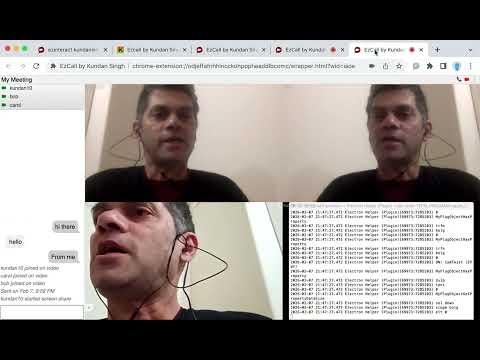
Please watch the video demonstration, and read our research paper for more information including motivation, software architecture and implementation details.
| Video Demonstration | Research paper |
|---|---|
 |
 |
We present the software architecture and implementation of our web-based multiparty video conference application. It does not use a media server. For call signaling, it either piggybacks on existing push notifications via a lightweight notification server, or utilizes email messages to further remove that server dependency. For conference control and data storage, it creates a peer-to-peer network of the clients participating in the call. Our prototype client web app can be installed as a browser extension, or a progressive web app on desktop and mobile. It uses WebRTC data channels and media streams for the control and media paths in implementing a full featured video conferencing with audio, video, text and screen sharing. The challenges faced and the techniques used in creating our lightweight or serverless system are useful to other low-end WebRTC applications that intend to save cost on server maintenance or paid subscriptions for multiparty video calls.
Please contact the software owner, or join the discussion group mentioned below, to get started with this project. There are many ways to use this software.
If you host this on your own website, then use your own Firebase cloud
messaging/service account, and update the SQLlite database contacts.db
with the encrypted config, vapidkey and privatekey for the namespace
you plan to use, and set that as default. Please see index.php for
details on the database schema.
Make sure that index.php is available at /contacts and the main
web app of webapp-dist is available at /ezcall on your website
domain. Ensure that your database file, contacts.db, is not accessible
from the web.
If you want to use our hosted webapp, please get in touch with the owner, to get access password, and signin auth-token. If you would like to create your own namespace on our hosted webcapp, and manage your own users' signups, please get in touch with the owner.
If you want to use the client in browser extension, enable developer mode in
your Chrome browser, and drag-drop the chrome-extension.zip file on the
extensions page to install. Once you have the auth token, use that to login,
or use the app in serverless or email mode that does not require login.
If you want to use the web app or installed app (progressive web app), just
visit the main webapp, from Chrome browser on Windows, Mac, or Android.
The core software is released under dual license: AGPL (GNU Affero General Public License) as well as Alternative commercial license. In summary, if you keep this software to yourself, or make your whole product or service open-source, then AGPL is fine; if you want to sell your own software with pieces of this project inside, even if you are offering software-as-a-service or a cloud hosted product, you'll likely need to buy the alternative commercial license.
If you are interested in sponsoring this project, or hiring (contract work) for integration with your system, please reach out to the owner by email, mentioned below. You can also join the project support and discussion group for all our projects.
Software owner is Kundan Singh (theintencity@gmail.com). All pieces of this software including source code, documentation, and binaries are copyright protected as © 2026, Kundan Singh <theintencity@gmail.com>.
Any contributions to this software such as in the form of pull request or suggested changes that gets merged or included is this software, automatically get the copyright and ownership transferred to the original software owner mentioned above, and turn into the dual license term mentioned here, to be compatible with the original software license. This clause allows the software owner to continue to provide the open source offering at the dual license terms, and benefits everyone.