Tokenomics
A healthy token economy is essential in incentivizing behavior that helps support the TEA ecosystem. To this end, we've designed three main types of tokens to help the TEA Project achieve its goals:
- A utility token, TEA.
- NFTs with mining privileges, CML and state maintainer seat licenses.
- Bonding curve tokens for both CML and TApp entities.
Our first token, TEA, is a utility token that will have a 100 million token pre-allocation in the genesis block. TEA is also given as a reward to miners for running public services (e.g. remote attestation) on the TEA network. Note that there's no inflation: the 100 million TEA tokens is a hard cap with mining rewards generated through a taxation process on state maintainer nodes.
TEA has a variety of uses on the platform:
- TEA pays for gas when performing any transaction on the network.
- TEA is paid by consumers when using a TApp.
- For miners, TEA can be part of the reward for hosting TApps on the network.
- TEA can be used to purchase tokens issued on a bonding curve representing different entities in the TEA ecosystem (explained below).
The 100 million tokens minted at genesis will be allocated with different vesting schedules (18 months for the investment rounds, 22 months for the community and team). The allocation is as follows:

Note that any tokens not distributed for the Series A / B / IDO rounds will be moved to a mining rewards funds.
To run a node on the TEA platform, miners must associate a special NFT with their machine that acts as a mining license. There are two kinds of mining NFTs on the TEA Project platform:
- A CML (Camellia) NFT that allows a miner to host TApps on the platform.
- A state maintainer seat license that allows a user to run a state machine node.
Let's take a look at each of these in turn.
A CML is an NFT with a life cycle determined randomly via algorithm. CML, also known as Camellia, has some unique properties and uses on the TEA Project platform.
- A TEA mining node can only be activated by associating a CML NFT with it.
- Each CML has a lifespan associated with it (approximately 2 years). Its lifespan and other attributes such as productivity have variations that are generated algorithmically. And although each CML has a lifespan, they can remain frozen past its defrost date for an indefinite amount of time.
- Each mining machine's characteristics (e.g. its RAM and whether it has a graphics card) will be recorded within the CML NFT.
- Investors can buy shares in a mining nodes to earn a percentage of that node's mining rewards. This is done through a CML token which will be described below.
- Miners buy new Camellia seeds through open bidding. The DAO issues new CML NFTs in accordance to how much demand for hosting there is in the TEA ecosystem.
- CML mining nodes earn TEA whenever an end-user accesses their node to host a TApp. A portion of the end-user's payment goes to the TApp owner, and the other part goes to the CML node for providing hosting to run the TApp.
- CML nodes can also earn remote attestation rewards in TEA as compensation for performing this public service. These rewards are paid out by the state maintainer nodes directly from their collection pool. If during any period there's not enough from these Harberger Taxes to pay the remote attestation rewards, then a reserve fund will be tapped. The reserve fund is part of the treasury and will eventually go away after the ecosystem has had enough time to mature.
A state maintainer seat license allows a node operator to function as a state machine node. Because of the importance of the state machine, the TEA Project team and select invitees will only be allowed to run state machine nodes for approximately the first 2 years after mainnet launches. The supply of these seat licenses will be determined by a DAO vote and they have a complex token economy described as follows:
- TApps will pay state maintainer nodes as part of using the state machine. This is known as the Memory Tax.
- The Memory Tax is the sole source of income for state maintainer nodes and is shared among all node operators. This, along with state machine transaction fees paid by the TApps and the state subscription fee paid by some CML nodes, goes into a collective "wallet" for all state maintainer nodes referred to as the collection pool.
- Every state maintainer will pay a state maintainer tax known as a Harberger Tax. The TEA Project has elected to adopt a Harberger Tax given that state maintainer licenses are a public good.
- The Harberger Tax paid by each state maintainer is a set percentage (voted on by the DAO) of the seat's self-valuated price (currently 7%). Each seat owner can set their own price for what they think their state maintainer license is worth. Anyone in the community can purchase any of these seats by bidding 1T higher than the self-valuation price.
- Harberger Taxes go into a distribution pool which is sent to TEA token holders every hour based on their assets in our layer-2.
The Harberger Tax paid by the state maintainers goes into a distribution pool that can be thought of as a treasury that is topped up and then emptied every hour. This tax revenue is distributed to three pools in sequence as follows:
1. A node subsidy pool. Especially during the early stages ofter mainnet launch, TEA miners will be renting nodes from AWS Nitro with a probable lack of early end-user activity on the TEA network. To help subsidize miners to provide their hosting machines, this pool will provide each miner a node subsidy that aims for 80% of their hardware cost. This amount is not algorithmically set and will be a flat payment based on a DAO vote.
Note that this pool is primarily funded by the mining subsidy rewards pre-allocation. The amount from the Harberger Tax is an extra amount and can always be changed according to DAO voting. 2. A new user subsidy pool. As new users will not have TEA on their layer-2 wallets, this subsidy will allow them to earn some TEA very much like a faucet so they can on-board into the TEA ecosystem. 3. The final pool shares all remaning Harberger Taxes in the distribution pool to all currently running nodes based on how much they contributed during the last period (currently measured on a daily basis). This pool rewards the node hardware that's been utilized by end-users the most.
The TEA Project uses bonding curves throughout its tokeonomics design namely for the following types of token entities:
- TApp tokens
- CML hosting node tokens
Before further explaining each type of token, let's look at some traits of bonding curves.
The project's bonding curve provides on-chain liquidity to enter and exit positions, providing security for investors. In the bonding curve below, the price increases as more tokens are bought. Investors buy at the red line and sell at the blue line where there will always be liquidity at each level along the bonding curve.

When using TEA to purchase bonding curve tokens, it's most advantageous to be among the early investors. Early adopters are rewarded for their investment as their token price increases when more people buy the entity's token on its bonding curve. And conversely as people sell into the bonding curve, the sold tokens are destroyed (decreasing the supply) while releasing the TEA locked in the bonding curve back to the investor.
Entities can elect to be one of three different types for profit sharing purposes:
- Private: The owner owns 100% of all revenue with no token generated for their entity. In the case of CML tokens they don't need to pay a deposit.
- Tokenized: this is the standard entity setup where a theta % that goes directly to the entity owner for every consume action and tokens are issued so that others can invest.
- Non-profit: all revenue goes to the DAO via the TApp Store accrued balance. There's no bonding curve or investment since there's no revenue to share.
Each TApp has an associated token issued on a bonding curve. A developer looking to launch a dApp on the TEA network could hold a bonding curve sale to generate early liquidity. Investors could use their TEA tokens to buy the TApp tokens of projects they believe will be more valuable in the future.
When a consumer pays TEA to use a TApp, this is known as a consume action where the following chain reaction occurs:
- A percentage of the payment known as theta is channeled directly to the TApp developers. This is used by the developers to fund development (i.e. pay salaries) as well as pay for the cost of running the TApp (paying CML host miners and purchasing state memory tokens).
- The rest of the payment is used to buy the TApp's tokens on its bonding curve.
- The new TApp tokens generated by this transaction are distributed proportionally to the existing TApp token holders.
The gains from consume action are therefore shared by the app developers, the hosting miners, and the investors.
Each Camellia has a bonding curve token associated with it that investors can purchase. The purchasers of any CML's token will have a claim on a percentage of what that mining machine earns as mining revenue. This allows non-technical users (or uses who don't have the space or bandwidth to run a mining machine) to earn TEA revenue by participating in mining without having to setup and administer a mining machine.
The timing of when these bonding curve tokens are purchased matters when it comes time to distribute the mining revenue. The earlier the purchase time, the cheaper the price of the bonding curve tokens. And the earlier the purchase time, the more chances the token holder will have to earn dividend payouts according to the amount of tokens they hold. Dividends are paid out in the camellia's bonding curve token. Because it's a bonding curve, token holders can cash out to TEA at any time at the price determined by the bonding curve.
We can begin to put together all of this somewhat complex tokenomics in an illustrative graphic that helps clarify how the tokenomics incentivizes ecosystem participation.
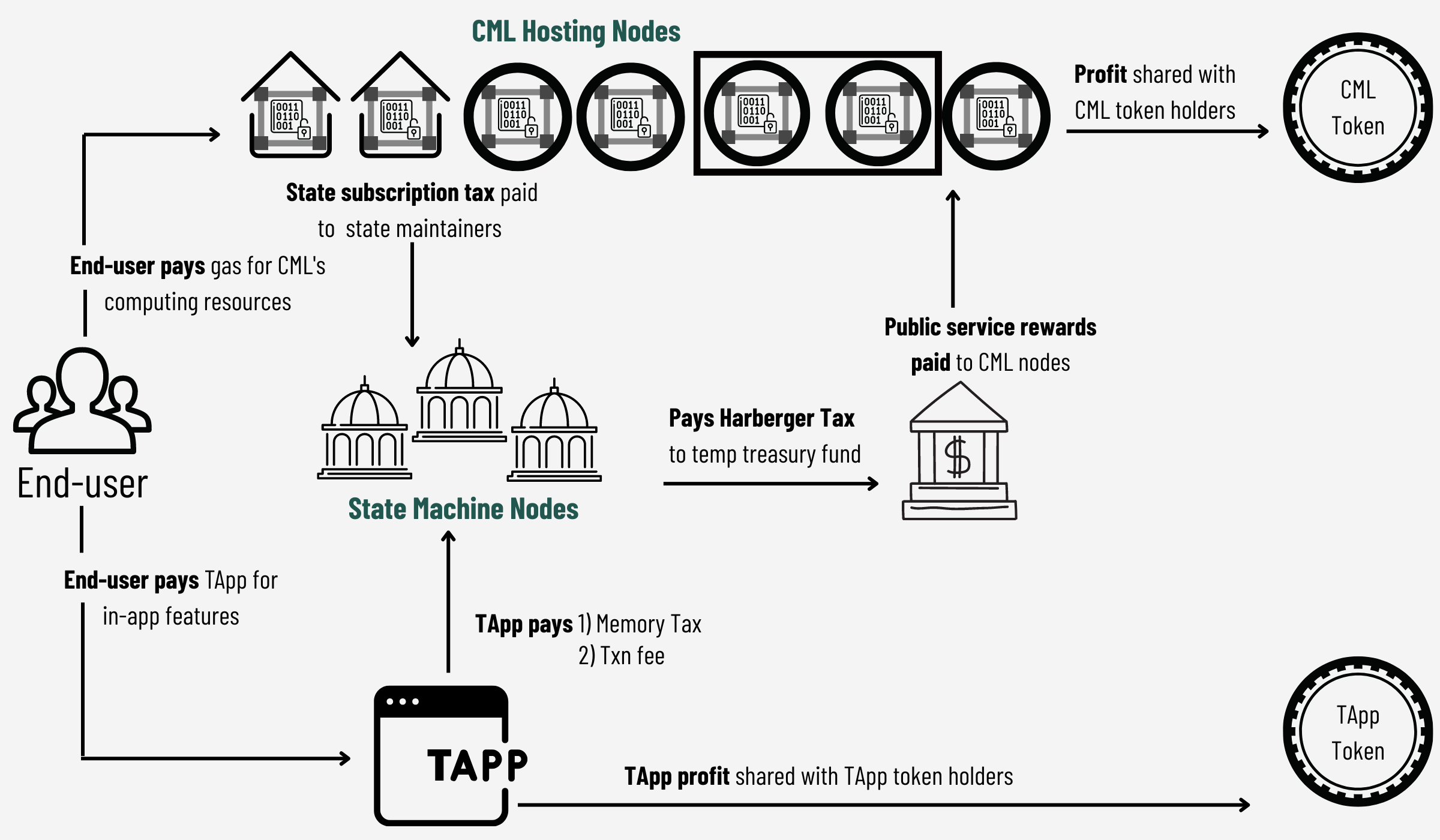
Looking at the graphic above, we can start with two fundamental concepts as illustrated on both sides of the graphic.
- On the left side, the end-user starts everything off by paying to use a TApp. Part of their payment goes to the miners who host the TApp for them, and the other part goes to the TApp for providing the app itself. This makes them the fundamental driver of the TEA ecosystem's tokenomics which makes perfect sense: demand and consumer uptake is what drives revenue.
- On the right side, the CML and TApp tokens are where CML node and TApp profits ultimately end up respectively. All those complicated concepts about bonding curves above essentially means that these token holders benefit when there's activity for the entity they're holding the token of.
If we focus in the horizontal middle of the graphic:
- The CML hosting nodes has a couple endogenous expenses: the CML needed to host on the network as well as a state subscription tax. This tax is optional and allows certain nodes to get state updates faster. Their biggest exogenous expense is the cost of paying for and running their hardware. As far as profits, they get the gas payment from the end-user's usage of their hosting infrastructure as well as public service rewards. These rewards are for providing utility that benefits the entire ecosystem (like remote attestation) and is compensated from the state maintainer's Harberger Tax. There's also the miners subsidy rewards from the pre-allocation that are distributed to the miners. This technically comes from pool #1 mentioned above. We can only take into consideration endogenous factors when calculating profit for CML token holders: end-user payment + public service rewards + mining rewards subsidy - state subscription tax (optional) = CML token holders' profits. Note that we consider the CML purchase a sunk cost borne by the miner which isn't factored into the profit calculation.
- Going to the bottom of the graphic, the TApp takes payment from the end-user and has as its expenses a memory tax and a transaction fee. Both of these expenses are for TApps utilizing state memory resources which must be paid by the TApp. Therefore, profit for TApp token holders = end-user payment - memory tax - transaction fee.
- And finally in the middle of the page are the critical state machine nodes (aka state maintainers). Their source of revenue is the state subcription tax paid by some CML nodes + the memory tax and transaction fees paid by TApps. Their main expense is the Harberger Tax, which they control through their self-valuation. The Harberger tax is designed to setup an efficient pricing system for the public good of the state maintainer license by allowing its owners to value their seat in a way that keeps them profitable.