I present a very fast block rotation algorithm for general use
This algorithm came about as a result of work on my ForSort Sorting Algorithm.
Included is a copy of Scandum's library of rotation algorithms which can be found here. I highly recommend reading through Scandum's repository as he explains well why Block Swap algorithms are important, and he has many excellent visualisations of the various main stream algorithms out there. Most notably he links to a YouTube video that explains the story: Sean Parent's C++ Seasoning Talk
I am also providing a test harness utility that can be compiled like so:
cc -O3 -o rotate rotate.c
and then run via:
./rotate
This utility will run multiple iterations of rotations upon arrays of varying sizes across a selection of rotation algorithms.
Unlike Scandum's test utility, my utility does not focus on corner cases, but instead measures the average time taken to
rotate an array using the left size from: 1..(N-1) for an array of N items. This, IMO, provides a clearer indication of
the general performance of each algorithm.
By all means though, do use Scandum's bench test as well, to sample corner case performances. Scandum's bench utility is not included here, but can be found at his repository linked above.
Added on Nov 25th, the V2 Algorithm is an evolution on the V1 Algorithm below, and address the matter of requiring two different code-paths depending on if the two blocks were overlapping or not. The V2 Algorithm instead "rolls" overlapping values through the overlapping section. In a sense, the overlapping section between two blocks essentially becomes a circular buffer for items on their way to being deposited into their correct location. This also keeps CPU cache locality much more consistently than the V1 algorithm, and as a consequence it is observed to consistently run 5% faster than V1. Further, this improvement appears to carry well to all CPU architectures that I've tried it one, raising my confidence in stating that the Triple Shift V2 Algorithm is almost undoubtedly the fastest algorithm that can be used in any scenario.
Consider the following array with 2 blocks out of order. A has 5 items on the left, and B has 7 items on the right.
             A                     B
   ┌───┬───┬───┬───┬───╥───┬───┬───┬───┬───┬───┬───┐
   │ I │ J │ K │ L │ M ║ A │ B │ C │ D │ E │ F │ G │
   └───┴───┴───┴───┴───╨───┴───┴───┴───┴───┴───┴───┘
Triple Shift V2 uses the 2 item overlapping section to "roll" the values from B into place while directly placing items from A into place.
The main function that gets used here is the three_way_swap_block_positive() function that when given 3 blocks of
equal size, B1, B2, and B3, it will move B3 to B2, B2 to B1, and B1 to B3, effectively doing a left rotate by 1 across
all items in the 3 blocks. This can be achieved by doing 2 swap operations, being swap(b1, b2), followed by swap(b2, b3)
for all corresponding elements within the 3 blocks.
Since the A block is smaller than B here, we need to "roll" 5 elements from B through the overlapping section of 2 items into A. Every time we reach the end of the overlapping section, we just move the pointer back to the start of the overlapping section and continue.
The following diagrams will help demonstrate this more clearly.
First, let's break up our array into 3 blocks. A, just as before, O, being the 2 items that overlap, and B
being the remainder of the original B block, minus the overlap. B is also sized to 5 items, just like A is.
Our divided array now looks like so:
             A             O             B
   ┌───┬───┬───┬───┬───╥───┬───╥───┬───┬───┬───┬───┐
   │ I │ J │ K │ L │ M ║ A │ B ║ C │ D │ E │ F │ G │
   └───┴───┴───┴───┴───╨───┴───╨───┴───┴───┴───┴───┘
Now we'll be rotate the first elements from each of the 3 blocks left by 1. This is the same as swapping I and A, and then I with C.
Swapping I and A looks like so:
             A             O             B
   ┌───┬───┬───┬───┬───╥───┬───╥───┬───┬───┬───┬───┐
   │ A │ J │ K │ L │ M ║ I │ B ║ C │ D │ E │ F │ G │
   └───┴───┴───┴───┴───╨───┴───╨───┴───┴───┴───┴───┘
     ↑                   ↑
     └───────────────────┘
          Swap I and A
Followed by swapping I and C. The makes the array look like so:
             A             O       B
   ┌───┬───┬───┬───┬───╥───┬───╥───┬───┬───┬───┬───┐
   │ A │ J │ K │ L │ M ║ C │ B ║ I │ D │ E │ F │ G │
   └───┴───┴───┴───┴───╨───┴───╨───┴───┴───┴───┴───┘
                         ↑       ↑
                         └───────┘
                        Swap I and C
We repeat this for J, B, and D as well, which makes our array look like so:
             A             O       B
   ┌───┬───┬───┬───┬───╥───┬───╥───┬───┬───┬───┬───┐
   │ A │ B │ K │ L │ M ║ C │ D ║ I │ J │ E │ F │ G │
   └───┴───┴───┴───┴───╨───┴───╨───┴───┴───┴───┴───┘
Now, let's pause and observe that C and D are now in the O block, but we've hit the end of O. What we do here is
just reset the pointer to O back to the start again, and keep rolling the items through it.
This means we now swap K with C, and then K with E. This leaves us with the following array:
             A             O             B
   ┌───┬───┬───┬───┬───╥───┬───╥───┬───┬───┬───┬───┐
   │ A │ B │ C │ L │ M ║ K │ D ║ I │ J │ E │ F │ G │
   └───┴───┴───┴───┴───╨───┴───╨───┴───┴───┴───┴───┘
             ↑           ↑
             └───────────┘
             Swap K and C
Then swap K and E
             A             O             B
   ┌───┬───┬───┬───┬───╥───┬───╥───┬───┬───┬───┬───┐
   │ A │ B │ C │ L │ M ║ E │ D ║ I │ J │ K │ F │ G │
   └───┴───┴───┴───┴───╨───┴───╨───┴───┴───┴───┴───┘
                         ↑               ↑
                         └───────────────┘
                           Swap K and E
Now do L, D and F
             A             O             B
   ┌───┬───┬───┬───┬───╥───┬───╥───┬───┬───┬───┬───┐
   │ A │ B │ C │ D │ M ║ E │ F ║ I │ J │ K │ L │ G │
   └───┴───┴───┴───┴───╨───┴───╨───┴───┴───┴───┴───┘
Notice here how we've almost completed placing all of A, and all of the first portion of B into their correct locations.
Let's reset the O location again, and repeat once more with M, E and G
             A             O             B
   ┌───┬───┬───┬───┬───╥───┬───╥───┬───┬───┬───┬───┐
   │ A │ B │ C │ D │ E ║ G │ F ║ I │ J │ K │ L │ M │
   └───┴───┴───┴───┴───╨───┴───╨───┴───┴───┴───┴───┘
...and here we see that A through E are correctly placed, and I through M are correctly placed.
The A and B blocks are removed from further consideration, and we now focus on just the O block
We see that the O block is disordered, with G and F swapped around, because we had finished moving A and B
while only part way through the O block.
So, we set our new A to be the portion of O that had been rolled, and B to be the portion that we never got to.
This leaves the block that we pass to the next loop looking like so:
      A   B
    ┌───╥───┐
    │ G ║ F │
    └───╨───┘
Since both blocks are of even size, we just do a straight swap, as opposed to the rolling swap from above, and then
we're done!
      A   B
    ┌───╥───┐
    │ F ║ G │
    └───╨───┘
      ↑   ↑
      └───┘
   Swap F and G
...and that's it!
Because our O block gets used as a type of ring buffer to roll items through, this means that the O block has a very
strong CPU cache locality. Additionally, because we're stepping through A and B in a linear fashion, this allows the
CPU to employ any read-ahead/pre-load mechanisms very effectively, resulting in "streaming" the transfer of items from
one side to the other.
When we start off with one block MUCH smaller than the other, what happens there is we just keeping doing straight-up block swaps of the smaller block through the larger block until we reach the point where overlapping occurs, and then we can employ the algorithm described above to finish off the rotation of the two blocks.
This first visualisation shows the swapping in place of 2 blocks of roughly even size. Here we can clearly see the
O block getting used to "roll" the values that are streaming from one side to the other. It creates a distinctive
rippling pattern as ever larger values get rotated through the section on their way to being placed correctly. This,
to me, is a great visualisation of the algorithm walk-through that we just went through above.

The following GIF shows the V2 algorithm gradually swapping up displaced values from a very small block on the right. The initial values get swapped into place almost immediately, but that then leaves the part of the larger A block that needs to be rolled up repeatedly until it can be merged in. This visualisation shows that block "rolling" very well:

Finally we just have a visualiation of a typical sort of Rotate in place. In essense it's very similar to the first
visualisation above, just with a much larger O block:

The Triple-Shift-Rotation algorithm is, itself, a derivation of the Gries-Mills progressive rotation algorithm that many rotation algorithm variants are based upon, but Triple-Shift adds in the notion of 3-way swaps. A 3-way swap is, in fact, merely a left-rotate by 1 item across a set of 3 items. There are two modes of operation, depending on if the lists have any overlap, or not.
The first mode is the overlapping mode, where the smaller array, after rotating, partially overlaps a portion of the
second array. This occurs when the following is true: sizeof(A) < sizeof(B) < 2 * sizeof(A)
Note that A and B are interchangeable here depending upon which is the larger of the two sections, but for ease of explanation, we'll focus purely on the scenario where A is smaller than B.
Let's walk through an overlapping path:
Consider the following array with 2 blocks out of order. A has 5 items on the left, and B has 8 items on the right.
             A                       B
   ┌───┬───┬───┬───┬───╥───┬───┬───┬───┬───┬───┬───┬───┐
   │ I │ J │ K │ L │ M ║ A │ B │ C │ D │ E │ F │ G │ H │
   └───┴───┴───┴───┴───╨───┴───┴───┴───┴───┴───┴───┴───┘
First we caclulate the size of the overlap by subtracting the number of items in the smaller block, from the number of items in the larger block. 8 minus 5 is 3, and that is our overlapping amount.
For the overlapping path, the algorithm does a 3-way swap between the last 3 elements of A, the first 3 elements of B,
and the last 3 elements of B. It is essentially doing a left-rotation by 1 for each corresponding element. Just to
restate, the value of 3 here refers to the calculated amount of overlap mentioned in the prior paragraph.
A, B, and C move to where K, L, and M are. K, L, and M move to where F, G, and H are,
and finally F, G, and H are moved to where A, B, and C are.
Performing this operation gives us the following array:
             A                       B
   ┌───┬───┬───┬───┬───╥───┬───┬───┬───┬───┬───┬───┬───┐
   │ I │ J │ A │ B │ C ║ F │ G │ H │ D │ E │ K │ L │ M │
   └───┴───┴───┴───┴───╨───┴───┴───┴───┴───┴───┴───┴───┘
Now the 2nd part of the overlap path operation occurs, swapping the previously unmoved part of A, with its corresponding location in B. This is a basic swap operation, but still takes place within the same loop sequence as the 3-way above
The items I and J, are swapped with D and E.
Performing this operation gives us the following array:
             A                       B
   ┌───┬───┬───┬───┬───╥───┬───┬───┬───┬───┬───┬───┬───┐
   │ D │ E │ A │ B │ C ║ F │ G │ H │ I │ J │ K │ L │ M │
   └───┴───┴───┴───┴───╨───┴───┴───┴───┴───┴───┴───┴───┘
As we can see, the above sequence now leaves us with the B block having all of its items positioned correctly. The
original A block contains an A sized portion from what was at the start the B block, but switched about. B is
now removed from further consideration, and the algorithm loops, focusing on just the remaining A block, which now
looks like this, with the new A and B block tags assigned.
        A         B
    ┌───┬───╥───┬───┬───┐
    │ D │ E ║ A │ B │ C │
    └───┴───╨───┴───┴───┘
We can see that the next loop would follow the overlapping path again, with an overlap size of 1.
The next step with the 3-way swap as described above would leave us with an array like so:
        A         B
    ┌───┬───╥───┬───┬───┐
    │ D │ A ║ C │ B │ E │
    └───┴───╨───┴───┴───┘
Followed by swapping the D with the B to give the following array:
        A         B
    ┌───┬───╥───┬───┬───┐
    │ B │ A ║ C │ D │ E │
    └───┴───╨───┴───┴───┘
We can see, that just like before, B is now fully positioned, leaving just A to be rotated.
      A   B
    ┌───╥───┐
    │ B ║ A │
    └───╨───┘
The next step is trivial and left as an exercise for the reader to look at the code and verify how it completes.
Now, let's walk through a remainder path. This is where B is greater than 2 * A.
Let's consider the following array. A is 3 items long, and B is 8 items long
         A                     B
   ┌───┬───┬───╥───┬───┬───┬───┬───┬───┬───┬───┐
   │ I │ J │ K ║ A │ B │ C │ D │ E │ F │ G │ H │
   └───┴───┴───╨───┴───┴───┴───┴───┴───┴───┴───┘
The Remainder path is significantly simpler than the above Overlap path, and it consists of just a single 3-way swap.
The algorithm ensures that an A sized portion of the total set is in place at both ends of the array with just a single swap call. Note that a single swap call can move multiple elements in sequence/
F, G, and H, move to where A, B, and C are. A, B, and C move to where I, J, and K are. I, J, and K move to where F, G, and H are.
This results in the following array:
         A                     B
   ┌───┬───┬───╥───┬───┬───┬───┬───┬───┬───┬───┐
   │ A │ B │ C ║ F │ G │ H │ D │ E │ I │ J │ K │
   └───┴───┴───╨───┴───┴───┴───┴───┴───┴───┴───┘
As we can see, all of A, and the last part of B are now correctly positioned. These elements are removed from consideration, and the next loop is presnted with an array that looks like the following:
          A         B
    ┌───┬───┬───╥───┬───┐
    │ F │ G │ H ║ D │ E │
    └───┴───┴───╨───┴───┘
We can see that the next loop would process what remains as an Overlapping path where A is the larger block. This proceeds
much like as described above, except all the directions are reversed.
This visualisation shows the algorithm rotating 2 blocks where A (the Left Block) is exactly 2 x B (the Right Block).
ie. sizeof(A) == (2 * sizeof(B))
In a single loop operation the algorithm is able to re-organise the sections into their correct locations. In practise
this occurs as a natural outcome of the No-Overlap code-path when A == 2 * B

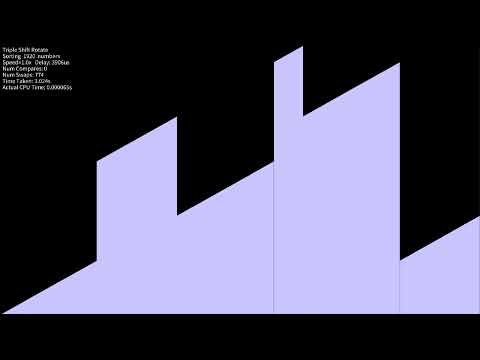
This visualisation shows the algorithm rotating 2 blocks where A (the Left Block) is overlapping with B (the Right Block).
This occurs when sizeof(B) < sizeof(A) < (2 * sizeof(B)
The algorithm cannot place both ends of the array into the correct location in one loop operation, so instead it places B
in the correct location, and a sizeof(A) - sizeof(B) portion of A into the correct location immediately after the end of
B, all within the same loop operation.
This means that per loop, the algorithm is collapsing the operational space by the size of the larger of the two blocks. The next loop is then left to process a B-sized portion that is still swapped around.
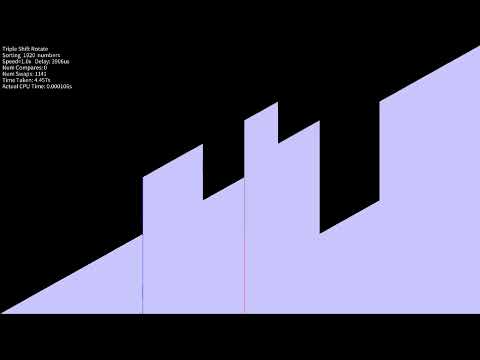
This visualisation shows the algorithm rotating 2 blocks where A (the Left Block) is NOT overlapping with B (the Right Block).
This occurs when sizeof(A) >= (2 * sizeof(B)
The algorithm this time is able to collapse the operational space from both ends of the main array, by placing all of B, and a B-sized portion of A into their correct positions with a single loop operation. This results in rapidly collapsing the size of the operational space with each loop.
Below are the results for all of the algorithms included. Item size used is 32-bit integers,
The tests were performed on an AMD 9800X3D CPU, running Fedora 43, with 96GB of DDR5 memory at 6000MHz
gcc version 15.2.1 was the C compiler, and the test utility was compiled with: cc -O3 -o rotate rotate.c
Triple Shift Rotate is seen to hold a strong and clear lead over all other rotation algorithms that do not allocate an auxiliary buffer space, and it even manages to outperform even those for small set sizes, and closes the gap on them for very large set sizes.
With the smallest array sizes it is a touch slower than the best, which is Drill Rotation. From about 18 items and up
it starts to pull a clear lead over the rest of the algorithms.
In my own testing I also observed that in the ranges from around 2000-8000 items the algorithm hits something of a rough patch where it will perform a little worse than usual, and this can be seen in the 5000 item result listed below.
It does still post the best, or close to the best, of all other non-auxiliary completion times while in the "rough" range though. I suspect that this is an CPU architecture specific anomaly from crossing a cache boundary somewhere on the 9800X3D which is exacerbated by the algorithm's three-way swapping. Once past this "rough" range however it returns to holding a significant lead.
=======================================================
         NAME                 ITEMS     TIME/ROTATE (s)
=======================================================
Juggling Rotation                10             5.023ns
Gries-Mills Rotation             10             6.461ns
Piston Rotation                  10             5.547ns
Grail Rotation                   10             6.007ns
Old Forsort Rotation             10             5.348ns *
Helix Rotation                   10             4.486ns
Drill Rotation                   10             4.345ns
Triple-Reverse Rotate            10             7.166ns
ContRev Rotation                 10             5.022ns
Trinity Rotation                 10             4.791ns
Triple Shift Rotate              10             5.084ns **
Aux Rotation (N/2 Aux)           10             6.881ns
Bridge Rotate (N/3 Aux)          10             7.452ns

=======================================================
         NAME                 ITEMS     TIME/ROTATE (s)
=======================================================
Juggling Rotation                50            17.573ns
Gries-Mills Rotation             50            16.610ns
Piston Rotation                  50            14.318ns
Grail Rotation                   50            14.462ns
Old Forsort Rotation             50            14.181ns *
Helix Rotation                   50            16.539ns
Drill Rotation                   50            16.196ns
Triple-Reverse Rotate            50             9.494ns
ContRev Rotation                 50            11.659ns
Trinity Rotation                 50             8.766ns
Triple Shift Rotate              50             6.793ns **
Aux Rotation (N/2 Aux)           50             8.527ns
Bridge Rotate (N/3 Aux)          50             8.427ns

=======================================================
         NAME                 ITEMS     TIME/ROTATE (s)
=======================================================
Juggling Rotation               100            31.202ns
Gries-Mills Rotation            100            22.535ns
Piston Rotation                 100            19.453ns
Grail Rotation                  100            20.833ns
Old Forsort Rotation            100            19.055ns *
Helix Rotation                  100            24.140ns
Drill Rotation                  100            23.934ns
Triple-Reverse Rotate           100            11.694ns
ContRev Rotation                100            15.234ns
Trinity Rotation                100            12.824ns
Triple Shift Rotate             100             9.177ns **
Aux Rotation (N/2 Aux)          100            13.676ns
Bridge Rotate (N/3 Aux)         100            11.857ns

=======================================================
         NAME                 ITEMS     TIME/ROTATE (s)
=======================================================
Juggling Rotation               500           163.998ns
Gries-Mills Rotation            500            66.037ns
Piston Rotation                 500            56.985ns
Grail Rotation                  500            62.583ns
Old Forsort Rotation            500            51.677ns *
Helix Rotation                  500            67.274ns
Drill Rotation                  500            63.436ns
Triple-Reverse Rotate           500            46.994ns
ContRev Rotation                500            35.708ns
Trinity Rotation                500            34.125ns
Triple Shift Rotate             500            27.760ns **
Aux Rotation (N/2 Aux)          500            22.452ns
Bridge Rotate (N/3 Aux)         500            21.437ns

=======================================================
         NAME                 ITEMS     TIME/ROTATE (s)
=======================================================
Juggling Rotation              1000           339.952ns
Gries-Mills Rotation           1000           128.337ns
Piston Rotation                1000           118.691ns
Grail Rotation                 1000           130.115ns
Old Forsort Rotation           1000           110.647ns *
Helix Rotation                 1000           122.555ns
Drill Rotation                 1000           115.409ns
Triple-Reverse Rotate          1000            86.461ns
ContRev Rotation               1000            79.050ns
Trinity Rotation               1000            74.528ns
Triple Shift Rotate            1000            62.657ns **
Aux Rotation (N/2 Aux)         1000            31.905ns
Bridge Rotate (N/3 Aux)        1000            33.901ns

=======================================================
         NAME                 ITEMS     TIME/ROTATE (s)
=======================================================
Juggling Rotation              5000          1578.675ns
Gries-Mills Rotation           5000           494.151ns
Piston Rotation                5000           477.446ns
Grail Rotation                 5000           484.842ns
Old Forsort Rotation           5000           458.682ns *
Helix Rotation                 5000           429.145ns
Drill Rotation                 5000           420.709ns
Triple-Reverse Rotate          5000           389.436ns
ContRev Rotation               5000           343.692ns
Trinity Rotation               5000           332.919ns
Triple Shift Rotate            5000           343.589ns **
Aux Rotation (N/2 Aux)         5000           107.252ns
Bridge Rotate (N/3 Aux)        5000           125.921ns

=======================================================
         NAME                 ITEMS     TIME/ROTATE (s)
=======================================================
Juggling Rotation             10000          3243.701ns
Gries-Mills Rotation          10000           899.104ns
Piston Rotation               10000           874.534ns
Grail Rotation                10000           878.997ns
Old Forsort Rotation          10000           837.042ns *
Helix Rotation                10000           789.884ns
Drill Rotation                10000           771.447ns
Triple-Reverse Rotate         10000           744.597ns
ContRev Rotation              10000           652.705ns
Trinity Rotation              10000           634.697ns
Triple Shift Rotate           10000           626.014ns **
Aux Rotation (N/2 Aux)        10000           237.388ns
Bridge Rotate (N/3 Aux)       10000           252.574ns

=======================================================
         NAME                 ITEMS     TIME/ROTATE (s)
=======================================================
Juggling Rotation             50000         18319.853ns
Gries-Mills Rotation          50000          3973.161ns
Piston Rotation               50000          3878.596ns
Grail Rotation                50000          3870.903ns
Old Forsort Rotation          50000          3748.275ns *
Helix Rotation                50000          3618.986ns
Drill Rotation                50000          3635.094ns
Triple-Reverse Rotate         50000          3660.954ns
ContRev Rotation              50000          3199.648ns
Trinity Rotation              50000          3178.132ns
Triple Shift Rotate           50000          2950.690ns **
Aux Rotation (N/2 Aux)        50000          2071.971ns
Bridge Rotate (N/3 Aux)       50000          1905.802ns

=======================================================
         NAME                 ITEMS     TIME/ROTATE (s)
=======================================================
Juggling Rotation            100000         37221.580ns
Gries-Mills Rotation         100000          7854.443ns
Piston Rotation              100000          7695.984ns
Grail Rotation               100000          7610.874ns
Old Forsort Rotation         100000          7390.227ns *
Helix Rotation               100000          7153.446ns
Drill Rotation               100000          7141.109ns
Triple-Reverse Rotate        100000          7382.198ns
ContRev Rotation             100000          6467.977ns
Trinity Rotation             100000          6426.485ns
Triple Shift Rotate          100000          5910.248ns **
Aux Rotation (N/2 Aux)       100000          3600.972ns
Bridge Rotate (N/3 Aux)      100000          3559.232ns

=======================================================
         NAME                 ITEMS     TIME/ROTATE (s)
=======================================================
Juggling Rotation            500000        203656.559ns
Gries-Mills Rotation         500000         40106.277ns
Piston Rotation              500000         40076.753ns
Grail Rotation               500000         39835.602ns
Old Forsort Rotation         500000         39621.104ns *
Helix Rotation               500000         37820.957ns
Drill Rotation               500000         37642.651ns
Triple-Reverse Rotate        500000         39881.265ns
ContRev Rotation             500000         33779.788ns
Trinity Rotation             500000         33824.463ns
Triple Shift Rotate          500000         32142.761ns **
Aux Rotation (N/2 Aux)       500000         32639.573ns
Bridge Rotate (N/3 Aux)      500000         28253.924ns

=======================================================
         NAME                 ITEMS     TIME/ROTATE (s)
=======================================================
Juggling Rotation           1000000        434340.810ns
Gries-Mills Rotation        1000000         78918.004ns
Piston Rotation             1000000         78353.930ns
Grail Rotation              1000000         78512.982ns
Old Forsort Rotation        1000000         77734.205ns *
Helix Rotation              1000000         75833.244ns
Drill Rotation              1000000         75174.838ns
Triple-Reverse Rotate       1000000         79787.879ns
ContRev Rotation            1000000         68071.345ns
Trinity Rotation            1000000         68369.475ns
Triple Shift Rotate         1000000         63237.759ns **
Aux Rotation (N/2 Aux)      1000000         65060.416ns
Bridge Rotate (N/3 Aux)     1000000         57945.938ns
I'd like to extend a particular thank you to Scandum for providing the inspiration and challenge of exploring Block Swap algorithms more deeply than I had. Without his excellent research and work, I would have almost undoubtedly not given my old Forsort Block Swap algorithm any deeper thought than I had.
      ┌───┬───┬───┬───┬───┐
      ˅   ˅   ˅   │   │   │