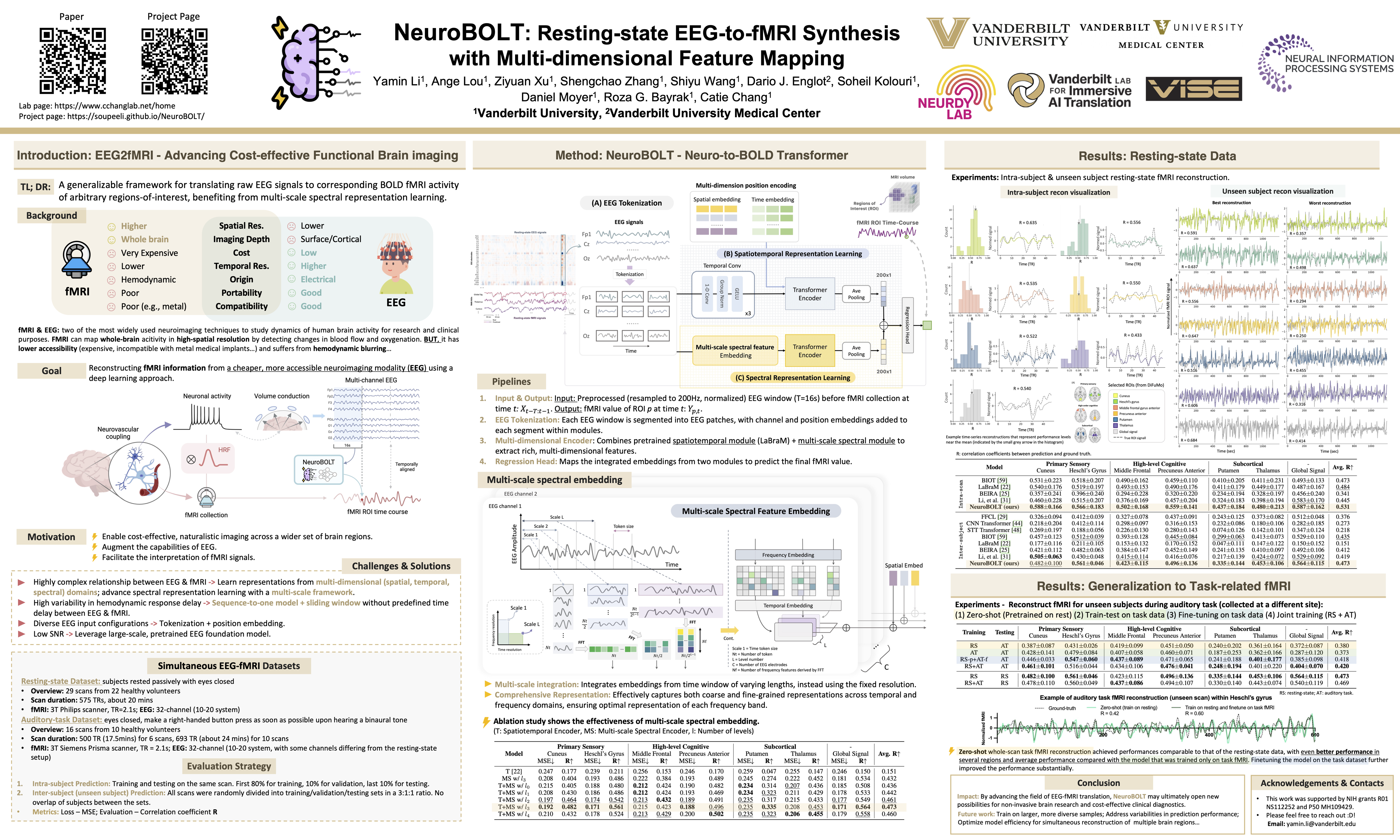
This repo contains the code of our NeurIPS 2024 paper: "NeuroBOLT: Resting-state EEG-to-fMRI Synthesis with Multi-dimensional Feature Mapping"
Yamin Li, Ange Lou, Ziyuan Xu, Shengchao Zhang, Shiyu Wang, Dario J. Englot, Soheil Kolouri, Daniel Moyer, Roza G. Bayrak, Catie Chang
Vanderbilt University
-📄 Paper - 🖼️ Project Page - 🪧Poster

Create environment and install required packages:
conda create -n neurobolt python=3.9
conda activate neurobolt
conda install pytorch==2.0.0 torchvision==0.15.0 torchaudio==2.0.0 pytorch-cuda=11.8 -c pytorch -c nvidia
conda install tensorboardX
pip install -r requirements.txtCheckpoints
- Please find checkpoints here on Huggingface 🤗.
- If you are training the model from scratch, please download the checkpoint of LaBraM
labram-base.pthfrom here, and place it undercheckpointsfolder.
Dataset
- Our dataset is publicly available here.
- Organize your dataset and pretrained weights as follows
NeuroBOLT/
├── checkpoints/          # Store model weights here
├── data/
│   ├── EEG/              # Store EEG dataset (EEGLAB format) files
│   ├── fMRI_difumo/      # Store fMRI ROI time series files
│   ├── fMRI/             # Store fMRI data (.nii file) if you are starting from 4d fMRI data
│   ├── motions/          # Store fMRI motion parameters or other confounds if you are starting from 4d fMRI data
The data folder can be stored in any location of your choice. If it's not placed within the code directory, simply update the dataset_root configuration in main.py to reflect the correct path.
You can try NeuroBOLT inference directly in your browser using Google Colab. This short tutorial walks you through the essential steps to run inference with our pretrained model:

-
EEG: The current scripts require preprocessed EEG data in EEGLAB
.setformat as input. If needed, you may write your own preprocessing code to prepare the data accordingly. Notably, if you want to train the model, the EEG.setfile should include event markers for synchronization with fMRI data collection. -
fMRI: Prepare your fMRI data using
making_difumo.py. This script convert fMRI.niifile into ROI time series using DiFuMo atlas. You can modify the script as needed to adapt it to your specific fMRI dataset. You can also use a different brain atlas by creating a custom script for ROI extraction, as long as the output format remains consistent.
Configure the model for your dataset:
- Update the default configurations in
main.pyunder # ---- Dataset specific info ---- to match your dataset, or specify them when running the command. - Define your dataset loader with the appropriate channel names in
def get_dataset(args)inmain.py. - If needed, you can create a new dataloader in
get_datasets.pyto properly handle your dataset format. - If you would like to do cross-subject training, use the example
scan_split_example.xlsxfile to define the train/val/test split of all scans. Ensure that if a subject has multiple scans, all scans from the same subject should belong to the same set.
Run main.py for training, e.g., to predict Thalamus fMRI activity:
- Intra-subject/scan prediction
python main.py --batch_size 16 --finetune ./checkpoints/labram-base.pth --labels_roi Thalamus --dataset VU --train_test_mode intrascan --dataname sub11-scan01
- Cross-subject prediction
python main.py --batch_size 64 --finetune ./checkpoints/labram-base.pth --labels_roi Thalamus --dataset VU --train_test_mode full_test --split_index_sheet ./scan_split_example.xlsx
- Release code.
- Release dataset.
- Upload inference demo
- Release pretrained checkpoints.
If you find our work helpful or use our dataset, please consider citing our paper. Thank you ✨✨✨!
@inproceedings{
li2024neurobolt,
title={Neuro{BOLT}: Resting-state {EEG}-to-f{MRI} Synthesis with Multi-dimensional Feature Mapping},
author={Yamin Li and Ange Lou and Ziyuan Xu and Shengchao Zhang and Shiyu Wang and Dario J. Englot and Soheil Kolouri and Daniel Moyer and Roza G Bayrak and Catie Chang},
booktitle={The Thirty-eighth Annual Conference on Neural Information Processing Systems},
year={2024},
url={https://openreview.net/forum?id=y6qhVtFG77}
}

and our earlier work:
@inproceedings{li2024leveraging,
  title={Leveraging sinusoidal representation networks to predict fMRI signals from EEG},
  author={Li, Yamin and Lou, Ange and Xu, Ziyuan and Wang, Shiyu and Chang, Catie},
  booktitle={Medical Imaging 2024: Image Processing},
  volume={12926},
  pages={795--800},
  year={2024},
  organization={SPIE}
}