


- Small, ~1k lines of code single header with no dependencies
- State machine parser, no allocations, no recursion
- High level API - fetch from JSON directly into C/C++ by jsonpath
- Low level SAX API
- Flexible JSON generation API - print to buffer, file, socket, etc
- JSON-RPC client/server, suitable for the Cloud Connector
-D MJSON_ENABLE_PRINT=0disable emitting functionality, default: enabled-D MJSON_IMPLEMENT_STRTOD=1use ownstrtod(), default: stdlib is used-D MJSON_MAX_DEPTH=30define max object depth, default: 20-D MJSON_ENABLE_BASE64=0disable base64 parsing/printing, default: enabled-D MJSON_ENABLE_RPC=0disable RPC functionality, default: enabled-D MJSON_RPC_IN_BUF_SIZE=4096sets JSON-RPC input buffer size, default: 256
enum mjson_tok mjson_find(const char *s, int len, const char *path,
                          const char **tokptr, int *toklen);
In a JSON string s, len, find an element by its JSONPATH path.
Save found element in tokptr, toklen.
If not found, return JSON_TOK_INVALID. If found, return one of:
MJSON_TOK_STRING, MJSON_TOK_NUMBER, MJSON_TOK_TRUE, MJSON_TOK_FALSE,
MJSON_TOK_NULL, MJSON_TOK_ARRAY, MJSON_TOK_OBJECT. Example:
// s, len is a JSON string: {"foo": { "bar": [ 1, 2, 3] }, "baz": true}
char *p;
int n;
assert(mjson_find(s, len, "$.foo.bar[1]", &p, &n) == MJSON_TOK_NUMBER);
assert(mjson_find(s, len, "$.baz", &p, &n) == MJSON_TOK_TRUE);
assert(mjson_find(s, len, "$", &p, &n) == MJSON_TOK_OBJECT);int mjson_get_number(const char *s, int len, const char *path, double *v);In a JSON string s, len, find a number value by its JSONPATH path and
store into v. Return 0 if the value was not found, non-0 if found and stored.
Example:
// s, len is a JSON string: {"foo": { "bar": [ 1, 2, 3] }, "baz": true}
double v = 0;
mjson_get_number(s, len, "$.foo.bar[1]", &v); // v now holds 2int mjson_get_bool(const char *s, int len, const char *path, int *v);In a JSON string s, len, store value of a boolean by its JSONPATH path
into a variable v. Return 0 if not found, non-0 otherwise. Example:
// s, len is a JSON string: {"foo": { "bar": [ 1, 2, 3] }, "baz": true}
bool v = mjson_get_bool(s, len, "$.baz", false); // Assigns to trueint mjson_get_string(const char *s, int len, const char *path, char *to, int sz);In a JSON string s, len, find a string by its JSONPATH path and unescape
it into a buffer to, sz with terminating \0.
If a string is not found, return -1.
If a string is found, return the length of unescaped string. Example:
// s, len is a JSON string [ "abc", "de\r\n" ]
char buf[100];
int n = mjson_get_string(s, len, "$[1]", buf, sizeof(buf)); // Assigns to 4int mjson_get_base64(const char *s, int len, const char *path, char *to, int sz);In a JSON string s, len, find a string by its JSONPATH path and
base64 decode it into a buffer to, sz with terminating \0.
If a string is not found, return 0.
If a string is found, return the length of decoded string. Example:
// s, len is a JSON string [ "MA==" ]
char buf[100];
int n = mjson_get_base64(s, len, "$[0]", buf, sizeof(buf)); // Assigns to 1int mjson(const char *s, int len, mjson_cb_t cb, void *cbdata);Parse JSON string s, len, calling callback cb for each token. This
is a low-level SAX API, intended for fancy stuff like pretty printing, etc.
The emitting API is flexible and can print to anything: fixed buffer, dynamic growing buffer, FILE *, network socket, etc etc. The printer function gets the pointer to the buffer to print, and a user-specified data:
typedef int (*mjson_print_fn_t)(const char *buf, int len, void *userdata);mjson library defines the following built-in printer functions:
struct mjson_fixedbuf {
  char *ptr;
  int size, len;
};
int mjson_print_fixed_buf(const char *ptr, int len, void *userdata);

int mjson_print_file(const char *ptr, int len, void *userdata);
int mjson_print_dynamic_buf(const char *ptr, int len, void *userdata);
If you want to print to something else, for example to a network socket,
define your own printing function. If you want to see usage examples
for the built-in printing functions, see unit_test.c file.
int mjson_vprintf(mjson_print_fn_t, void *, const char *fmt, va_list ap);
int mjson_printf(mjson_print_fn_t, void *, const char *fmt, ...);
Print using printf()-like format string. Supported specifiers are:
%Qprint quoted escaped string. Expect NUL-terminatedchar *%.*Qprint quoted escaped string. Expectint, char *%sprint string as is. Expect NUL-terminatedchar *%.*sprint string as is. Expectint, char *%gprint floating point number. Expectdouble%d/%uprint signed/unsigned integer. Expectint%ld/%luprint signed/unsigned long integer. Expectlong%Bprinttrueorfalse. Expectint%Vprint quoted base64-encoded string. Expectint, char *%Mprint using custom print function. Expectint (*)(mjson_print_fn_t, void *, va_list *)
The following example produces {"a":1, "b":[1234]} into the
dynamically-growing string s.
Note that the array is printed using a custom printer function:
static int m_printer(mjson_print_fn_t fn, void *fndata, va_list *ap) {
  int value = va_arg(*ap, int);
  return mjson_printf(fn, fndata, "[%d]", value);
}

...
char *s = NULL;
mjson_printf(&mjson_print_dynamic_buf, &s, "{%Q:%d, %Q:%M}", "a", 1, "b", m_printer, 1234);
/* At this point `s` contains: {"a":1, "b":[1234]}  */
free(s);For the example, see unit_test.c :: test_rpc() function.
void jsonrpc_init( int (*response_cb)(char *, int, void *),
                  void *privdata);
Initialize JSON-RPC context. The sender() function must be provided
by the caller, and it is responsible to send the prepared JSON-RPC
reply to the remote side - to the UART, or socket, or whatever.
The sender() function receives the full frame to send, and the privdata
poitner.
The response_cb() function could be left NULL. If it is non-NULL, it will
be called for all received responses generated by the jsonrpc_call().
The response_cb() function receives full response frame, and the privdata
pointer.
jsonrpc_process(const char *frame, int frame_len, jsonrpc_sender_t fn, void *fdata);Parse JSON-RPC frame contained in frame, and invoke a registered handler.
jsonrpc_call(jsonrpc_sender_t fn, void *fdata, const char *fmt, ...)Send JSON-RPC call frame. The format must create a valid frame.
If the id is specified in the frame, then it'll generate a response frame.
When a response frame gets received, a
#define jsonrpc_export(const char *name,
                       void (*handler)(struct jsonrpc_request *),
                       void *handler_data)
Export JSON-RPC function. A function gets called by jsonrpc_ctx_process(),
which parses an incoming frame and calls a registered handler.
A handler() receives struct jsonrpc_request *. It could use
jsonrpc_return_error() or jsonrpc_return_success() for returning the result.
struct jsonrpc_request {
  const char *params;     // Points to the "params" in the request frame
  int params_len;         // Length of the "params"
  const char *id;         // Points to the "id" in the request frame
  int id_len;             // Length of the "id"
  mjson_print_fn_t fn;    // Printer function
  void *fndata;           // Printer function data
  void *userdata;         // Callback's user data as specified at export time
};
This structure gets passed to the method callback.
void jsonrpc_return_success(struct jsonrpc_request *r, const char *result_fmt, ...);Return result from the method handler. NOTE: if the request frame ID is not specified, this function does nothing.
void jsonrpc_return_error(struct jsonrpc_request *r, int code, const char *message_fmt, ...);Return error from the method handler. NOTE: if the request frame ID is not specified, this function does nothing.
In the following example, we initialize JSON-RPC context, and call
a couple of JSON-RPC methods: a built-in rpc.list method which lists
all registered methods, and our own foo method.
The sender() implementation just prints the reply to the standard output,
but in real life it should send a reply to the real remote peer - UART, socket,
or whatever else.
#include "mjson.h"

// A custom RPC handler. Many handlers can be registered.
static void foo(struct jsonrpc_request *r) {
  double x = mjson_get_number(r->params, r->params_len, "$[1]", 0);
  jsonrpc_return_success(r, "{%Q:%g,%Q:%Q}", "x", x, "ud", r->userdata);
}

// Sender function receives a reply frame and must forward it to the peer.
static int sender(char *frame, int frame_len, void *privdata) {
  printf("%.*s\n", frame_len, frame); // Print the JSON-RPC reply to stdout
  return frame_len;
}

int main(void) {
  jsonrpc_init(NULL, NULL);

  // Call rpc.list
  char request1[] = "{\"id\": 1, \"method\": \"rpc.list\"}";
  jsonrpc_process(request1, strlen(request1), sender, NULL);

  // Call non-existent method
  char request2[] = "{\"id\": 1, \"method\": \"foo\"}";
  jsonrpc_process(request2, strlen(request2), sender, NULL);

  // Register our own function
  char request3[] = "{\"id\": 2, \"method\": \"foo\",\"params\":[0,1.23]}";
  jsonrpc_export("foo", foo, (void *) "hi");
  jsonrpc_process(request3, strlen(request3), sender, NULL);

  return 0;
}#include "mjson.h" // Sketch -> Add file -> add mjson.h
// Gets called by the RPC engine to send a reply frame
static int sender(const char *frame, int frame_len, void *privdata) {
return Serial.write(frame, frame_len);
}
// RPC handler for "Sum". Expect an array of two integers in "params"
static void sum(struct jsonrpc_request *r) {
int a = mjson_get_number(r->params, r->params_len, "$[0]", 0);
int b = mjson_get_number(r->params, r->params_len, "$[1]", 0);
jsonrpc_return_success(r, "%d", a + b);
}
void setup() {
jsonrpc_init(NULL, NULL); // Initialise the library
jsonrpc_export("Sum", sum, NULL); // Export "Sum" function
Serial.begin(115200); // Setup serial port
}
void loop() {
if (Serial.available() > 0) jsonrpc_process_byte(Serial.read(), sender, NULL);
}When this sketch is compiled and flashed on an Arduino
board, start Arduino Serial Monitor, type
{"id": 1, "method": "Sum", "params": [2,3]} and hit enter. You should
see an answer frame:

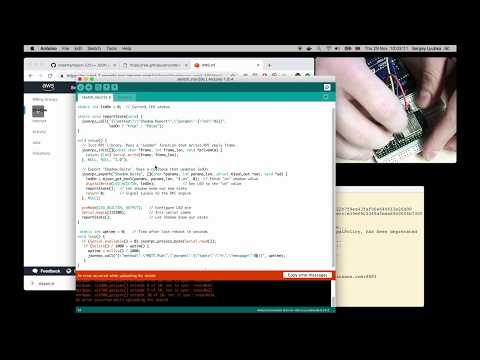
See https://mongoose-os.com/ccm/ for more information.
Questions? See https://mdash.net/home/company.html