A c++ program that takes input a .c or .cpp program file and writes the tokens present in it in a file. It also creates a symbol table for the program.
- Lexical Analysis is the process of converting a sequence of characters into a sequence of Lexical Tokens
- A program that performs lexical analysis is termed as Lexical Analyzer
C++ 11 or higher to compile the code Unix users can run the following command to install latest version of C++ compiler
sudo apt-get install g++-
cdto this project -
Compile with C++ 11
- Method 1: Run the following command in terminal
g++ -std=c++11 FSM.cpp -o FSM - Method 2: Run
makecommand if Makefile is supported in your system
- Method 1: Run the following command in terminal
-
Run the executable with input the input file as follows
./FSM < inputProgram
- Following two files will be generated:
pa_1.outThis file contains description of tokens in the following format<token> <token_id>symbol_table_1.outThis file contains identifiers and keywords in the following format<token> 1if token is an identifier<token> 0if token is a keyword The tokens are identified as defined indef.hfile
- The input file is read character by character and stored in buffer string.
- The string is preprocessed using
removeComments()routine to remove comments enclosed between/*and*/. - The
lexicalAnalysisis function then performs the tokenization. - We make use of
lexemeBeginandforwardPtrwhich keeps track of the index we have to start scannnig from and the end index of token we are currently considering respectively. - In each iteration, we find the maximum length token we can get that starts from index pointed by
lexemeBegin. We skip the iteration if the character pointed bylexemeBeginis a white space, which is checked usingisWhiteSpace()routine. - If a token is found, we write it in the required format in the
pa_1.outfile and update thesymbol_table_1.outif the token found is an identifer or keyword. - If no token is found, then we
exit(1)denoting a failure in analysing the code.
int isKeyword(const string&);
int isIdentifier(const string&);
int isIntegerConstant(const string&);
int isFloatingConstant(const string&);
int isArithmeticOperator(const string&);
int isAssignmentOperator(const string&);
int isRelationalOperator(const string&);
int isSpecialSymbol(const string&);
int matchToken(int, int); // returns token_id if token is found in the substring [L,R] else returns -1
bool isWhiteSpace(char);
void lexicalAnalysis();
void removeComments();
All the functions are self-explanatory.
-
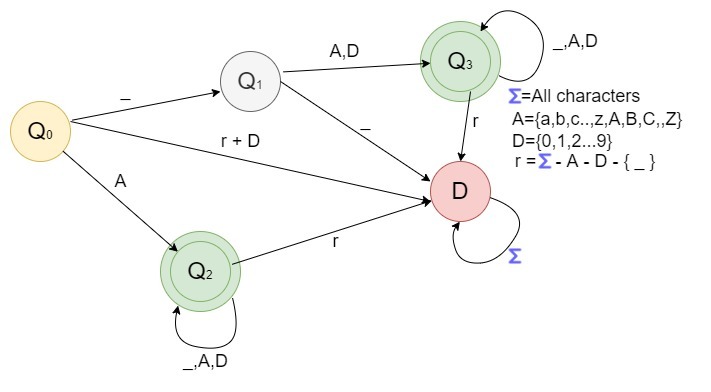
Identifier
-
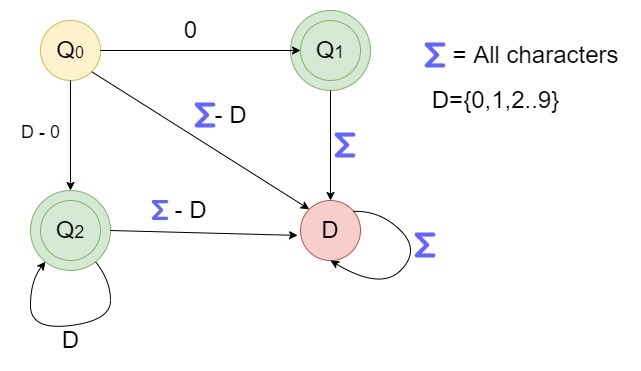
Integer Constant
-
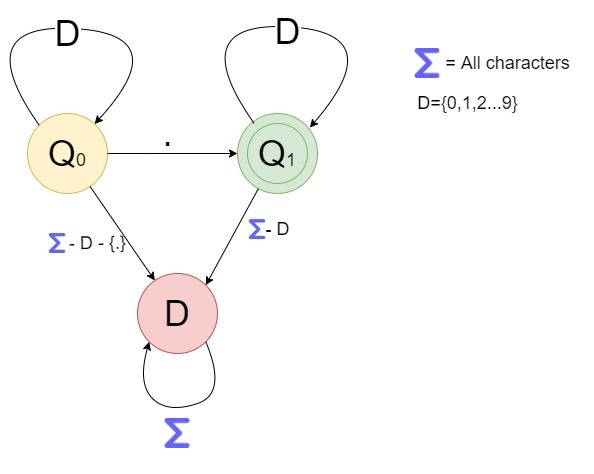
Floating Constant
For the given input.in file, the analyzer generates following two files
symbol_table_1.out
int 0
main 1
x 1
i 1
ans 1
for 0
return 0
n 1
pa_1.out
423 int
300 main
418 (
419 )
416 {
423 int
300 x
311 =
301 4
420 ,
300 i
311 =
301 0
420 ,
300 ans
311 =
301 0
421 ;
430 for
418 (
300 i
311 =
301 0
421 ;
300 i
307 <
300 x
421 ;
300 i
304 ++
419 )
300 ans
316 +=
301 4
421 ;
433 return
300 ans
421 ;
417 }
430 for
418 (
423 int
300 i
311 =
301 0
421 ;
300 i
307 <
300 n
421 ;
300 i
304 ++
419 )- Sumit Kumar Prajapati (B20CS074) - prajapati.3@iitj.ac.in
- Pratul Singh (B20CS095) - singh.142@iitj.ac.in