





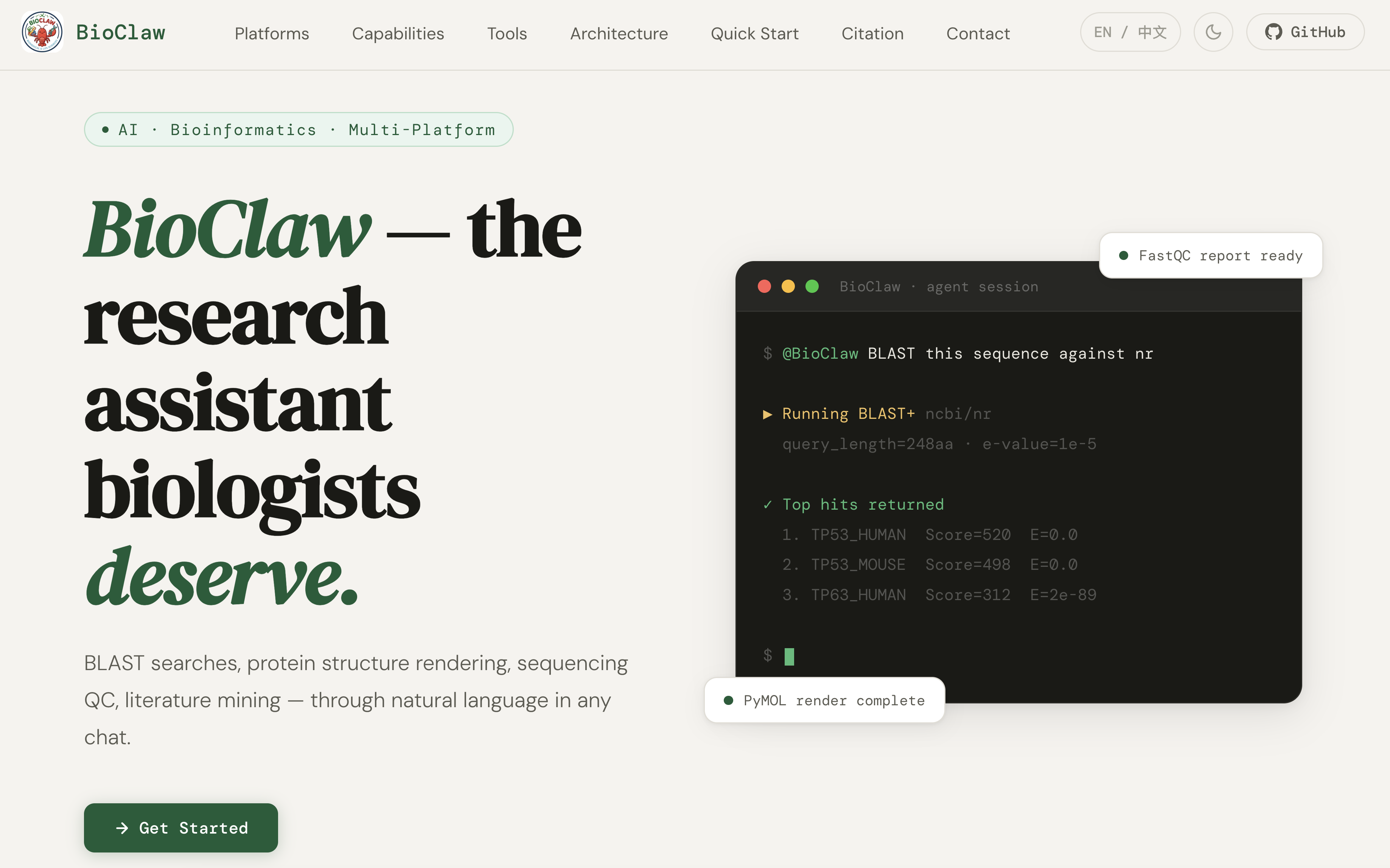



BioClaw brings the power of computational biology directly into WhatsApp group chats. Researchers can run BLAST searches, render protein structures, generate publication-quality plots, perform sequencing QC, and search the literature — all through natural language messages.
Built on the NanoClaw architecture with bioinformatics tools and skills from the STELLA project, powered by the Claude Agent SDK.
New BioClaw-compatible skills can be developed either directly in BioClaw or in Bioclaw_Skills_Hub, which can serve as a staging space for early iteration and testing before useful skills are promoted into the main BioClaw repository. Skills that prove practical and stable may later be integrated into BioClaw itself. To get newly promoted skills and other updates from BioClaw, pull the latest version of this repository with git pull.
- Overview
- What's New
- Quick Start
- Messaging channels
- Demo Examples
- System Architecture
- Skills & Skills Hub
- Included Tools
- Project Structure
- Citation
- License
The rapid growth of biomedical data, tools, and literature has created a fragmented research landscape that outpaces human expertise. Researchers frequently need to switch between command-line bioinformatics tools, visualization software, databases, and literature search engines — often across different machines and environments.
BioClaw addresses this by providing a conversational interface to a comprehensive bioinformatics toolkit. By messaging @Bioclaw in a WhatsApp group, researchers can:
- Sequence Analysis — Run BLAST searches against NCBI databases, align reads with BWA/minimap2, and call variants
- Quality Control — Generate FastQC reports on sequencing data with automated interpretation
- Structural Biology — Fetch and render 3D protein structures from PDB with PyMOL
- Data Visualization — Create volcano plots, heatmaps, and expression figures from CSV data
- Literature Search — Query PubMed for recent papers with structured summaries
- Image-based Wet-Lab Interpretation — Analyze gel/blot photos captured from camera or uploaded in chat (e.g., SDS-PAGE lane quality and target-band checks)
- Workspace Management — Triage files, recommend analysis steps, and manage shared group workspaces
Results — including images, plots, and structured reports — are delivered directly back to the chat.
Recent updates make BioClaw feel much closer to a real multi-chat research workspace:
- Multiple web chats, each with its own memory — the local web UI now lets you open separate threads like ChatGPT, so one chat can stay on literature search while another focuses on QC or plotting.
- A built-in control layer in chat — you can now manage the current thread directly in chat with commands like
/status,/doctor,/threads,/new,/use,/rename,/archive,/workspace,/provider, and/model. - Per-thread working directory —
/dirlets each thread remember its own default folder inside the workspace, so different chats can work in different subdirectories without stepping on each other. - Reusable shortcuts for recurring workflows —
/commandsand/aliaslet you save common prompts as short commands, so repeated lab routines do not need to be typed from scratch every time. - Skill visibility and preference control —
/skillsshows the installed BioClaw skill modules and lets you mark preferred ones for the current thread or agent. - Better local web management — the browser UI now has a thread list, rename/archive controls, and a lightweight management panel for status and diagnostics.
- Quick OpenRouter health check —
npm run check:openroutersends a tiny test request using your current.envso you can tell whether the key works before debugging the full app.
- macOS / Linux / Windows (Windows requires PowerShell 5.1+)
- Node.js 20+
- Docker Desktop
- Anthropic API key or OpenRouter API key
One-command setup (recommended for first-time users):
macOS / Linux
git clone https://github.com/Runchuan-BU/BioClaw.git
cd BioClaw
bash scripts/setup.sh
Windows (PowerShell)
git clone https://github.com/Runchuan-BU/BioClaw.git
cd BioClaw
powershell -ExecutionPolicy Bypass -File scripts\setup.ps1
The setup script will check prerequisites, install dependencies, build the Docker image, and walk you through API key configuration interactively.
Manual setup:
git clone https://github.com/Runchuan-BU/BioClaw.git
cd BioClaw
npm install
cp .env.example .env        # Edit with your API keys (see model section below)
docker build --no-cache -t bioclaw-agent:latest container/ # uncomment Dockerfile image source if you meet 100 errors.
npm startBioClaw now supports two provider paths:
- Anthropic — default, keeps the original Claude Agent SDK flow
- OpenRouter / OpenAI-compatible — optional path for OpenRouter and similar
/chat/completionsproviders
Create a .env file in the project root and choose one of the following setups.
Option A — Anthropic (default)
ANTHROPIC_API_KEY=your_anthropic_keyOption B — OpenRouter (Gemini, DeepSeek, Claude, GPT, and more)
MODEL_PROVIDER=openrouter
OPENROUTER_API_KEY=sk-or-v1-your-key
OPENROUTER_BASE_URL=https://openrouter.ai/api/v1
OPENROUTER_MODEL=deepseek/deepseek-chat-v3.1
Popular model IDs: deepseek/deepseek-chat-v3.1, google/gemini-2.5-flash, anthropic/claude-3.5-sonnet. Full list: openrouter.ai/models
Note: Use models that support tool calling (e.g. DeepSeek, Gemini, Claude). Session history is preserved within a container session; after idle timeout, a new container starts with a fresh context.
Generic OpenAI-compatible setup
MODEL_PROVIDER=openai-compatible
OPENAI_COMPATIBLE_API_KEY=your_api_key
OPENAI_COMPATIBLE_BASE_URL=https://your-provider.example/v1
OPENAI_COMPATIBLE_MODEL=your-model-name
After updating .env, restart BioClaw:
npm run devWhen a container starts, docker logs <container-name> will show which provider path is active.
In any connected chat, simply message:
@Bioclaw <your request>
Supported platforms include WhatsApp (default), Feishu (Lark), WeCom, Discord, Slack (Socket Mode), WeChat (fully supported), QQ and optional local web (browser) chat. Full setup steps, env vars, and disabling channels are in docs/CHANNELS.md (简体中文:docs/CHANNELS.zh-CN.md).
BioClaw supports WhatsApp group workflows for conversational task requests and in-chat delivery of analysis results.

BioClaw also supports Feishu/Lark conversations for interactive task requests and result delivery in chat.

BioClaw also supports WeCom conversations for team collaboration and in-chat analysis result delivery.

BioClaw supports Discord channel workflows. Screenshot example will be added in a future update.
BioClaw supports Slack (Socket Mode) workflows. Screenshot example will be added in a future update.
BioClaw supports one-click WeChat onboarding and in-chat file handoff workflows (send docs/images, then continue analysis in the same thread).

BioClaw also supports QQ-based conversations for task requests and chat-native result delivery.

The local web channel includes both chat and the built-in dashboard (Lab trace) for timeline observability.

Lab trace (SSE timeline, workspace tree) is built into the local web UI — no extra config needed. See docs/DASHBOARD.md.
Just send the message to OpenClaw:
install https://github.com/Runchuan-BU/BioClaw
See the ExampleTask document for 6 ready-to-use demo prompts with expected outputs.
Below are live demonstrations of BioClaw handling real bioinformatics tasks across mainstream channels (WhatsApp, QQ, WeCom, WeChat, Feishu/Lark, and local web UI).
Analyze files in a shared workspace and recommend the best next analysis steps.
Run FastQC on paired-end FASTQ files and deliver the QC report with key findings.

BLAST a protein sequence against the NCBI nr database and return structured top hits.

Create a differential expression volcano plot from a CSV file and interpret the results.

Fetch a PDB structure, render it in rainbow coloring with PyMOL, and send the image.

Search PubMed for recent high-impact papers and provide structured summaries.

Visualize hydrogen bonds between a ligand and protein in PDB 1M17.

Show residues within 5Å of ligand AQ4 in PDB 1M17.

Capture or upload a gel image in WhatsApp, then ask BioClaw to assess lane quality and whether major bands match expected targets.

BioClaw is built on the NanoClaw container-based agent architecture, extended with biomedical tools and domain knowledge from the STELLA framework.
WhatsApp ──► Node.js Orchestrator ──► SQLite (state) ──► Docker Container
                                                              │
                                                     Claude Agent SDK
                                                              │
                                                   ┌──────────┴──────────┐
                                                   │   Bioinformatics    │
                                                   │      Toolbox        │
                                                   ├─────────────────────┤
                                                   │ BLAST+  │ SAMtools  │
                                                   │ BWA     │ BEDTools  │
                                                   │ FastQC  │ PyMOL     │
                                                   │ minimap2│ seqtk     │
                                                   ├─────────────────────┤
                                                   │   Python Libraries  │
                                                   ├─────────────────────┤
                                                   │ BioPython │ pandas  │
                                                   │ RDKit     │ scanpy  │
                                                   │ PyDESeq2  │ pysam   │
                                                   │ matplotlib│ seaborn │
                                                   └─────────────────────┘
Key design principles (inherited from NanoClaw):
| Component | Description |
|---|---|
| Container Isolation | Each conversation group runs in its own Docker container with pre-installed bioinformatics tools |
| Filesystem IPC | Text and image results are communicated between the agent and orchestrator via the filesystem |
| Per-Group State | SQLite database tracks messages, sessions, and group-specific workspaces |
| Channel Agnostic | Channels self-register at startup; the orchestrator connects whichever ones have credentials |
Biomedical capabilities (attributed to STELLA):
The bioinformatics tool suite and domain-specific skills — including sequence analysis, structural biology, literature mining, and data visualization — draw from the tool ecosystem developed in the STELLA project, a self-evolving multi-agent framework for biomedical research.
BioClaw uses a two-tier skill system:
- Built-in skills — ~25 core skills bundled in the container image (BLAST search, differential expression, single-cell preprocessing, database queries, PubMed search, etc.). Always available, no setup needed.
- Skills Hub — A community-maintained repository with 70+ specialized skills across 10 domains (protein design, spatial transcriptomics, EHR analysis, multi-omics integration, etc.).
The agent automatically discovers Hub skills at runtime. When a user's task isn't covered by built-in skills, the agent fetches the relevant skill definition from the Hub via GitHub, caches it locally, and executes it — no manual installation required.
To contribute new skills, see the Skills Hub contributing guide. Skills that prove stable and widely useful may be promoted into BioClaw's built-in set.
| Tool | Purpose |
|---|---|
| BLAST+ | Sequence similarity search against NCBI databases |
| SAMtools | Manipulate alignments in SAM/BAM format |
| BEDTools | Genome arithmetic and interval manipulation |
| BWA | Burrows-Wheeler short read aligner |
| minimap2 | Long read and assembly alignment |
| FastQC | Sequencing quality control reports |
| fastp | FASTQ filtering and trimming (QC/preprocessing) |
| MultiQC | Aggregate QC reports into one summary |
| seqtk | FASTA/FASTQ file manipulation |
| seqkit | FASTA/FASTQ toolkit (extended) |
| BCFtools | Variant calling and VCF/BCF manipulation |
| tabix | Index/query compressed VCF/BED (bgzip/tabix) |
| pigz | Parallel gzip compression/decompression |
| SRA Toolkit | Download data from NCBI SRA (prefetch/fasterq-dump) |
| Salmon | RNA-seq transcript quantification |
| kallisto | RNA-seq transcript quantification |
| PyMOL | Molecular visualization and rendering |
| Library | Purpose |
|---|---|
| BioPython | Biological computation (sequences, PDB, BLAST parsing) |
| pandas / NumPy / SciPy | Data manipulation and scientific computing |
| matplotlib / seaborn | Publication-quality plotting |
| scikit-learn | Machine learning for biological data |
| RDKit | Cheminformatics and molecular descriptors |
| PyDESeq2 | Differential expression analysis |
| scanpy | Single-cell RNA-seq analysis |
| pysam | SAM/BAM file access from Python |
All utility scripts are in the scripts/ directory:
| Command | Script | Description |
|---|---|---|
bash scripts/setup.sh |
scripts/setup.sh |
One-command setup for macOS/Linux |
powershell scripts\setup.ps1 |
scripts/setup.ps1 |
One-command setup for Windows |
npm run web |
scripts/start-web.mjs |
Start BioClaw with local web UI (chat + lab trace) |
npm run open:web |
scripts/open-local-web.mjs |
Open the web UI in default browser |
npm run stop:web |
scripts/stop-bioclaw-web.mjs |
Stop the web server process |
npm run check:openrouter |
scripts/check-openrouter.mjs |
Send a minimal test request to OpenRouter using the current .env |
bash scripts/clear-local-web.sh |
scripts/clear-local-web.sh |
Clear all local-web chat history and trace events |
npx tsx scripts/test-cli.ts "prompt" |
scripts/test-cli.ts |
Run a single prompt through the container agent (CLI test) |
npx tsx scripts/manage-groups.ts list |
scripts/manage-groups.ts |
Manage WhatsApp group registrations (list / register / remove) |
python3 scripts/demo.py |
scripts/demo.py |
TP53 gene analysis demo (runs inside container) |
BioClaw/
├── src/                       # Node orchestrator
│   └── channels/              # WhatsApp, WeCom, Feishu, Discord, Slack, WeChat, local web
├── container/                 # Agent Dockerfile + skills
├── scripts/                   # Utility scripts (setup, web, testing)
├── groups/                    # Per-group workspace & CLAUDE.md
├── docs/
│   ├── CHANNELS.md            # Messaging platform setup (EN)
│   ├── CHANNELS.zh-CN.md      # Messaging platform setup (ZH)
│   ├── DASHBOARD.md           # Lab trace & observability
│   ├── SECURITY.md            # Trust model & container isolation
│   ├── SPEC.md                # Technical specification
│   ├── DEBUG_CHECKLIST.md     # Troubleshooting guide
│   └── images/                # Doc screenshots
├── ExampleTask/               # Demo prompts + screenshots
└── README.md
BioClaw builds upon the STELLA framework. If you use BioClaw in your research, please cite:
@article{jin2025stella,
  title={STELLA: Towards a Biomedical World Model with Self-Evolving Multimodal Agents},
  author={Jin, Ruofan and Xu, Mingyang and Meng, Fei and Wan, Guancheng and Cai, Qingran and Jiang, Yize and Han, Jin and Chen, Yuanyuan and Lu, Wanqing and Wang, Mengyang and Lan, Zhiqian and Jiang, Yuxuan and Liu, Junhong and Wang, Dongyao and Cong, Le and Zhang, Zaixi},
  journal={bioRxiv},
  year={2025},
  doi={10.1101/2025.07.01.662467}
}This project is licensed under the MIT License. See LICENSE for details.