




A high-performance a Polars plugin written in Rust with python bindings for fast and memory efficient reading of Avro files into DataFrames.
Jetliner is designed for data pipelines where Avro files live on S3 or local disk and need to land in Polars fast. It streams data block-by-block rather than loading entire files into memory, uses zero-copy techniques, and has (almost) complete support for the Avro spec.
- Avro Object Container Files — Reads self-contained
.avrofiles with embedded schemas. Does not support single-object encoding (schema registry) or bare Avro encoding - High-performance streaming — Supports block-by-block processing with minimal memory footprint, ideal for large files
- Query optimization — Projection pushdown (select columns) and predicate pushdown (filter rows) at the source via Polars LazyFrames
- S3 and local file support — Read Avro files from Amazon S3 or local disk with the same API
- All standard codecs — null, snappy, deflate, zstd, bzip2, and xz compression out of the box
- (Almost) complete avro schema support — reads almost any valid avro (see limitations)
- Flexible error handling — Optionally skip bad blocks for resilience to data corruption
- Ridiculously fast reads — Check the benchmarks!
This library was created to serve performance critical scenarios around processing large avro files from python. It's fast but limited to read use cases. If you also need to write avro files from Polars then you should check polars-avro.
Jetliner is built for speed. Benchmarks against other Python Avro readers show significant performance gains, especially on complex schemas and wide tables.
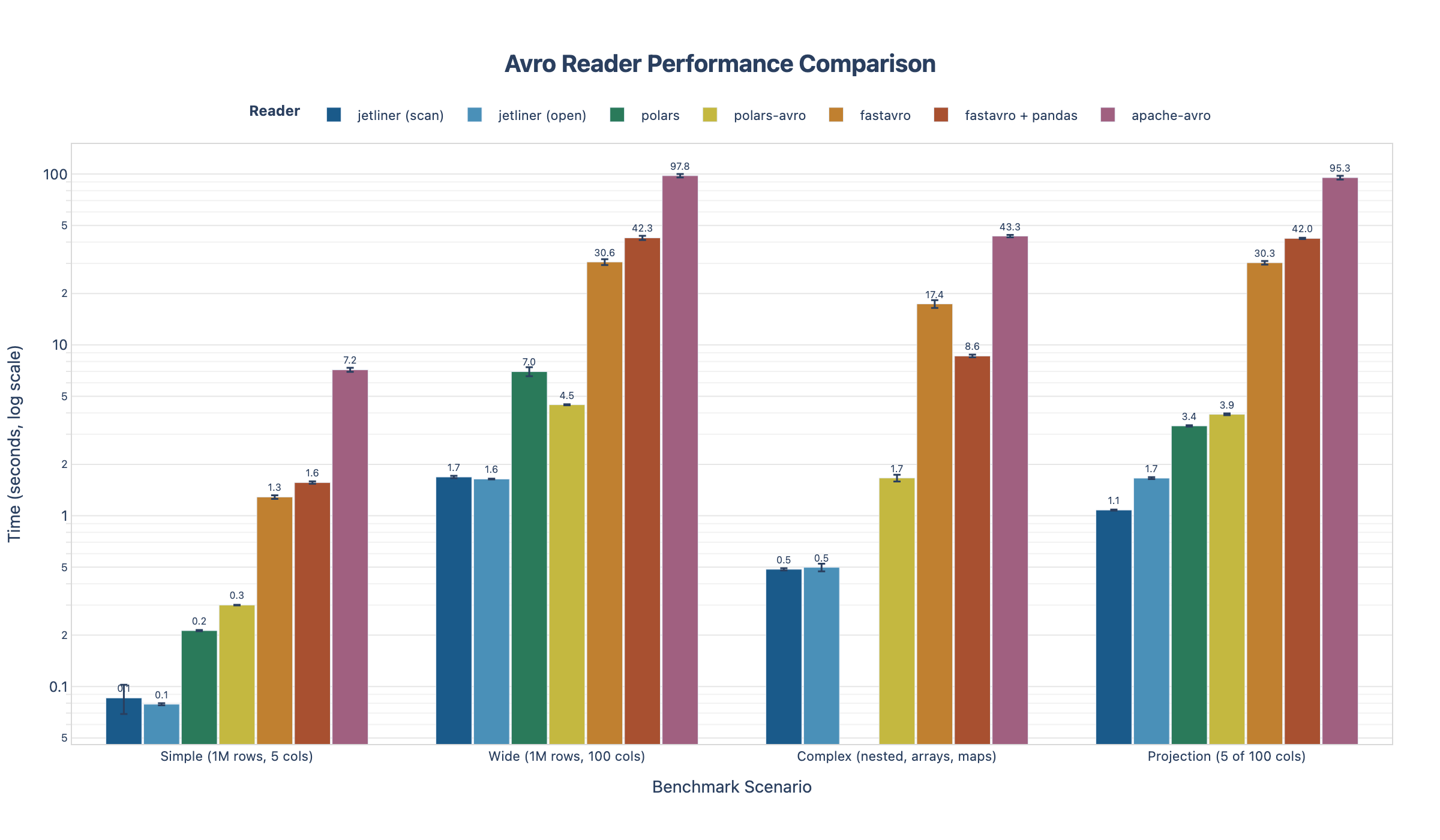
Yes, that's a log scale. The chart compares read times across four scenarios using 1M-row Avro files. Note that Polars' built-in Avro reader is missing from the "Complex" scenario entirely—it doesn't support maps. Jetliner handles complex nested schemas with arrays, maps, and nullable fields without breaking a sweat.
Install from PyPI using pip:
pip install jetlinerOr with uv:
uv add jetlinerUse scan_avro() to read an Avro file into a Polars LazyFrame:
import jetliner

# Read a local file
df = jetliner.scan_avro("data.avro").collect()

# Read from S3
df = jetliner.scan_avro("s3://my-bucket/data.avro").collect()

# Or use read_avro() for eager loading with column selection
df = jetliner.read_avro("data.avro", columns=["col1", "col2"])Use open() for fine-grained control over batch processing — useful for progress tracking, or memory-constrained environments:
import jetliner

# Process batches one at a time
with jetliner.open("large_file.avro") as reader:
    for batch in reader:
        print(f"Processing batch with {batch.height} rows")
        process(batch)

# Configure batch size and buffer settings
with jetliner.open(
    "large_file.avro",
    batch_size=50_000,
    buffer_blocks=2,
) as reader:
    for batch in reader:
process(batch)Jetliner reads from S3 using default AWS credentials (environment variables, IAM roles, or AWS config):
import jetliner

# Uses AWS_ACCESS_KEY_ID, AWS_SECRET_ACCESS_KEY from environment
df = jetliner.scan_avro("s3://my-bucket/data.avro").collect()

# Or pass credentials explicitly
df = jetliner.scan_avro(
    "s3://my-bucket/data.avro",
    storage_options={
        "aws_access_key_id": "AKIAIOSFODNN7EXAMPLE",
        "aws_secret_access_key": "wJalrXUtnFEMI/K7MDENG/bPxRfiCYEXAMPLEKEY",
        "region": "us-east-1",
    }
).collect()

# S3-compatible services (MinIO, LocalStack, R2)
df = jetliner.scan_avro(
    "s3://my-bucket/data.avro",
    storage_options={
        "endpoint": "http://localhost:9000",
        "aws_access_key_id": "minioadmin",
        "aws_secret_access_key": "minioadmin",
    }
).collect()The scan_avro() API enables Polars query optimizations — projection pushdown, predicate pushdown, and early stopping:
import jetliner
import polars as pl

# Only reads the columns you select (projection pushdown)
# Filters during read, not after (predicate pushdown)
# Stops reading after 1000 rows (early stopping)
result = (
    jetliner.scan_avro("s3://bucket/large_file.avro")
    .select(["user_id", "amount", "status"])
    .filter(pl.col("status") == "active")
    .filter(pl.col("amount") > 100)
    .head(1000)
    .collect()
)| Feature | scan_avro() |
read_avro() |
open() |
|---|---|---|---|
| Returns | LazyFrame | DataFrame | Iterator of DataFrames |
| Query optimization | ✅ Projection, predicate, early stopping | ✅ Column selection | ❌ Manual |
| Batch control | Automatic | Automatic | Full control |
| Best for | Most queries | Eager loading with columns | Custom streaming, progress tracking |
The project uses spec driven development via kiro. See ./.kiro for the specs and related documentation.
This project uses poethepoet for task management.
# Install poe globally with homebrew
brew tap nat-n/poethepoet
brew install nat-n/poethepoet/poethepoet
# Or with uv/pip/pipx
uv tool install poethepoet
# run poe without arguments to list available tasks, defined in pyproject.toml
poe
There are tasks available for formatting, linting, building, and testing. The check task orchestrated all tasks that must complete successfully for a change to be accepted.
poe test-rust # run rust unit tests
poe test-property # run rust property tests
poe test-schema # run rust schema tests
Feature flags control codec support: snappy, deflate, zstd, bzip2, xz. Disable what you don't need with --no-default-features --features "snappy,zstd" to optimize build times.
Jetliner is a read-only library. It does not support writing Avro files.
Jetliner reads Avro Object Container Files (.avro) — self-contained files where the schema is embedded in the file header. It does not support:
- Single-object encoding — Used with schema registries (e.g., Confluent Schema Registry, Kafka). These encode objects with a schema fingerprint that requires external lookup.
- Bare Avro encoding — Raw Avro binary without any schema information.
- Standalone schema files (
.avsc) — Schema JSON files are not read directly; schemas are extracted from.avrofile headers.
Avro supports recursive types (e.g., linked lists, trees) where a record can contain references to itself. Since Arrow and Polars don't natively support recursive data structures, Jetliner serializes recursive fields to JSON strings. This preserves data integrity while maintaining compatibility with the Polars DataFrame model.
Example: A binary tree node with left and right children will have those fields serialized as JSON strings that can be parsed if needed after reading.
Avro is usually used as a table format, with a Record as the top level type. However it may also be used with any other type at the top level.
Jetliner support primitive top level schemas (int, long, string, bytes) which are treated in the resulting polars Dataframe as a Record with a single 'value' key. However complex types have the following limitations:
- Arrays as top-level schema: Not yet supported (Polars list builder constraints)
- Maps as top-level schema: Not yet supported (struct handling in list builder)
An avro schema may consist of a Record with zero fields. Since Polars cannot represent a DataFrame with zero columns, such avro files are no compatible with Jetliner.
- The Avro Canada C102 Jetliner was the worlds second purpose built jet powered airliner.
If you encounter an issue or have an idea for how to make jetliner more awesome, do come say hi in the issues 👋
If you discover an avro file that other libraries can read but jetliner fails (for reasons other than Known Limitation) then please share it.
Licensed under the Apache License, Version 2.0. See LICENSE for details.