







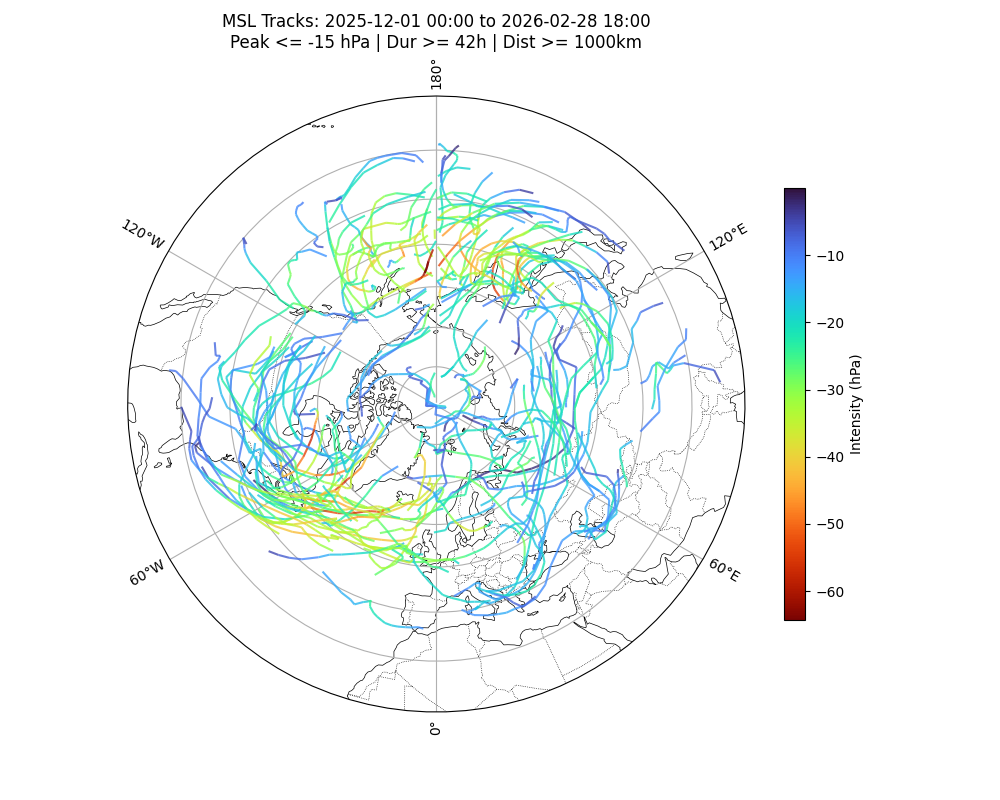
Storm Track Explorer (Interactive Map)
PyStormTracker is a Python package for cyclone trajectory analysis. It implements the "Simple Tracker" algorithm described in Yau and Chang (2020) and the "Hodges (TRACK)" algorithm with adaptive constraints described in Hodges (1999). It provides a scalable framework for processing large-scale climate datasets like ERA5.
Initially developed at the National Center for Atmospheric Research (NCAR) as part of the 2015 SIParCS program, PyStormTracker leverages task-parallel strategies and tree reduction algorithms to efficiently process large-scale climate datasets.
- Vectorized Architecture: Uses an Array-Backed data model to eliminate Python object overhead and ensure zero-copy serialization during parallel execution. Achieves up to 11.8x speedup in serial workloads.
- JIT-Optimized Kernels: Core mathematical filters are implemented in Numba, executing with C-level efficiency while releasing the GIL for multi-process execution.
- Multiple Algorithms:
- Simple (Default): Fast, heuristic linking optimized for higher resolutions.
- Hodges (TRACK): Algorithmic parity with the industry-standard TRACK software, including object-based detection (CCL), spherical cost functions, and recursive MGE optimization.
- Xarray Native: Seamlessly handles NetCDF and GRIB formats with coordinate-aware processing and robust variable alias handling (e.g.,
msl/slp,lon/longitude). - Scalable Backends:
- Serial: Standard sequential execution. Default fallback.
- Dask: Multi-process scaling for local or distributed environments. Selected if
--workersis provided without MPI. - MPI: High-performance distributed execution via
mpi4py. Selected automatically in MPI environments.
- Typed Implementation: Built for Python 3.11+ with strict type safety and
mypycompliance. - Interoperable: Full support for the standard IMILAST and TRACK (tdump) intercomparison formats.
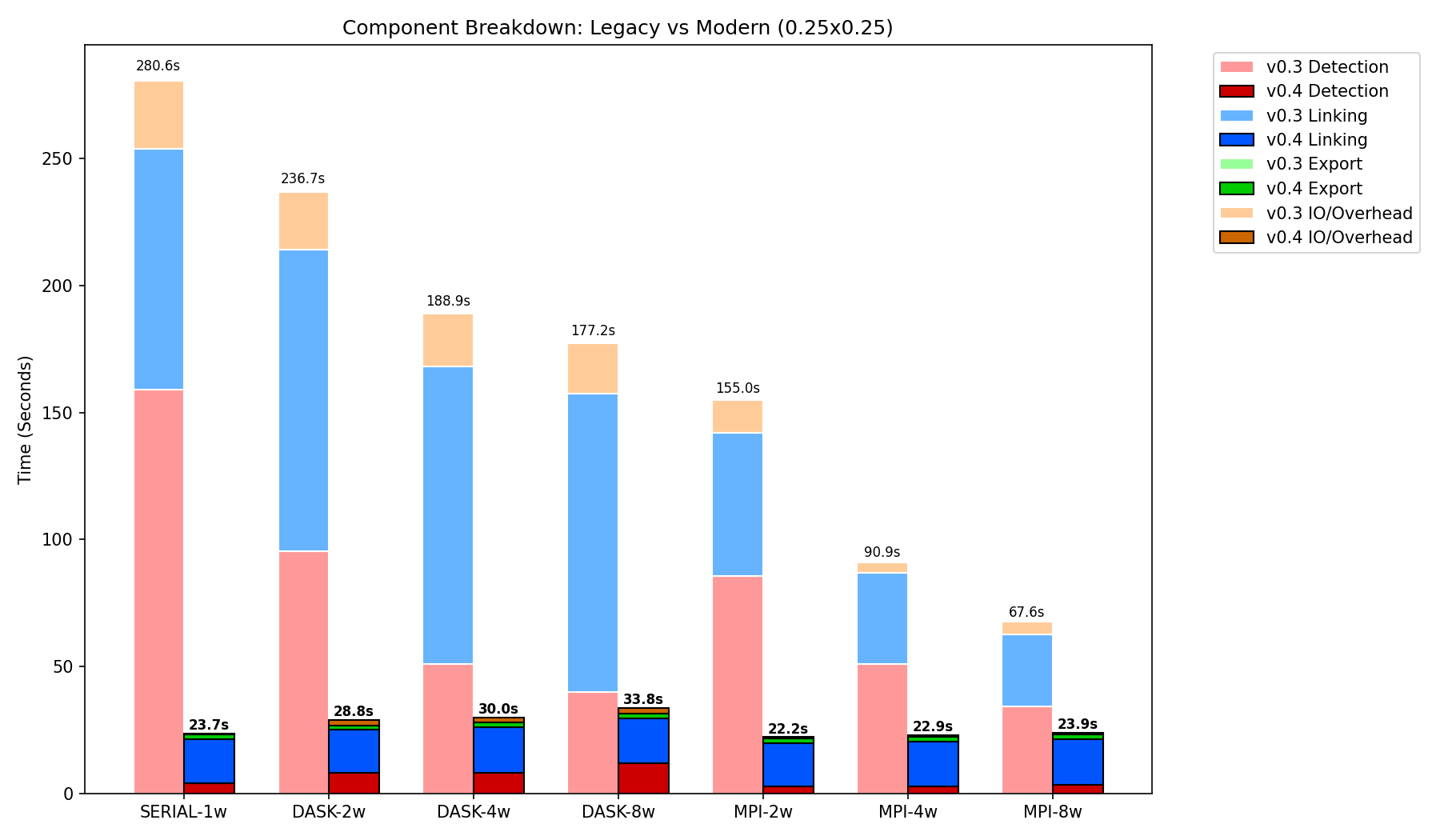
Significant performance gains in v0.4.0+ compared to the v0.3.3 architecture on high-resolution ERA5 data.
PyStormTracker treats meteorological fields as 2D images and leverages JIT-compiled Numba loops for feature detection:
- Local Extrema Detection: Employs an optimized sliding window filter to identify local minima (e.g., cyclones) or maxima (e.g., anticyclones, vorticity).
- Intensity & Refinement: Applies the discrete Laplacian operator to measure the "sharpness" of the field at each candidate center. This metric resolves duplicate detections, ensuring only the most physically intense point is retained when adjacent pixels are flagged.
- Trajectory Linking: Connects detected centers across consecutive time steps into continuous trajectories using a vectorized nearest-neighbor heuristic linking strategy.
Full documentation, including API references and advanced usage examples, is available at pystormtracker.readthedocs.io.
- Python 3.11+
- (Optional) OpenMPI for MPI support.
- SHT Backends: Supported engines for filtering and derivatives:
ducc0: Core dependency. High-precision C++ library (Distinctly Useful Code Collection) providing high performance spherical harmonic transforms.shtns: (Optional) High-performance C library (pip install PyStormTracker[shtns]). Recommended for large datasets.
- Windows: GRIB support is experimental. SHTns is not supported on Windows;
ducc0will be used automatically.
You can install the latest stable version of PyStormTracker directly from PyPI:
Using pip:
# Standard installation
pip install PyStormTracker

# With optional components
pip install PyStormTracker[hodges]  # Includes SHTns for Hodges algorithm
pip install PyStormTracker[mpi]     # Includes mpi4py for distributed execution
pip install PyStormTracker[grib]    # Includes GRIB support
pip install PyStormTracker[netcdf4] # Includes NetCDF4 backend
pip install PyStormTracker[all]     # Includes all optional components
Using uv:
# For use as a CLI tool
uv tool install PyStormTracker --with hodges,mpi

# For use as a library in your project
uv add PyStormTracker --extra hodges,mpiYou can also install PyStormTracker from conda-forge:
Using mamba:
mamba install -c conda-forge pystormtrackerUsing conda:
conda install -c conda-forge pystormtrackerInstall with uv:
git clone https://github.com/mwyau/PyStormTracker.git
cd PyStormTracker
uv syncOnce installed, you can use the stormtracker command directly:
stormtracker -i data.nc -v msl -o my_tracks.txt| Argument | Short | Description |
|---|---|---|
| Required | ||
--input |
-i |
Path to the input NetCDF/GRIB file. |
--var |
-v |
Variable name to track (e.g., msl, vo). |
--output |
-o |
Path to the output track file (e.g., tracks.txt). |
| General | ||
--algorithm |
-a |
simple (default) or hodges. |
--format |
-f |
Output format: imilast (default) or hodges. |
--mode |
-m |
min (default) for cyclones, max for vorticity. |
--threshold |
-t |
Intensity threshold for feature detection. |
--filter-range |
Spectral filter range (min-max). Default '5-42'. | |
--no-filter |
Disable default T5-42 spectral filtering. | |
--sht-engine |
SHT backend: auto, shtns, ducc0. |
|
--num |
-n |
Number of time steps to process. |
| Performance | ||
--backend |
-b |
serial, dask, or mpi. Auto-detected by default. |
--workers |
-w |
Number of parallel workers. Auto-detected for MPI; sets Dask if not MPI. |
--chunk-size |
-c |
Steps per chunk for Dask/RSPLICE (default 60). |
--overlap |
Overlap steps between chunks for splicing (default 3). | |
--engine |
-e |
Xarray engine (e.g., h5netcdf, netcdf4). |
| Hodges-Specific | ||
--min-points |
Minimum grid points per object (default 1). | |
--taper |
Number of points for boundary tapering (default 0). | |
--w1, --w2 |
Cost weights for direction (0.2) and speed (default 0.8). | |
--dmax |
Max search radius in degrees (default 6.5). | |
--phimax |
Smoothness penalty (default 0.5). | |
--iterations |
Max MGE optimization passes (default 3). | |
--min-lifetime |
Minimum time steps for a valid track (default 3). | |
--max-missing |
Max consecutive missing frames (default 0). | |
--zone-file / --zones |
Path to legacy zone.dat or JSON string for regional DMAX zones. |
|
--adapt-file / --adapt-params |
Path to legacy adapt.dat or JSON string for adaptive smoothness (2x4 array). |
You can easily integrate PyStormTracker into your own scripts or Jupyter Notebooks:
import pystormtracker as pst

# 1. Instantiate the tracker (Simple or Hodges)
# tracker = pst.SimpleTracker()
tracker = pst.HodgesTracker()

# 2. Run the tracking algorithm. Returns an array-backed Tracks object.
tracks = tracker.track(
    infile="data.nc",
    varname="vo",
    mode="max"
)for track in tracks:
if len(track) >= 8:
print(f"Track {track.track_id} lived for {len(track)} steps.")
tracks.write("output.txt", format="imilast")
Sample datasets for testing and benchmarking are hosted in the PyStormTracker-Data repository.
Using uv to set up your development environment:
# Install dependencies and sync virtual environment
uv syncRun automated checks using uv run:
Linting & Formatting:
uv run ruff check . --fix
uv run ruff format .
Type Checking:
uv run mypy src/To keep development cycles fast, testing is tiered:
- Fast Tests: Default local runs (skips integration tests).
- Integration Tests: Integration and regression tests.
- Local: Runs "short" variants (60 time steps) to ensure backend consistency quickly.
- CI: Runs "full" (all time steps) variants, including legacy regressions.
- Full Suite: Everything.
Run fast unit tests only (Default):
uv run pytestRun integration tests (Short variants locally):
uv run pytest --run-integrationRun everything:
uv run pytest --run-allIf you use this software in your research, please cite the following:
-
Yau, A. M. W., 2026: mwyau/PyStormTracker. Zenodo, https://doi.org/10.5281/zenodo.18764813.
-
Yau, A. M. W. and Chang, E. K. M., 2020: Finding Storm Track Activity Metrics That Are Highly Correlated with Weather Impacts. J. Climate, 33, 10169–10186, https://doi.org/10.1175/JCLI-D-20-0393.1.
-
Yau, A. M. W., K. Paul and J. Dennis, 2016: PyStormTracker: A Parallel Object-Oriented Cyclone Tracker in Python. 96th American Meteorological Society Annual Meeting, New Orleans, LA. Zenodo, https://doi.org/10.5281/zenodo.18868625.
-
Neu, U., et al., 2013: IMILAST: A Community Effort to Intercompare Extratropical Cyclone Detection and Tracking Algorithms. Bull. Amer. Meteor. Soc., 94, 529–547, https://doi.org/10.1175/BAMS-D-11-00154.1.
- IMILAST Intercomparison Protocol: https://proclim.scnat.ch/en/activities/project_imilast/intercomparison
- IMILAST Data Download: https://proclim.scnat.ch/en/activities/project_imilast/data_download
-
Schaeffer, N., 2013: Efficient spherical harmonic transforms aimed at pseudospectral numerical simulations. Geochem. Geophys. Geosyst., 14, 751–758, https://doi.org/10.1002/ggge.20071.
-
Hodges, K. I., 1999: Adaptive Constraints for Feature Tracking. Mon. Wea. Rev., 127, 1362–1373, https://doi.org/10.1175/1520-0493(1999)127<1362:ACFFT>2.0.CO;2.
-
Hodges, K. I., 1995: Feature Tracking on the Unit Sphere. Mon. Wea. Rev., 123, 3458–3465, https://doi.org/10.1175/1520-0493(1995)123<3458:FTOTUS>2.0.CO;2.
-
Hodges, K. I., 1994: A General Method for Tracking Analysis and Its Application to Meteorological Data. Mon. Wea. Rev., 122, 2573–2586, https://doi.org/10.1175/1520-0493(1994)122<2573:AGMFTA>2.0.CO;2.
This project is licensed under the BSD-3-Clause terms found in the LICENSE file.

![@dependabot[bot]](https://avatars.githubusercontent.com/in/29110?s=64&v=4)
![@github-advanced-security[bot]](https://avatars.githubusercontent.com/in/57789?s=64&v=4)