A macro-econmic analysis of global plastic pollution
Link to Dataset: Data
The main article: Plastic Pollution. Created by Hannah Ritchie and Max Roser (2018) - "Plastic Pollution". Published online at OurWorldInData.org. Retrieved from: Online Resource
Scope of the study:
- Data collected between 1980 to 2019
- Understand the total waste produced by each country and the total waste mismanaged by the countries
- Check the relation between waste and the GDP per capita for each nation
Key Insights:
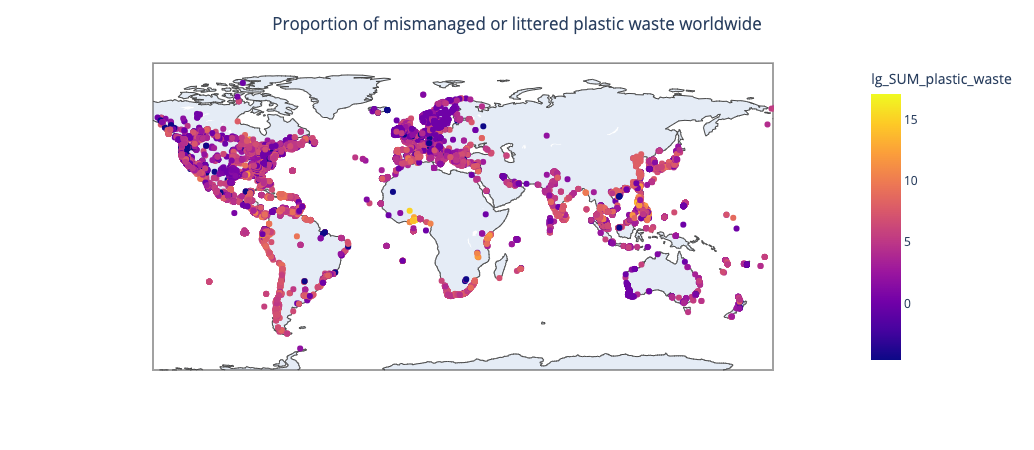
Asia and Africa stands out (regions appearing yellow) - emerging/developing/low income countries have a waste mismanagement problem.
Assumption: Countries that are either developing or emerging economies (med-low GDP per capita) are more likely to mismanage their waste. [ASIA & AFRICA]
Research: Also, our research revealed that not all the waste in ASIA are generated in ASIA. Most the waste accepted in this region are from the west as these countries prefer to export these waste then recycle them.
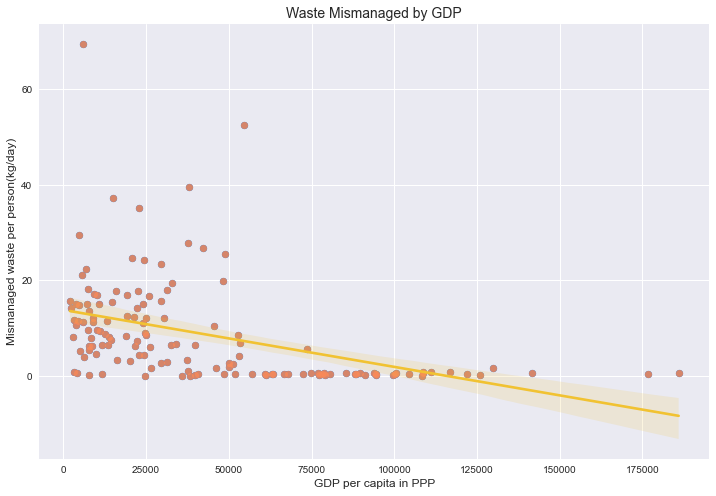
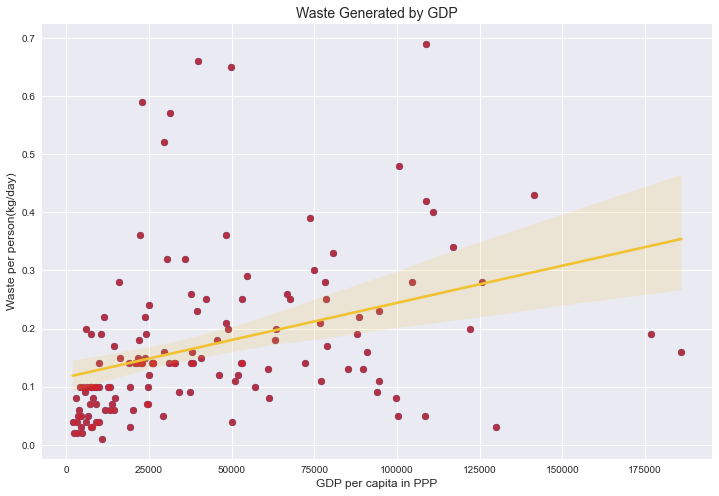
From the graphs above we understand that:
- Mismanaged waste decreases with an increase in country's GDP per capita
- Generated waste increases with an increase in country's GDP per capita
Therefore, the trends and assumptions that were spotted on the crowd sourced GIS data is empirically and statistically significant. Even though countries with higher GDP per capita produces a lot of waste but they are also in a better position to manage and track what percentage of this waste gets missmanaged. On the contary, emerging economies that are in the business of trading plastic waste needs to ensure that system are in place to prevent the imported or generated waste from ending up in the oceans.
Ultimately, tackling plastic pollution requires a multi-pronged approach. It needs to be tackled at 3 main levels:
- At the source: Encourage and invest in companies trying to build more eco-friendly plastic or alternatives
- Limiting usage: Replacing single-use plastic packaging cannot happen overnight. Therefore, as an immediate countermeasure, limiting its use-cases whenever possible seems only realistic
- End-of-life: The only way to make the system circular is to ensure these plastic waste is being repurposed ethically and responsibly. For example: Turning plastic waste into bricks