




A high-performance, production-ready ray tracing renderer with hybrid CPU/GPU rendering
Features • Quick Start • Architecture • Performance • Gallery
RayTrophi is a state-of-the-art physically-based ray tracing engine designed for architectural visualization, product rendering, and real-time graphics. It combines the flexibility of CPU rendering with the raw power of GPU acceleration through NVIDIA OptiX.
- Hybrid Rendering: Seamlessly switch between CPU (Embree/Custom BVH) and GPU (OptiX) acceleration
- Blender Cycles Quality: Path tracing, adaptive sampling, and progressive rendering competing with top-tier renderers
- Production-Ready: Principled BSDF, advanced materials, volumetrics, subsurface scattering
- High Performance: Optimized BVH construction (<1s for 3.3M triangles), 75% memory-optimized triangle structure
- Real-time Preview: Modern interactive UI with ImGui, animation timeline
- Industry Standard: AssImp loader supports 40+ 3D formats (GLTF, FBX, OBJ, etc.)
Note: This project is in active alpha development. Features and APIs may change.
- ✅ Non-RTX GPU Support: OptiX now works on GTX series GPUs using compute-based ray tracing
- GTX 9xx (Maxwell): SM 5.0+ supported
- GTX 10xx (Pascal): Fully supported (GTX 1080 Ti, 1070, 1060, etc.)
- GTX 16xx (Turing): Fully supported
- RTX Series: Full hardware RT core acceleration
- HUD Notification: GPU mode displayed at startup (RTX vs Compute Mode)
-
✅ Advanced Pro Camera HUD: Complete overhaul of the camera interface for a professional photography experience.
- Interactive Focus Ring: Use the mouse wheel to manually pull focus with precision.
- Focus Mode Control: Dedicated slider to switch between Auto Focus (AF) and Manual Focus (MF).
- Smart Auto-Focus: Smooth, dampened transition when locking onto objects in the center of the frame.
- Visual Feedback: HUD elements react to focus changes (Green = Locked, White = Searching/Manual).
-
✅ Physically Correct Lens Distortion:
- Brown-Conrady Model: Implemented realistic radial distortion simulation on both CPU and GPU (OptiX).
- Auto-Calculated Defects: Distortion is now derived purely from physical lens properties (Focal Length/FOV).
- Wide Angle (Barrel): Lenses wider than 50mm naturally exhibit barrel distortion.
- Telephoto (Pincushion): Long lenses exhibit slight pincushion distortion.
- No Manual Sliders: The "Distortion" slider has been removed in favor of this physically accurate, automatic behavior.
-
✅ Embedded Texture Serialization Fix: GLB embedded textures now correctly saved and loaded with projects
- Issue: Embedded textures from GLB files were lost when saving/loading projects
- Root Cause 1: Member shadowing -
Material*base pointer accessed wrong texture properties - Root Cause 2:
MaterialManager::getOrCreateMaterialIDdidn't update existing materials' textures - Solution: Proper
PrincipledBSDF*cast inserializeTextures()and texture reference updates
-
✅ Normal Map Texture Type Fix: Fixed GPU rendering artifacts caused by incorrect texture type loading
- Issue: One triangle per polygon appeared black/inverted after project load
- Root Cause: All textures were loaded as
TextureType::Albedo, causing sRGB conversion on normal maps - Solution:
deserializeProperty()now accepts texture type parameter, each property uses correct type
-
✅ Material Keyframe Rendering Fix: Fixed batch animation rendering where material property keyframes (albedo, emission, roughness, etc.) were not being applied during OptiX-based animation output
- Issue: Viewport playback correctly animated materials, but batch rendering showed only initial material states
- Root Cause: Missing timeline frame synchronization and GPU material buffer upload in
render_Animationloop - Solution: Added
render_settings.animation_current_framesync andupdateOptiXMaterialsOnlycall before each frame render
-
✅ Animation Render Cancel Button: Added functional "Stop Animation" button in UI
- Issue: No way to cancel ongoing batch animation renders
- Solution: Wired "Stop Animation" button to set
rendering_stopped_cpuandrendering_stopped_gpuflags that the render loop checks - Location: System & Output panel, visible during animation rendering
Files Modified:
Main.cpp: AddedisOptixCapable()for SM 5.0+ detection, GPU mode HUD notificationcompile_ptx.bat: Updated to compile forcompute_50(Maxwell+) compatibilityRenderer.cpp: Added timeline frame sync and material GPU upload in batch render loopscene_ui.cpp: Connected "Stop Animation" button to rendering stop flags
Known Limitations:
- Non-RTX GPUs use compute-based ray tracing (2-3x slower than RTX hardware acceleration)
- CPU viewport rendering can be slow during intensive scenes (GPU recommended)
-
Materials
- ✅ Principled BSDF (Disney-style uber-shader)
- ✅ Lambertian, Metal, Dielectric
- ✅ Volumetric rendering with noise-based density
- ✅ Subsurface Scattering (SSS)
- ✅ Clearcoat, Anisotropic materials
-
Lighting
- ✅ Point lights, Directional lights
- ✅ Area lights (mesh-based)
- ✅ Emissive materials
- ✅ HDR/EXR Environment Maps (equirectangular projection)
- ✅ Global Volumetric Clouds:
- Any Sky Mode: Decoupled rendering works seamlessly with HDRI, Solid Color, or Nishita Sky.
- Physical Scattering: Henyey-Greenstein phase function with controllable Anisotropy (Silver Lining).
- High Quality: Adaptive ray marching (up to 128 steps) and jittered sampling to eliminate banding artifacts.
- Dynamic Control: Wind/Seed offsets, Coverage, Density, and Altitude layers.
- Soft Horizon: Smart density fading prevents black horizon artifacts.
- ✅ Advanced Nishita Sky Model:
- Physical atmosphere (Air, Dust, Ozone, Altitude) matching Blender concepts.
- Day/Night Cycle: Automatic transition with procedural stars and moon.
- Moon Rendering: Horizon size magnification, redness, atmospheric dimming, and phases.
- Sun Glow: High Mie Anisotropy (0.98) for realistic sun halos.
- Light Sync: Automatically synchronizes Scene Directional Light with Sky Sun position.)
- ✅ Soft shadows with multiple importance sampling
-
Advanced Features
- ✅ Accumulative Rendering: Progressive path tracing for noise-free, high-quality output
- ✅ Adaptive Sampling: Intelligent sampling engine focusing on noisy areas
- ✅ Depth of Field (DOF)
- ✅ Motion Blur
- ✅ Intel Open Image Denoise (OIDN) integration
- ✅ Tone mapping & post-processing
- ✅ Advanced Animation:
- Bone animation with quaternion interpolation
- Multi-track timeline with keyframe editing (Location/Rotation/Scale/Material)
- Batch Animation Rendering: Export animation sequences to image files with material keyframe support
- Cancellable renders with "Stop Animation" button
- Real-time playback preview with scrubbing
- ✅ Advanced Cloud Lighting Controls:
- Light Steps control for volumetric cloud quality
- Shadow Strength for realistic cloud shadows
- Ambient Strength for cloud base illumination
- Silver Intensity (Silver Lining) for sun-edge effects
- Cloud Absorption for light penetration control
- ✅ Full Undo/Redo System (v1.2):
- Object transforms (move, rotate, scale)
- Object deletion and duplication
- Light transforms (move, rotate, scale)
- Light add/delete/duplicate
- Keyboard shortcuts: Ctrl+Z (Undo), Ctrl+Y (Redo)
- ✅ Advanced Selection System (NEW v1.3):
- Box Selection: Right-click drag to select multiple objects
- Mixed Selection: Select lights + objects together
- Ctrl+Click: Add/remove from selection
- Select All/None buttons: Quick selection in Scene panel
- Multi-object transform: Move multiple selected items at once
- ✅ Idle Preview (NEW v1.3):
- During gizmo manipulation, pause mouse for 0.3s to preview position
- See render result before releasing - adjust if needed
- Blender-like UX for precise positioning
-
Multi-BVH Support
- Embree BVH (Intel, production-grade)
- Custom ParallelBVH (SAH-based, OpenMP parallelized)
- OptiX GPU acceleration structure
-
Optimizations
- SIMD vector operations
- Multi-threaded tile-based rendering
- Progressive refinement
- Memory Optimization: Triangular footprint reduced from 612 to 146 bytes (75% reduction)
- Robust Texture System: Crash-proof loader for Unicode paths and corrupted formats
- Cached Texture Management (Optimized Hit/Miss logic)
- Deferred BVH Update (NEW v1.3): Gizmo manipulation doesn't block - BVH updates only when needed
- O(n) Multi-Delete (NEW v1.3): Delete 100+ objects instantly (was O(n²))
- Modern ImGui-based Dark UI with Docking
- Animation Timeline:
- Multi-track visualization with group hierarchy (Objects/Lights/Cameras/World)
- Per-Channel Keyframing: Separate Location/Rotation/Scale keyframes
- Expandable L/R/S sub-channels with color coding
- Context menu for insert/delete/duplicate operations
- Drag-to-move keyframes, zoom/pan/scrub navigation
- Render Quality Presets (Low, Medium, High, Ultra)
- Dynamic Resolution Scaling
- Scene hierarchy viewer and Material editor
- Performance metrics (FPS, rays/s, memory usage)
- Box Selection: Right-click drag for multi-selection
- Transform Gizmo Idle Preview: Pause during drag to preview position
Required:
- Visual Studio 2022 (MSVC v143) - RECOMMENDED BUILD SYSTEM
- Windows 10/11 (x64)
- CMake 3.20+ (optional, VS2022 preferred)
Optional (for GPU rendering):
- NVIDIA GPU (SM 5.0+): GTX 9xx, 10xx, 16xx, or RTX series
- CUDA Toolkit 12.0+
- OptiX 7.x SDK
GPU Compatibility:
| GPU Series | Architecture | Mode | Performance |
|---|---|---|---|
| RTX 40xx | Ada Lovelace | Hardware RT | ⚡ Fastest |
| RTX 30xx | Ampere | Hardware RT | ⚡ Very Fast |
| RTX 20xx | Turing | Hardware RT | ⚡ Fast |
| GTX 16xx | Turing | Compute | 🔶 Good |
| GTX 10xx | Pascal | Compute | 🔶 Moderate |
| GTX 9xx | Maxwell | Compute | 🔶 Slower |
All dependencies are managed automatically:
- SDL2 (graphics output)
- Embree 4.x (CPU BVH)
- AssImp 5.x (model loading)
- ImGui (UI)
- OpenMP (parallelization)
- stb_image (HDR/texture loading)
- TinyEXR (EXR format support)
- Intel OIDN (denoising)
- CUDA/OptiX (GPU rendering - optional)
# 1. Clone the repository
git clone https://github.com/maxkemal/RayTrophi.git
cd RayTrophi/raytrac_sdl2

# 2. Open the solution
# Double-click raytrac_sdl2.vcxproj or open in Visual Studio 2022

# 3. Build
# Set configuration to "Release" and platform to "x64"
# Build > Build Solution (Ctrl+Shift+B)

# 4. Run
# The executable will be in: x64/Release/raytracing_render_code.exeNote: All dependencies (DLLs, resources) are automatically copied to the output directory by the build system.
mkdir build && cd build
cmake .. -G "Visual Studio 17 2022" -A x64
cmake --build . --config Releasecd x64/Release
raytracing_render_code.exeThe UI will appear. Use File > Load Scene to import models (GLTF recommended).
RayTrophi/
├── raytrac_sdl2/                  # Main project
│   ├── source/
│   │   ├── cpp_file/              # Implementation files
│   │   │   ├── Renderer.cpp       # Main rendering loop
│   │   │   ├── EmbreeBVH.cpp     # Embree BVH wrapper
│   │   │   ├── ParallelBVHNode.cpp # Custom SAH BVH
│   │   │   ├── OptixWrapper.cpp   # OptiX GPU backend
│   │   │   ├── AssimpLoader.cpp   # Model/texture loader
│   │   │   ├── PrincipledBSDF.cpp # Disney BSDF
│   │   │   └── ...
│   │   ├── header/                # Header files
│   │   │   ├── Ray.h, Vec3.h     # Math primitives
│   │   │   ├── Material.h         # Material base
│   │   │   ├── Triangle.h         # Optimized triangle
│   │   │   ├── Camera.h           # Camera & DOF
│   │   │   └── ...
│   │   ├── imgui/                 # ImGui library
│   │   └── res/                   # Resources (icons, etc.)
│   ├── raytrac_sdl2.vcxproj      # Visual Studio project
│   ├── CMakeLists.txt             # CMake build (has issues)
│   └── raygen.ptx                 # OptiX shader
└── README.md                      # This file
-
Renderer (
Renderer.cpp)- Tile-based multi-threaded rendering
- Progressive refinement
- Denoising integration
-
BVH Systems
- EmbreeBVH: Industry-standard, optimized for speed
- ParallelBVHNode: Custom SAH-based, OpenMP parallel build
- OptiX BVH: GPU-accelerated structure
-
Material System (
Material.h,PrincipledBSDF.cpp)- Modular property-based materials
- Texture support (albedo, roughness, metallic, normal, emission)
- sRGB/Linear color space handling
-
OptixWrapper (
OptixWrapper.cpp)- CUDA/OptiX backend
- SBT (Shader Binding Table) management
- Texture object caching
-
AssimpLoader (
AssimpLoader.cpp)- Supports 40+ formats
- Embedded texture extraction
- Material conversion to Principled BSDF
| BVH Type | Build Time | Quality | Use Case |
|---|---|---|---|
| Embree | 872 ms | High | Production rendering |
| ParallelBVH | ~2000 ms | High | Custom research/debug |
| OptiX (GPU) | ~150 ms | Very High | Real-time GPU |
- CPU (Embree): ~1-5 million rays/s (16 threads)
- GPU (OptiX RTX 3080): ~100-500 million rays/s
- Memory: 146 bytes/triangle (optimized layout)
- ✅ Direct Embree buffer writes (no intermediate vectors)
- ✅ Vector pre-allocation with
reserve() - ✅ Two-pass BVH construction (count → allocate → build)
- ✅ Embree build quality tuning (MEDIUM for speed)
- ✅ Material ID lookup via MaterialManager (no shared_ptr in Triangle)
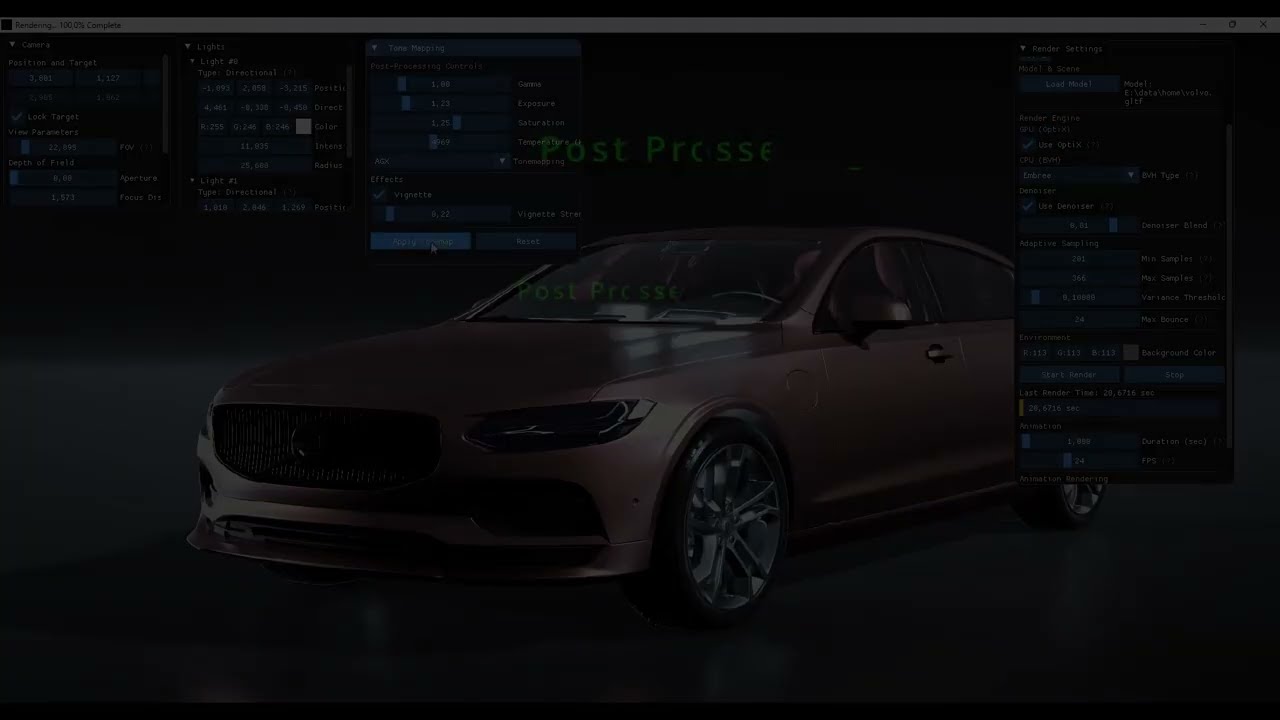

Complex architectural scene with advanced lighting - 3.3M triangles, Embree BVH

Interior design with volumetric lighting and subsurface scattering

Real-time GPU rendering with OptiX - 500M+ rays/second

Stylized dragon with custom materials and procedural textures

Pure CPU path tracing with progressive refinement

Principled BSDF materials with PBR textures

Outdoor environment with natural lighting

Interactive ImGui interface with live parameter adjustments
Automatic (recommended): The Visual Studio project manages dependencies via vcpkg or manual paths.
Manual:
- Download SDL2, Embree, AssImp from official sources
- Update include/library paths in project properties
- Debug: Full symbols, slower (~10x)
- Release: Optimized, production use
- RelWithDebInfo: Optimized + symbols (profiling)
| Feature | VS2022 .vcxproj | CMake |
|---|---|---|
| CPU Rendering (SDL) | ✅ Working | |
| GPU Rendering (OptiX) | ✅ Working | ✅ Working |
| Dependency Management | ✅ Excellent | |
| Build Speed | Fast | Slower |
| Recommendation | USE THIS | Experimental |
Why VS2022?
- All dependencies are pre-configured
- Resource files (icons, PTX) auto-copied
- No SDL refresh bugs in CPU rendering
- Better debugging experience
#include "Renderer.h"
#include "SceneData.h"

int main() {
    Renderer renderer(1920, 1080, 8, 128);
    SceneData scene;
    OptixWrapper optix;

    // Load scene
    renderer.create_scene(scene, &optix, "path/to/model.gltf");

    // Render
    SDL_Surface* surface = /* ... */;
    renderer.render_image(surface, scene, /* ... */);

    return 0;
}// Use Embree (fastest)
renderer.rebuildBVH(scene, true); // use_embree = true
// Use custom ParallelBVH
renderer.rebuildBVH(scene, false); // use_embree = falseauto mat = std::make_shared<PrincipledBSDF>();
mat->albedoProperty.constant_value = Vec3(0.8, 0.1, 0.1); // Red
mat->roughnessProperty.constant_value = Vec3(0.3, 0.3, 0.3);
mat->metallicProperty.constant_value = Vec3(1.0, 1.0, 1.0); // Metallic⚠️ CMake build has SDL screen update bug in CPU rendering → Use VS2022 instead- DLL dependencies must be in same folder as .exe
- OptiX requires NVIDIA GPU with SM 5.0+ (GTX 9xx or newer)
- RTX GPUs use hardware RT cores; GTX GPUs use compute-based ray tracing (slower)
- Very large scenes (>10M triangles) may cause memory issues
- Denoising uses Intel OIDN with CUDA acceleration on NVIDIA GPUs
- Currently Windows-only (SDL2, DirectX dependencies)
- Linux/macOS support would require porting
- Binned SAH for faster BVH construction
- Index-based BVH (remove vector copying)
- SBVH (Spatial BVH splits)
- Linux/macOS support
- Vulkan backend (alternative to OptiX)
- Network rendering (distributed ray tracing)
- USD format support
- Light path visualization/debugging
Contributions are welcome! Areas of interest:
- Performance optimizations
- New material models
- Additional 3D format support
- Bug fixes
- Documentation improvements
How to contribute:
- Fork the repository
- Create a feature branch (
git checkout -b feature/amazing-feature) - Commit your changes (
git commit -m 'Add amazing feature') - Push to the branch (
git push origin feature/amazing-feature) - Open a Pull Request
This project is licensed under the MIT License - see the LICENSE file for details.
- Embree - Intel's high-performance ray tracing kernels
- OptiX - NVIDIA's GPU ray tracing engine
- AssImp - Open Asset Import Library
- ImGui - Dear ImGui for user interface
- SDL2 - Simple DirectMedia Layer
- Intel OIDN - Open Image Denoise
- stb - Sean Barrett's public domain libraries (stb_image for HDR)
- TinyEXR - Syoyo Fujita's EXR loader library
Kemal - @maxkemal
- Issues: GitHub Issues
- Discussions: GitHub Discussions
⭐ Star this repository if you find it useful!
Made with ❤️ and lots of ☕