


A set of Python functions to store data securely.
I used to keep a text file on my desktop with a lot of personal data. Realizing that the habit was growing dangerous, I decided to build a program to encrypt the content.
After studying cryptographic primitives, I created an application to browse my personal notes and passwords.
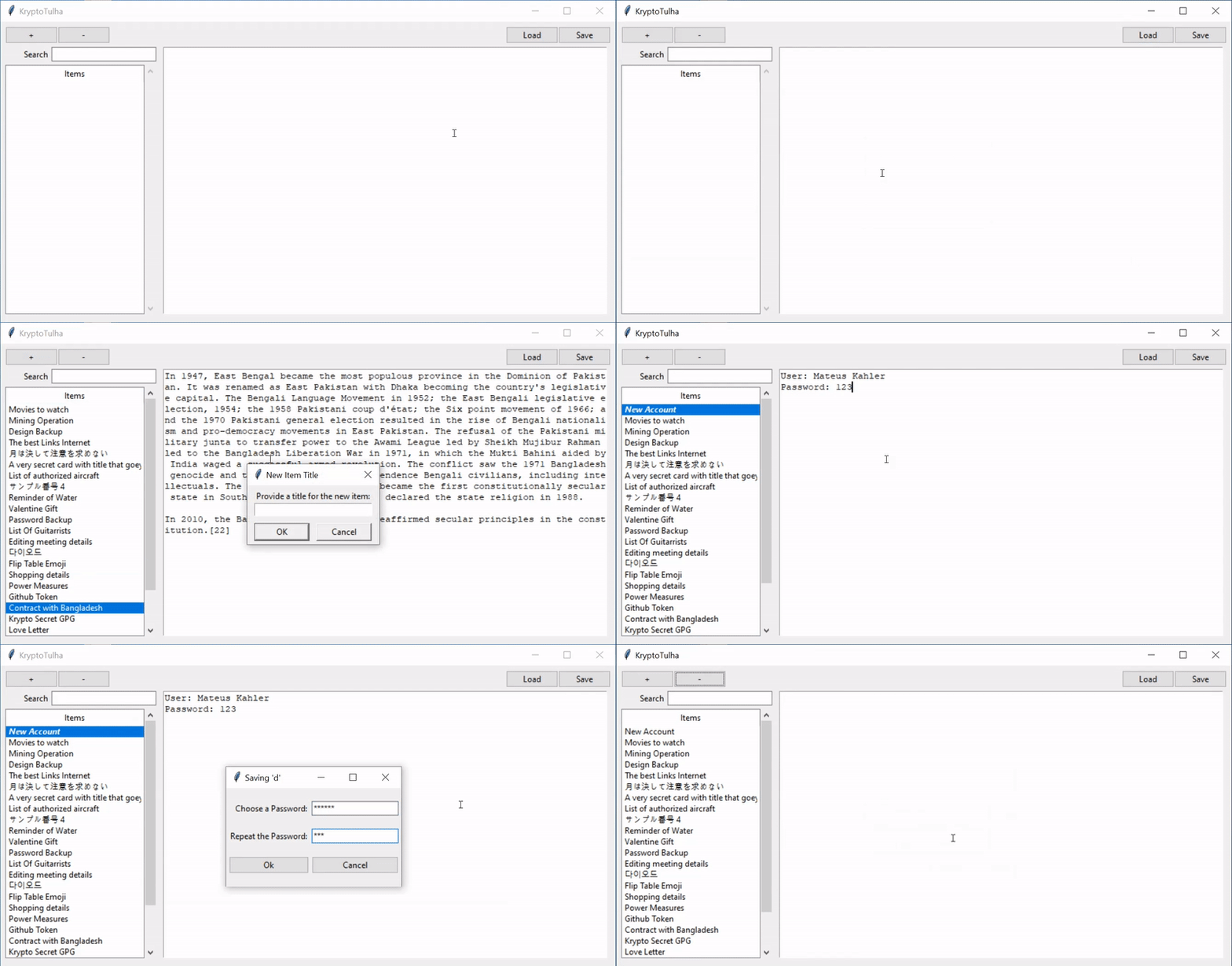
You can clone the repository and run the Python script or download the executable.
The executables are available on the releases page, and instructions on how to build it yourself are presented below.
To launch the User Interface as a Python script, execute kriptoTulhaUI.py:
python kriptoTulhaUI.pyThe requirements are listed in requirements.txt, and can be installed with
pip3 install -r requirements.txtThis project requires Python >= 3.10, mostly because I enjoy using the type hints.
If you want to compile the script as a standalone executable yourself:
pyinstaller --noconsole --onefile --hidden-import argon2-cffi --hidden-import python-Levenshtein ./kriptoTulhaUI.py
These are the options I used. For details, take a look at pyinstaller homepage.
Once compiled (or if you downloaded the program) the dependencies are no longer needed to run the application.
Items are manipulated as title and content pairs, but are never saved to disk in readable form. Decoding them requires providing a user-defined password. The encryption scheme follows:
graph TD
    classDef userProvided stroke:red
    RC[User Content]
    UP[User Password]
    PN[Salt 1]
    SN[Salt 2]
    PK[Primary Key]
    SK[Secondary Key]
    KD1(Key Derivation)
    KD2(Key Derivation)

    UP ---> KD1
    PN --> KD1
    KD1 --> PK

    UP ---> KD2
    SN --> KD2
    KD2 --> SK

    TN[Salt 3]
    CH1(Cryptographic Hash)
    VS[Validity Stamp]
    SK --> CH1
    TN --> CH1
    RC ---> CH1
    CH1 --> VS

    VC[Content Stamped]
    CC(Cipher)
    QN[Salt 4]
    VS --> VC
    RC ---> VC
    VC --> CC
    PK ---> CC
    QN --> CC

    EC[Encrypted Content]
    CC --> EC

    class UP userProvided
    class RC userProvided
Key derivation is done using Argon2, a memory hard funtion.
Validation is done using Blake2b, a cryptographic hash function.
Encryption is done with ChaCha20, a stream cipher.
Two keys are derived from the user provided password, in combination with random generated salts. The salts are called Salt 1 and Salt 2, and the keys are called Primary Key and Secondary Key, repectively.
A cryptographic hash stamp of the content is generated, the function uses the Secondary Key with a new salt, Salt 3.
The stamp is appended to the content to be encrypted as a mean to verify that the correct password is provided during decryption (the decryption cipher will output something, no mather what password is provided, but its unlikely that the wrong password will also return the correct hash).
The content, along with Salt 2 and the Validity Stamp, are fed to a cipher using the Primary Key and a newly generated salt, called Salt 4.

The file is saved on disk containing an unencrypted layer with enough information to regenerate the decryption Primary key if the user provides the correct password, this layer contains Salt 1 and Salt 4, of 16 and 12 bytes, respectively.
Once decrypted, the main layer contains Salt 2, which is used to generate the Secondary key. The Secondary key is used in conjunction with Salt 3, which is integrated into the Validity Stamp, to compare the resulting cryptographic hash of the content with the expected value.
The hashes matching, the contents of the items are reconstructed. Items are arranged contiguously in the decrypted stream, as pairs of utf-8 strings, preceded by their size in bytes.
The program consists of three main modules:
- Tulha, which exposes a class to store items.
- Crypto, which contains routines to encrypt and verify data.
- User interface.
Code style is enforced by autopep8 and flake8, which are listed in the dev_requirements.txt file.
Tests of encryption and storage routines can be performed with:
python -m unittest -v
The tests are also run as a Github action on pull requests.