This project demonstrates the use of abstract interpretation for binary analysis, specifically focusing on tracking dispatch state transitions in x86_64 binaries obfuscated by control flow flattening (CFF). It serves as both an educational resource and a proof-of-concept implementation.
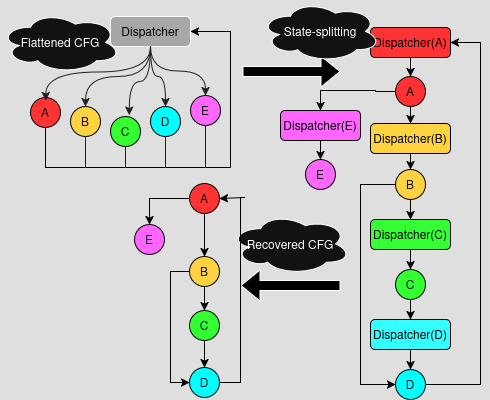
The project implements an abstract interpreter that:
- Uses a k-sets abstract domain to track possible values
- Analyzes binary code to track dispatch state transitions
- Generates a state transition graph showing how different dispatch states are connected
- Implements state splitting: maintains separate abstract states for different dispatch values, allowing precise tracking of program behavior under different conditions
- Provides static analysis guarantees: sound analysis that covers all possible execution paths without requiring concrete execution
Abstract interpretation is a static analysis technique that approximates program behavior by executing the program on abstract values rather than concrete ones. This provides several key advantages:
- Soundness: The analysis is guaranteed to cover all possible program behaviors - no execution path can be "missed"
- Termination: The analysis is guaranteed to terminate, even for programs with unbounded loops, as long as the dispatch state detection is successful
- Efficiency: The analysis does not need to explicitely trace each path
The k-sets domain is an abstract domain that tracks sets of concrete values, with a maximum size limit (k). It provides a lattice structure where:
- TOP represents all possible values
- Sets represent specific sets of possible values
- BOTTOM (empty set) represents no possible values
The analysis tracks how dispatch states (values at a specific memory address) change through program execution, building a graph of possible state transitions. This static analysis approach means:
- All possible state transitions are discovered
- No concrete execution is needed to explore different paths
- The analysis terminates even with unbounded loops
- Results are valid for all possible inputs
The dispatch state address is guessed by a preliminary analysis pass by detecting the variable that correlates the most with the path taken in each iteration. Heuristics parameters are configurable in config.py
A key feature of this implementation is its ability to maintain separate abstract states for different dispatch values. When the analysis encounters a branch or state change:
- It creates a new abstract state for each possible dispatch value
- These abstract states are tracked independently through the program
- This allows precise analysis of program behavior under different conditions
- The state splitting mechanism is crucial for handling conditional branches and state-dependent behavior
For each basic block, the associated abstract states are checked, if the abstract state contains only few (threshold configurable) possible dispatcher state value, then the instruction is considered belonging to original code, and matched to the corresponding dispatcher state value.
The obfuscation/dispatcher instructions usually corresponds to multiple dispatcher state values, and therefore are not considered original code instructions.
- Clone the repository:
git clone https://github.com/klemmm/auspex.git
cd auspex- Create and activate a python virtual env (optional but recommended)
python3 -m venv env
source env/bin/activate- Install dependencies:
pip install -r requirements.txtBasic usage:
./auspex.py examples/example graph.dotThis will:
- Load and analyze the specified binary
- Track dispatch state transitions
- Handle loops and recursion without concrete execution
- Detect instructions beloging to each dispatcher state by using the abstract interpretation results
- Generate a DOT file showing the state transition graph along with instructions for each node
- You can visualize the graph using Graphviz:
dot -Tpng graph.dot -o graph.pngint main(int argc, char **argv) {
unsigned int i;
unsigned int ret = 0;
for (i = 0; i < argc; i++) {
if (argv[i][0] != 0) {
ret++;
}
}
return ret;
}
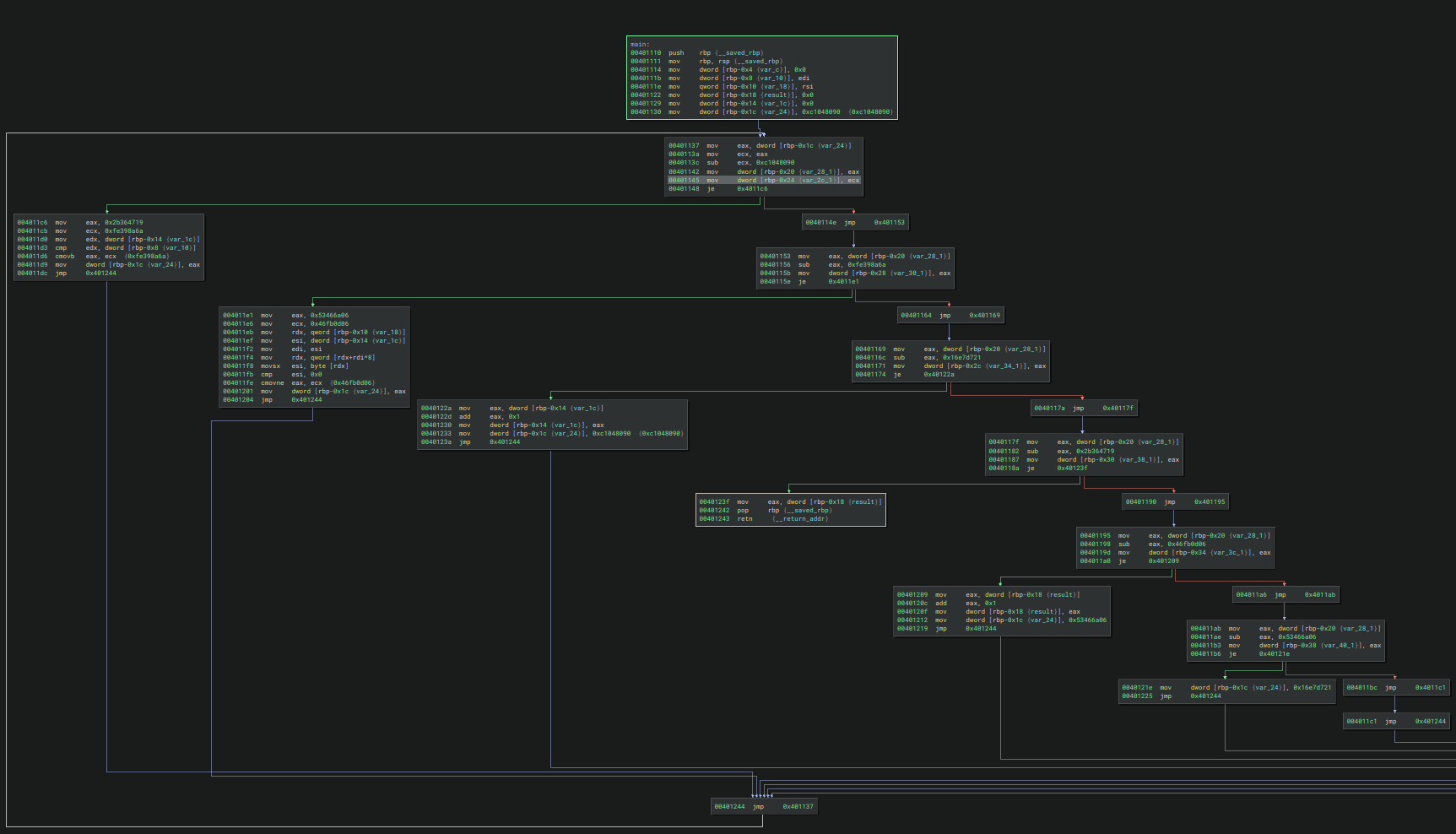
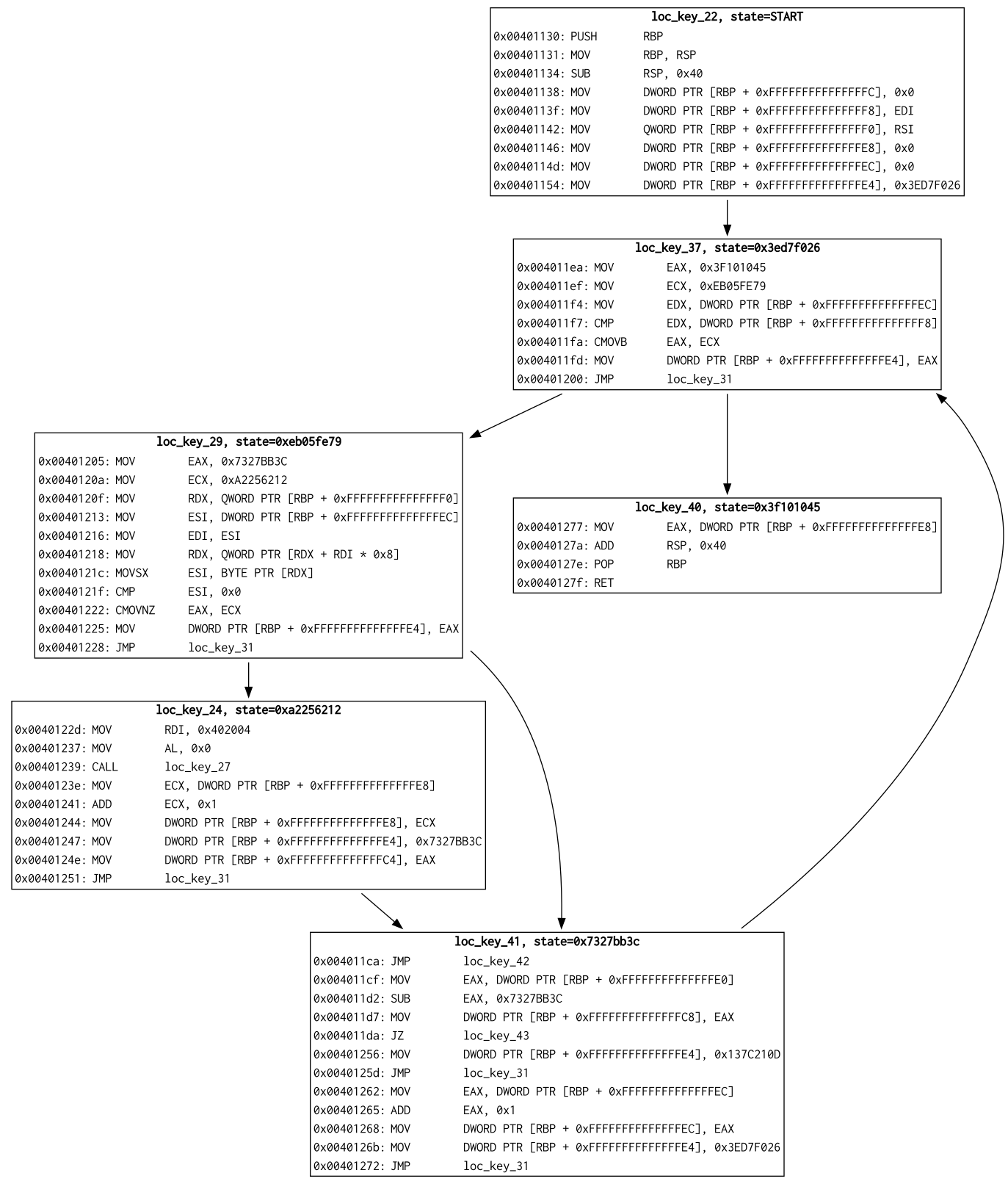
The analysis can be configured through config.py:
KSET_MAX: Maximum size of value sets in the abstract domainLOG_LEVEL: Logging verbosity
domain.py: Implements the k-sets abstract domainauspex.py: Main analysis engineutils.py: Utility functions and type definitionsconfig.py: Configuration parameterstests/: Test suiteexamples/: Example binaries and usage
Run the test suite:
python -m pytest tests/Running AUSPEX on a simple VM program (examples/vm.c) successfully detects the VIP address and recover the control flow of program emulated in the VM (note: modifying MAX_STATE_PER_INST to 2 in config.py is required):
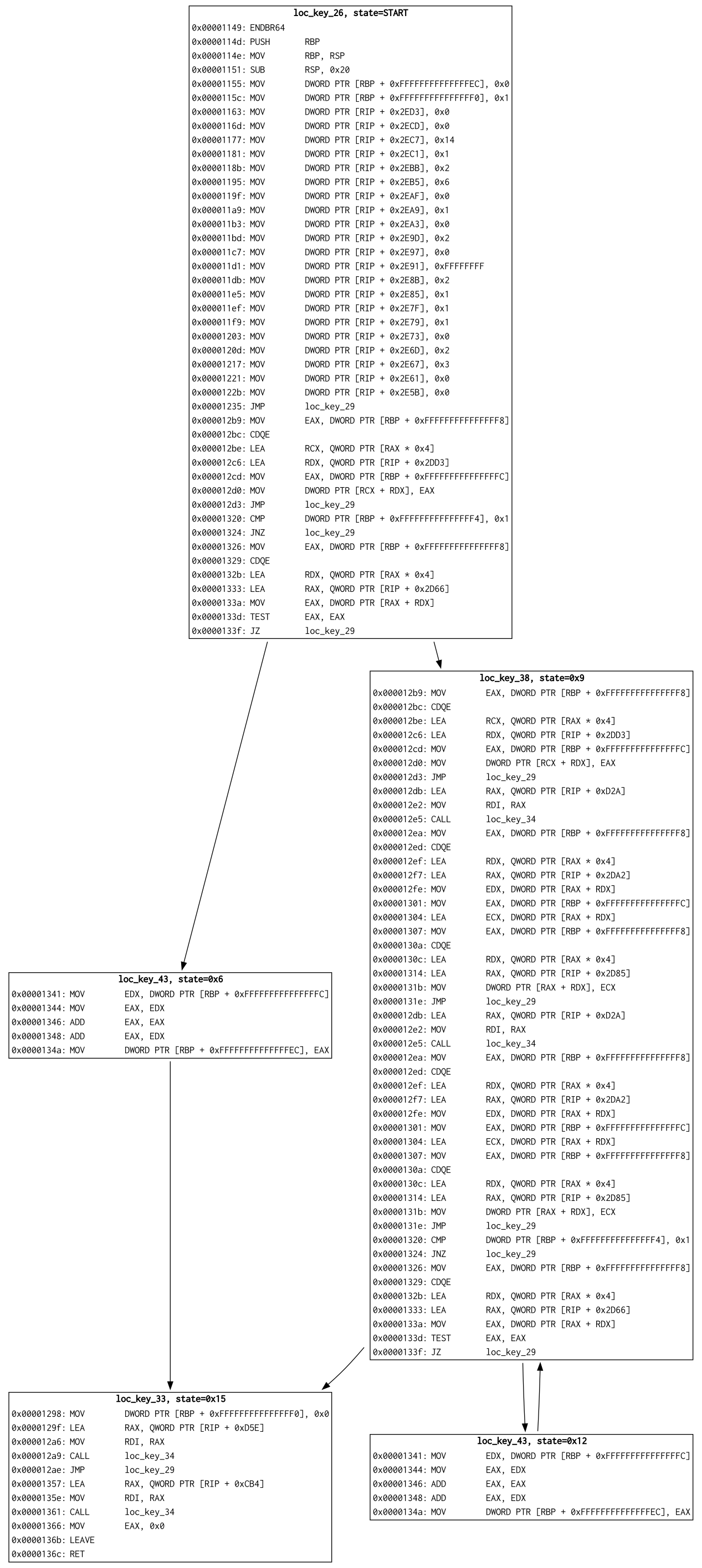
This is an educational/PoC tool, it has limitations such as:
- Not all IR instructions are handled
- Inter-procedural analysis is not done
- The abstract domain is quite simple (not relational) although it suffices for now
- No support for stuff like opaque predicates, etc.
- Should add an optimization pass to remove useless instructions (e.g. managing dispatcher state) from the final result
- Should ensure soundness for memory write with non-static addresses (needs a more powerful analysis, VSA / intervals / ...)
- Should handle better CFG construction (i.e. dynamic branches)
- Contents from .data/.rodata should be taken into account in initial abstract state
- Supports only one level of flattening / dispatcher state variable for now.
Contributions are welcome! Please:
- Fork the repository
- Create a feature branch
- Submit a pull request
- Based on abstract interpretation concepts from Cousot & Cousot
- Inspired by the "Value-guided partitioning" by Xavier Rival et al. (TOPLAS'07)
- Uses the Miasm framework for binary analysis