
create Natal Chart with ease
- SVG natal chart generation in pure python
- supported chart types:
- birth chart
- transit chart
- synastry chart
- solar return chart
- highly configurable
- all planets, asteroids, vertices can be enabled / disabled
- orbs for each aspect
- light, dark, or mono theme
- light / dark theme color definitions
- chart stroke, opacity, font, spacing between planets ...etc
- high precision astrological data with Swiss Ephemeris
- chart data statistics
- element, modality, and polarity counts
- planets in each houses
- quadrant and hemisphere distribution
- aspect pair counts
- composite chart aspects
- aspects cross reference table
- thoroughly tested with
pytest
- installation
uv add natal
- generate a chart
from natal import Data, Chart

# create chart data object
mimi = Data(
    name="MiMi",
    utc_dt="1980-04-20 06:30",
    lat=25.0531,
    lon=121.526,
)

# create a Chart object
chart = Chart(mimi, width=600)

# view the chart in jupyter notebook
from IPython.display import HTML

HTML(chart.svg)
following SVG chart will be created:
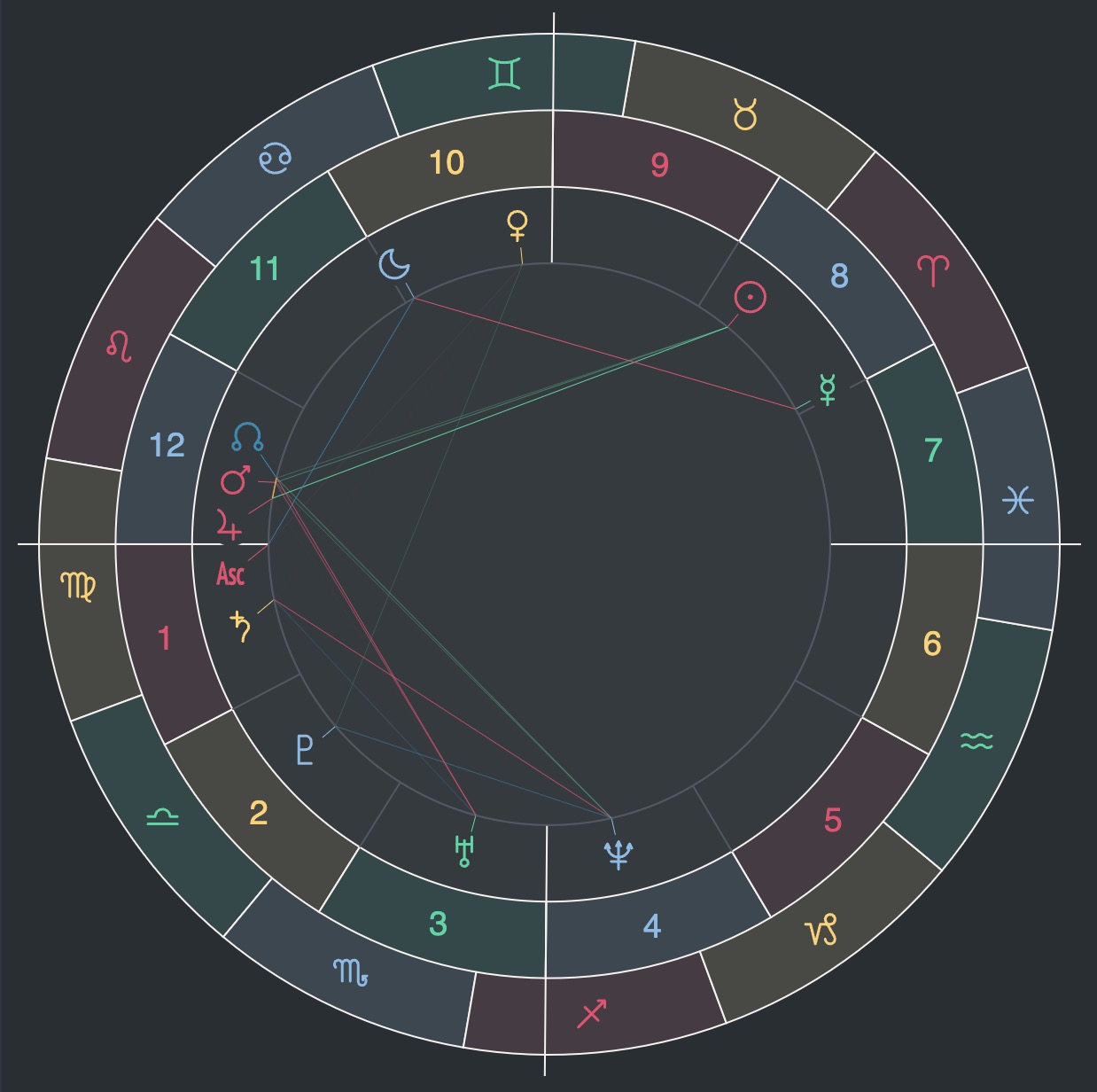
- see demo.ipynb for other examples:
- transit chart
- light theme
- mono theme
- Orb configuration
## -- retrieve natal chart properties -- ##

mimi.planets     # list[Planet]
mimi.houses      # list[House]
mimi.extras      # list[Extra]
mimi.vertices    # list[Vertex]
mimi.signs       # list[Sign]
mimi.aspects     # list[Aspect]
mimi.quadrants   # list[list[Aspectable]]

# Planet object
sun = mimi.planets[0]

sun.degree # 30.33039116987769
sun.normalized_degree # 230.62043431588035 # degree relative to Asc
sun.color # fire
sun.speed # 0.9761994105153413
sun.retro # False
sun.dms # 00°19'
sun.signed_dms # 00°♉19'
sun.signed_deg # 0
sun.sign.name # taurus
sun.sign.symbol # ♉
sun.sign.value # 2
sun.sign.color # earth
sun.sign.ruler # venus
sun.sign.classic_ruler # venus
sun.sign.element # earth
sun.sign.modality # fixed
sun.sign.polarity # negative

# Aspect object
aspect = mimi.aspects[0]

aspect.body1 # sun Planet obj
aspect.body2 # mars Planet obj
aspect.aspect_member # AspectMember(name='trine', symbol='△', value=120, color='air')
aspect.applying # False
aspect.orb # 3.3424- create a
Configobject and assign it toDataobject - it will override the default settings in
config.py - a sample config as follow:
from natal.config import Display, Config, Orb

# adjust which celestial bodies to display
display = Display(
    mc = False,
    north_node = False,
    chiron = True
)

# adjust orbs for each aspect
orb = Orb(
    conjunction = 8,
    opposition = 8,
    trine = 6,
    square = 6,
    sextile = 6
)

# the complete config object
config = Config(
    theme_type = "light", # or "dark", "mono"
    display = display,
    orb = orb
)

# create data object with the config
data = Data(
    name = "MiMi",
    utc_dt = "1980-04-20 06:30",
    lat = 25.0531,
    lon = 121.526,
    config = config,
)- tagit: SVG / HTML generation and manipulation
- pyswisseph: astrological data - Swiss Ephemeris
- pydantic: data validation