Predict Myers-Briggs personality test with last social media posts using Natural Language Processing.
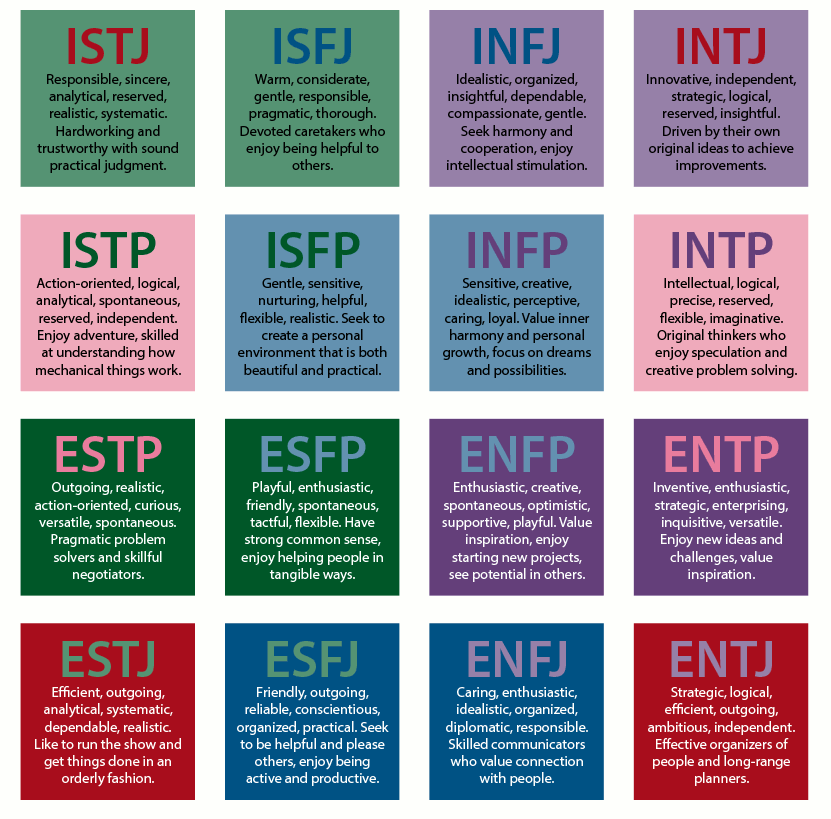
The MBTI personality classification system grew out with Jungian psychoanalytic psychology as a systematization of archetypal personality types. The system is divided along four binary orthogonal personality dimensions, altogether comprising a total of a 16 distinct personality types.The dimensions are the following:
- Extraversion (E) vs Introvertion (I): a measure of how much an individual prefers their outer or inner world.
- Sensing (S) vs Intuition (N): a measure of how much an individual processes information through the five senses versus impressions through patterns.
- Thinking (T) vs Feeling (F): a measure of preference for objective principles and facts versus weighing the emotional perspectivers of others.
- Judging (J) vs Perceiving (P): a measure of hoe much an individual prefers a planned ans ordered life versus a flexible and spontaneous life.
In the first place, I analyse the dataset to have a first impression of the data. Afterwards, the second step is to clean the posts column, deleting separations tabs, urls, @ and other information that is irrelevant for the model. I didn't remove stop words, tokenize the words or lemmatize them, due to the preprocessing model used doesn't need this steps.
Once we have our cleaned data and our labels in numbers, this step is the most controversial because there are several preprocessing models and I had to choose the best that fits to my problem. After trying different models the best one was nnlm-en-dim50, a token based text embedding trained on English Google News published by Google. It is based on NNLM (Neural Network Language Model) with two hidden layers.
With tensorflow and keras I create a sequential model where I added the data that was before transform in arrays and two more dense layers. The optimizer I used is the Adam Optimation and metric, categorical accuracy beacause there are 16 different personality types.
Categorical results:
| Model | Train accuracy | Validation accuracy | Test accuracy |
|---|---|---|---|
| Categorical model | 56.65% | 35.97% | 37.58% |
Binary results:
| Model | Train accuracy | Validation accuracy | Test accuracy |
|---|---|---|---|
| Introvertion vs Extrovertion | 99.10% | 86.23% | 83.54% |
| Sensing vs Intuition | 86.72% | 86.11% | 85.24% |
| Thinking vs Feeling | 87.19% | 80.45% | 80.87% |
| Judging vs Perceiving | 59.87% | 60.23% | 61.77% |