


A high-performance msgpack library for Go, optimized for database and serialization-heavy workloads. Zero external dependencies.
Gives how standards proliferate vibes. s/standards/msgpack libraries/g
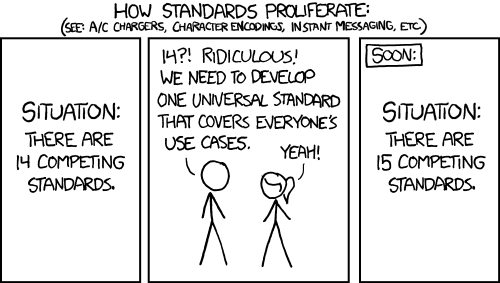
I built msgpck for tinykvs, a key-value store where msgpack encoding/decoding is on the hot path. I found issues with fuzz testing where vmihailenco would allocate excessively on big maps/arrays, and decided to check out the alternatives: shamaton/msgpack, hashicorp/go-msgpack, and tinylib/msgp. I didn't want code generation so tinylib/msgp was out. hashicorp/go-msgpack was slow. shamaton/msgpack was better but didn't compete with vmihailenco/msgpack on map[string]any performance. So I built msgpck focused on the common case: decoding known struct types and map[string]any with minimal allocations.
Benchmarks vs vmihailenco/msgpack (Apple M3 Max):
| Operation | msgpck | allocs |
|---|---|---|
| SmallStruct Encode | 61 ns | 1 |
| MediumStruct Encode | 226 ns | 1 |
| SmallStruct Decode | 65 ns | 2 |
SmallStruct Decode (zeroCopy: true) |
50 ns | 1 |
| MediumStruct Decode | 446 ns | 13 |
MediumStruct Decode (zeroCopy: true) |
338 ns | 4 |
| Operation | msgpck | allocs |
|---|---|---|
| LargeStruct Encode (cached) | 768 ns | 9 |
| LargeStruct Decode (cached) | 1169 ns | 30 |
LargeStruct Decode (zeroCopy: true) |
839 ns | 6 |
| Operation | msgpck | allocs |
|---|---|---|
| 1M int64 Encode | 8.7 ms | 1 |
| 1M int64 Decode | 7.2 ms | 3 |
| 1M uint16 Encode | 8.6 ms | 1 |
| 1M uint16 Decode | 6.2 ms | 2 |
| Operation | msgpck | allocs |
|---|---|---|
SmallMap Encode (Marshal) |
82 ns | 1 |
MediumMap Encode (Marshal) |
251 ns | 1 |
SmallMap Decode (Unmarshal) |
336 ns | 10 |
MediumMap Decode (Unmarshal) |
1235 ns | 40 |
StringMap Decode (Unmarshal) |
532 ns | 19 |
Run benchmarks yourself:
go test -bench=. -benchmemimport "github.com/freeeve/msgpck"
// Encode any value
data, _ := msgpck.Marshal(map[string]any{"name": "Alice", "age": 30})
// Decode to map
var m map[string]any
msgpck.Unmarshal(data, &m)
// Decode to struct
var user User
msgpck.Unmarshal(data, &user)For hot paths, use cached codecs that avoid reflection on every call:
// Get cached encoder/decoder (created on first use, reused forever)
enc := msgpck.GetStructEncoder[User]()
dec := msgpck.GetStructDecoder[User](false)

// Encode - 0 allocations with pooled buffer
data, _ := enc.Encode(&user)

// Decode - minimal allocations
var user User
dec.Decode(data, &user)When your input buffer outlives the decoded result (common in databases), skip string allocations entirely:
// Get cached zero-copy decoder
dec := msgpck.GetStructDecoder[User](true)

// Strings point directly into 'data' - no copies
dec.Decode(data, &user)Warning: Zero-copy strings are only valid while the input buffer exists. Copy strings if you need them to outlive the buffer.
The struct encoder/decoder fully supports Go generics:
type SortColumn[T cmp.Ordered] struct {
    Values   []T    `msgpack:"values"`
    MaxDocID uint32 `msgpack:"max_doc_id"`
}

// Works with any concrete type
enc := msgpck.GetStructEncoder[SortColumn[int64]]()
dec := msgpck.GetStructDecoder[SortColumn[int64]](false)The cached struct codecs support:
- Primitives: all int/uint sizes (8/16/32/64), float32/64, bool, string
- Slices:
[]Tfor all primitive types,[]string,[]byte - Maps:
map[string]string,map[string]any, nested maps - Nested structs: automatically handled
- Pointers: pointer fields are supported
// Encode any Go value to msgpack (safe to retain, concurrent-safe)
msgpck.Marshal(v any) ([]byte, error)

// For hot paths: cached struct encoder
enc := msgpck.GetStructEncoder[MyStruct]()
enc.Encode(&src)         // safe to retain (1 alloc)
enc.EncodeWith(e, &src) // zero-alloc with your own EncoderThe API matches encoding/json:
// Decode to any type - structs, maps, slices, primitives
var user User
msgpck.Unmarshal(data, &user)

var m map[string]any
msgpck.Unmarshal(data, &m)

var s map[string]string
msgpck.Unmarshal(data, &s)

// For hot paths: cached struct decoder
dec := msgpck.GetStructDecoder[MyStruct](false)
dec.Decode(data, &dst)

// Zero-copy cached decoder (strings point into input buffer)
dec := msgpck.GetStructDecoder[MyStruct](true)
dec.Decode(data, &dst)msgpck supports the msgpack timestamp extension type (-1). Times are encoded using the most compact format and decoded to UTC:
// Encode a time.Time
data := msgpck.MarshalTimestamp(time.Now())

// Decode back to time.Time (UTC)
t, _ := msgpck.UnmarshalTimestamp(data)

// Streaming API
enc := msgpck.NewEncoder(nil)
enc.EncodeTimestamp(time.Now())

dec := msgpck.NewDecoder(data)
t, _ := dec.DecodeTimestamp()

// Convert extension values
ext, _ := dec.DecodeExt()
if msgpck.IsTimestamp(ext) {
    t, _ := msgpck.ExtToTimestamp(ext)
}All public APIs are concurrent-safe:
MarshalandUnmarshalfunctions use internal poolsGetStructEncoder[T](),GetStructDecoder[T](zeroCopy)return cached, thread-safe codecsStructEncoderandStructDecoderinstances are safe to use from multiple goroutines
Use msgpck when:
- Encoding/decoding is on your hot path
- You decode the same struct types repeatedly
- You can benefit from zero-copy (database, network buffers)
- You need minimal allocations
Use vmihailenco/msgpack when:
- You need custom encoders/decoders for complex types
- You're decoding unknown/dynamic schemas
- Convenience matters more than raw speed
msgpck produces standard msgpack bytes. Data encoded with vmihailenco/msgpack decodes correctly with msgpck and vice versa.
MIT