



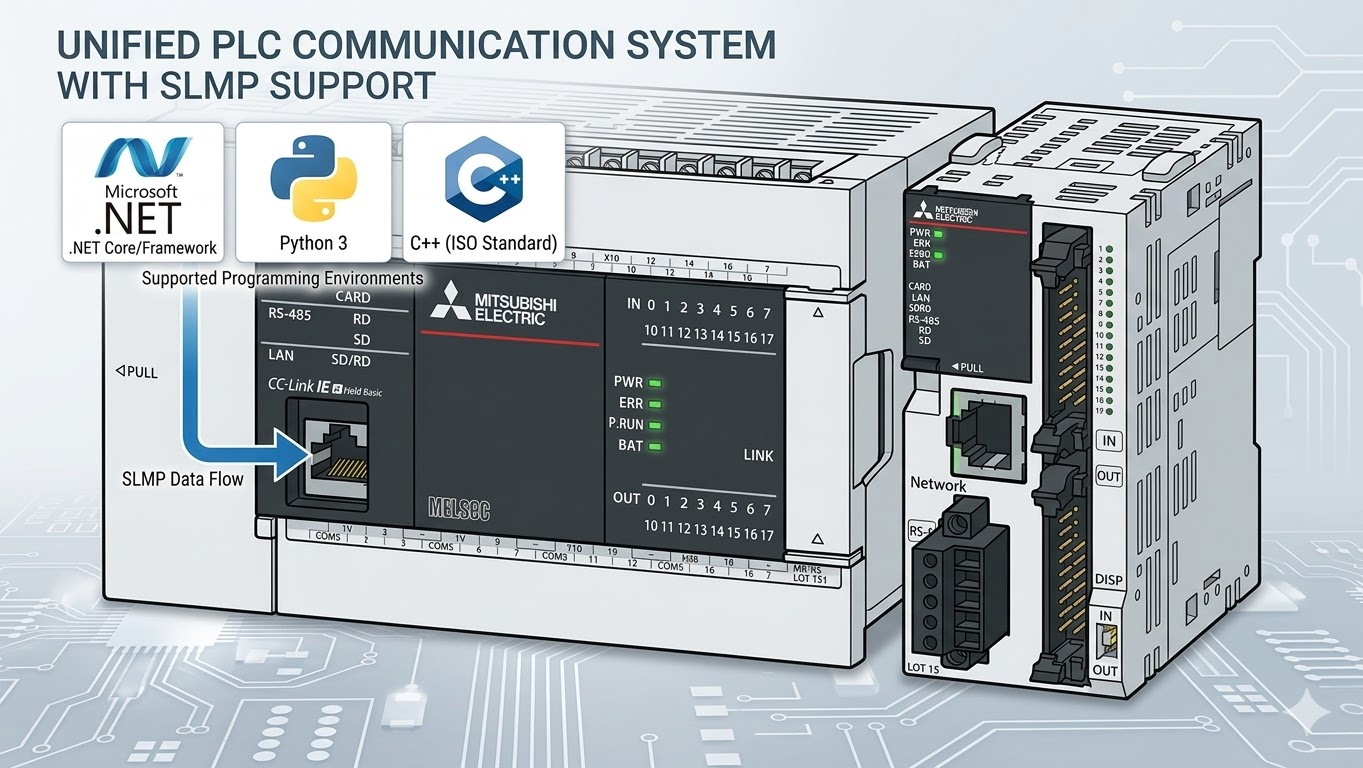
High-level SLMP helpers for Mitsubishi PLC communication over Binary 3E and 4E frames.
This repository treats the high-level helper layer as the recommended user surface:
SlmpConnectionOptionsopen_and_connect/open_and_connect_syncAsyncSlmpClientQueuedAsyncSlmpClientSlmpClientnormalize_addressread_typed/write_typedread_words_single_request/read_dwords_single_requestread_words_chunked/read_dwords_chunkedwrite_bit_in_wordread_named/write_namedpoll
pip install slmp-connect-pythonThe latest release lives at https://pypi.org/project/slmp-connect-python/, where wheel and tarball downloads and metadata are available.
Recommended async path:
import asyncio

from slmp import SlmpConnectionOptions, open_and_connect, read_named, write_typed


async def main() -> None:
    options = SlmpConnectionOptions(
        host="192.168.250.100",
        plc_family="iq-f",
        port=1025,
    )
    async with await open_and_connect(options) as client:
        before = await read_named(client, ["D100", "D200:F", "D50.3"])
        print("before:", before)

        await write_typed(client, "D100", "U", 42)

        after = await read_named(client, ["D100", "D200:F", "D50.3"])
        print("after:", after)


asyncio.run(main())
Choose canonical plc_family explicitly.
In the recommended high-level helper layer, the only PLC selector is plc_family.
For normal application code:
- set
plc_family - let the library derive the fixed frame type, access profile,
X/Ytext rule, and device-range family - do not pass raw
frame_type,plc_series, ordevice_family
plc_family |
Derived frame_type |
Derived access_profile |
X / Y text |
Derived range family | Notes |
|---|---|---|---|---|---|
iq-f |
3e |
ql |
octal | iq-f |
live-validated |
iq-r |
4e |
iqr |
hexadecimal | iq-r |
live-validated |
iq-l |
4e |
iqr |
hexadecimal | iq-r |
live-validated on L16HCPU |
mx-f |
4e |
iqr |
hexadecimal | mx-f |
provisional; review in TODO.md |
mx-r |
4e |
iqr |
hexadecimal | mx-r |
provisional; review in TODO.md |
qcpu |
3e |
ql |
hexadecimal | qcpu |
retained path |
lcpu |
3e |
ql |
hexadecimal | lcpu |
retained path |
qnu |
3e |
ql |
hexadecimal | qnu |
retained path |
qnudv |
3e |
ql |
hexadecimal | qnudv |
retained path |
Low-level compatibility tools may still work with raw frame_type / plc_series, but that is not the normal public helper path.
High-level accepted plc_family values:
| Canonical | Typical target | Notes |
|---|---|---|
iq-f |
FX5 / iQ-F | X / Y use manual octal text |
iq-r |
iQ-R | X / Y use hexadecimal text |
iq-l |
iQ-L | mapped to the iq-r range rules; live-validated on L16HCPU |
mx-f |
MX-F | pending live validation |
mx-r |
MX-R | pending live validation |
qcpu |
QCPU | 3e/ql fixed profile |
lcpu |
LCPU | 3e/ql fixed profile |
qnu |
QnU | 3e/ql fixed profile |
qnudv |
QnUDV | 3e/ql fixed profile |
Practical rules:
- non-
iQ-FX/Y: text such asX20/Y20is interpreted as hexadecimal iQ-F/ FX5X/Y: text such asX100/Y100is interpreted as manual octal notation and encoded to the binary numeric value- example:
X100oniQ-Fbecomes binary device number0x40 - if you pass a numeric
DeviceRef, string notation is already resolved, soplc_familyis not needed for that one address - short aliases such as
iqf,iqr,q,l, andqnudvcpuare rejected
Start with these public high-level families first:
- word devices:
D,SD,R,ZR,TN,CN - bit devices:
M,X,Y,SM,B - typed forms:
D200:F,D300:L,D100:S - mixed snapshot forms:
D50.3,D100,D200:F - current-value long families:
LTN,LSTN,LCN
See the full public table in Supported PLC Registers.
- Getting Started
- Supported PLC Registers
- Latest Communication Verification
- User Guide
- Samples
- Error Codes
Maintainer-only notes and retained evidence live under internal_docs/.
from slmp import normalize_address

print(normalize_address("x20"))   # X20
print(normalize_address("d200"))  # D200
print(normalize_address("x100", plc_family="iq-f")) # X100from slmp import read_typed, write_typed
temperature = await read_typed(client, "D200", "F")
counter = await read_typed(client, "D300", "L")
await write_typed(client, "D100", "U", 1234)Use .bit notation only with word devices such as D50.3.
Address bit devices directly as M1000, M1001, X20, or Y20.
For communication, X / Y string addresses require explicit plc_family.
Use plc_family and read the derived family SD block once.
from slmp import SlmpClient

with SlmpClient("192.168.250.100", 1025, plc_family="qnu") as client:
    catalog = client.read_device_range_catalog()
    for entry in catalog.entries:
        print(entry.device, entry.point_count, entry.address_range)
This path does not call read_type_name(). The client uses the fixed range family derived from plc_family.
run_ci.bat
build_docs.bat
release_check.batDistributed under the MIT License.