



The Cyber Security Awareness Framework (CSAF) is a structured approach aimed at enhancing cybersecurity awareness and understanding among individuals, organizations, and communities. It provides guidance for the development of effective cybersecurity awareness programs, covering key areas such as assessing awareness needs, creating educational materials, conducting training and simulations, implementing communication campaigns, and measuring awareness levels. By adopting this framework, organizations can foster a robust security culture, enhance their ability to detect and respond to cyber threats, and mitigate the risks associated with attacks and security breaches.
- Docker
- Docker Compose plugin
- 8 Core CPU
- 16GB RAM
- 128GB Disk free
- 12 Core CPU or above
- 32GB RAM or above
- 256GB Disk free or above
Clone the repository
git clone https://github.com/csalab-id/csaf.git
Navigate to the project directory
cd csaf
Pull the Docker images
docker compose --profile=all pull
Generate Wazuh SSL certificate
docker compose -f generate-certs.yml run --rm generator
Create a local environment file for Docker Compose:
cp .env.example .env
Update values in .env as needed, or use shell exports below.
Set these before running Docker Compose (defaults come from docker-compose.yml):
- ATTACK_PASS / DEFENSE_PASS / MONITOR_PASS: VNC passwords for attack, defense, and monitor hosts (defaults: attackpassword, defensepassword, monitorpassword)
- SPLUNK_PASS: Splunk admin password (default: splunkpassword)
- VELOX_PASS: Velociraptor admin password (default: veloxpassword)
- GOPHISH_PASS: Initial Gophish admin password (default: gophishpassword)
- MAIL_PASS: First mail domain admin password for iRedMail (default: mailpassword)
- PHISHING_URL: Target URL to clone for the phishing page (default: https://gmail.com/)
- PHISHING_TITLE: Page title for the phishing site (default: Gmail)
- PHISHING_FAVICON: Favicon URL for the phishing site (default: https://www.google.com/favicon.ico)
- BIND_ADDR: Bind address for exposed attack/defense/monitor services (default: 0.0.0.0)
Example:
export ATTACK_PASS=ChangeMePlease
export DEFENSE_PASS=ChangeMePlease
export MONITOR_PASS=ChangeMePlease
export SPLUNK_PASS=ChangeMePlease
export VELOX_PASS=ChangeMePlease
export GOPHISH_PASS=ChangeMePlease
export MAIL_PASS=ChangeMePlease
export PHISHING_URL=https://example.com/
export PHISHING_TITLE="Example Login"
export PHISHING_FAVICON=https://example.com/favicon.ico
export BIND_ADDR=127.0.0.1
Start all the containers
docker compose --profile=all up -d
You can run specific labs with these profiles
- all
- attackdefenselab
- phishinglab
- breachlab
- soclab
- ransomwarelab
For example
docker compose --profile=attackdefenselab up -d
- all: Starts every service in the stack.
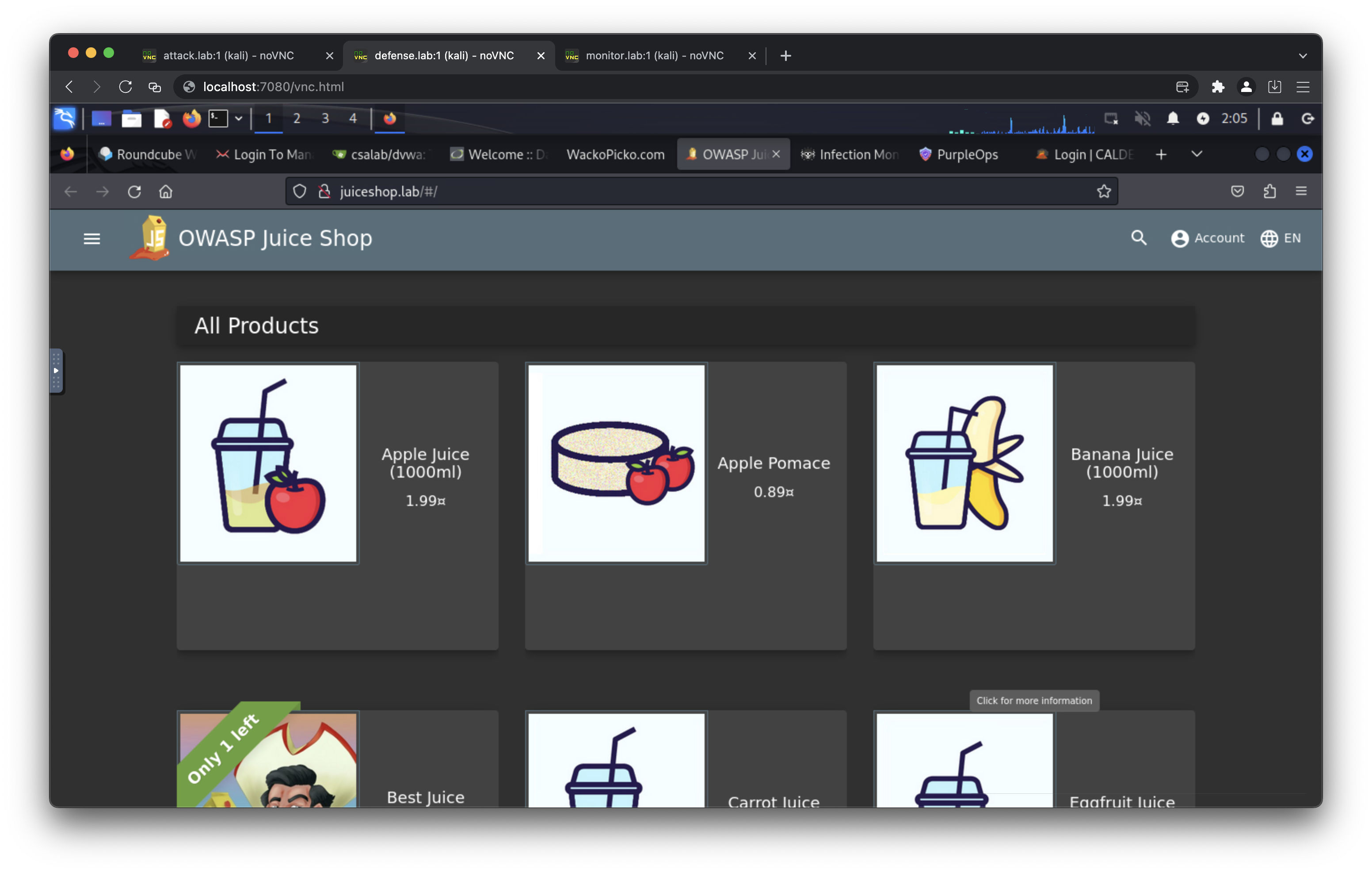
- attackdefenselab: Attack/Defense desktops, DVWA (+ secure + ModSecurity), WackoPicko, Juice Shop, Gitea, MariaDB.
- attackdefenselab: Attack/Defense desktops, DVWA (+ secure + ModSecurity), WackoPicko, Juice Shop, Gitea, MariaDB, Bunkerweb (reverse proxy/WAF).
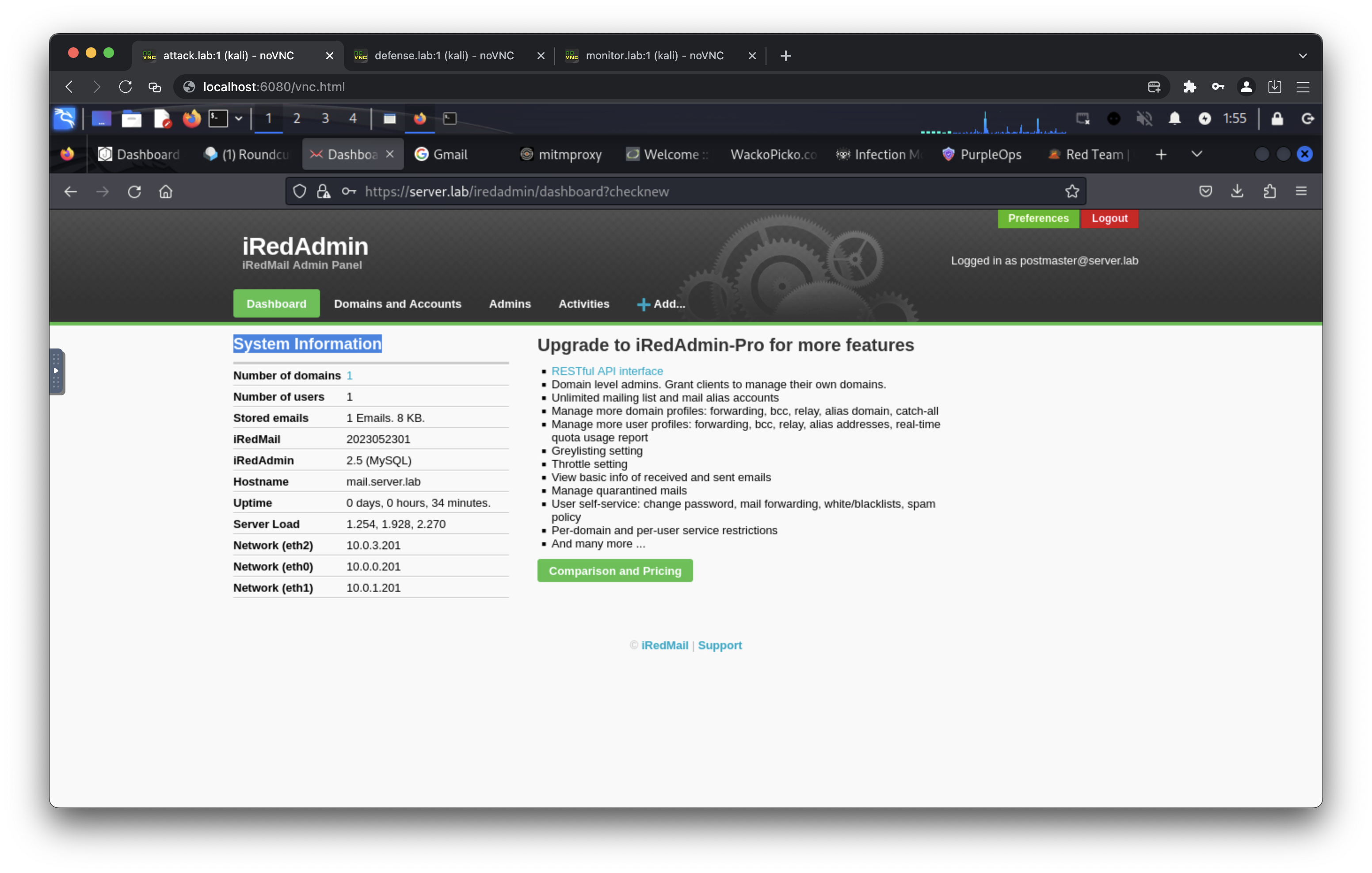
- phishinglab: Attack desktop, Gophish, Phishing site, iRedMail server.
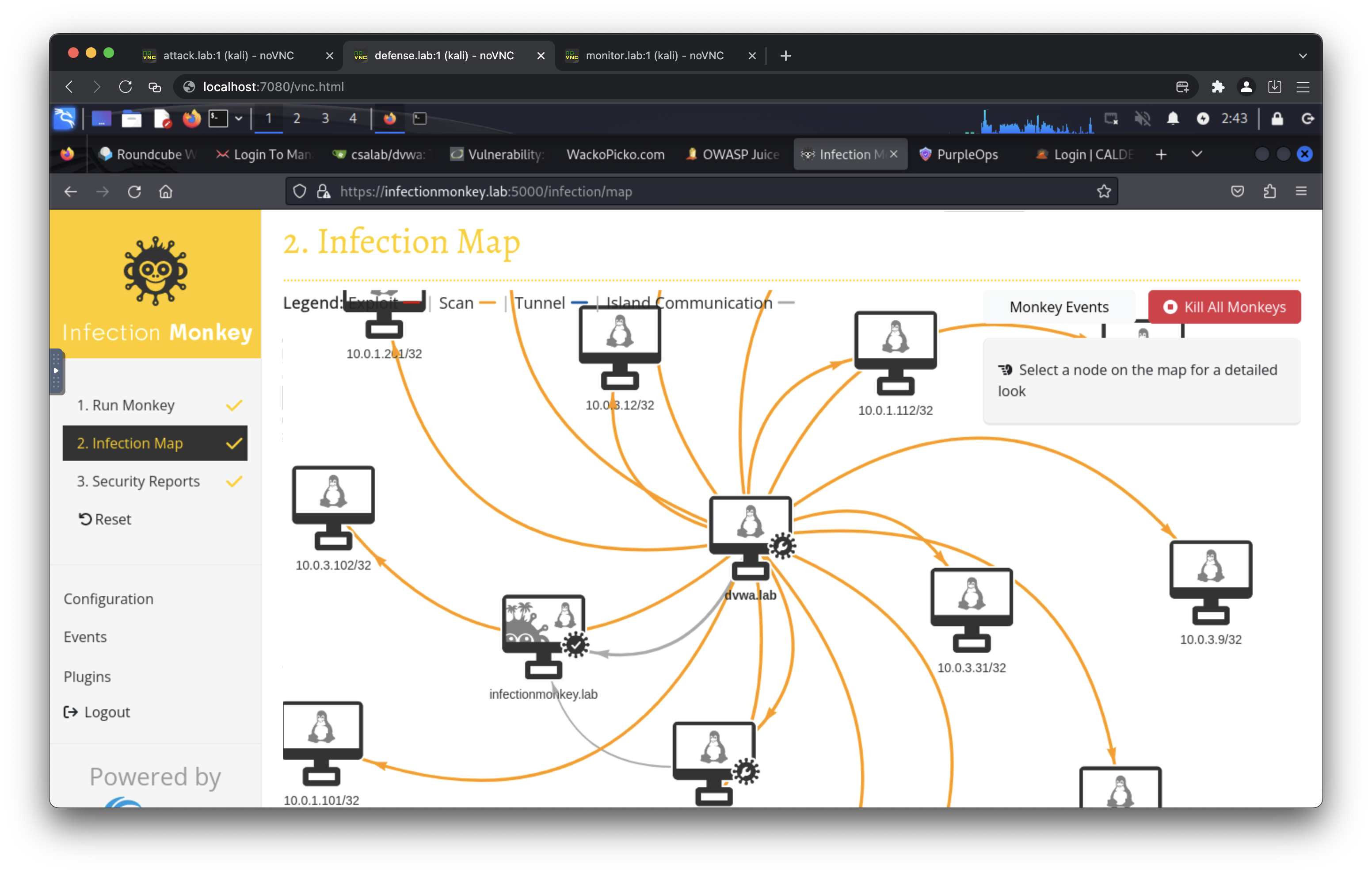
- breachlab: Attack/Defense desktops, DVWA, WackoPicko, Infection Monkey, MongoDB, Caldera.
- soclab: Monitor desktop, DVWA (+ secure + ModSecurity), Juice Shop, MariaDB, Wazuh (manager/indexer/dashboard), Splunk, Velociraptor, Bunkerweb (reverse proxy/WAF).
- ransomwarelab: Attack/Defense/Monitor desktops, Ransomware service.
- Desktops:
attack.lab(VNC on 6080),defense.lab(7080),monitor.lab(8080). - Web apps:
dvwa.lab,wackopicko.lab,juiceshop.lab,gitea.lab. - Mail/Phishing:
mail.server.lab(iRedMail),gophish.lab,phishing.lab. - Breach simulation:
infectionmonkey.lab,mongodb.lab,caldera.lab. - Ransomware:
ransomware.lab. - SOC tooling:
wazuh-manager.lab,wazuh-indexer.lab,wazuh-dashboard.lab,splunk.lab,velociraptor.lab. - Security/Proxy:
bunkerweb.labreverse proxy/WAF for DVWA, Juice Shop, and WackoPicko. Setup UI:https://bunkerweb.lab/setup. Aliases:dvwa-bunkerweb.lab,juiceshop-bunkerweb.lab,wackopicko-bunkerweb.lab.
- VNC:
attackpassword/defensepassword/monitorpassword(override via env). - DVWA, WackoPicko, Juice Shop: default app passwords per app (see Domain Access list).
- Gitea:
csalab/giteapassword. - Gophish: admin password from
GOPHISH_PASS. - iRedMail:
postmaster@server.lab/mailpassword. - Splunk:
admin/splunkpassword. - Velociraptor:
admin/veloxpassword. - Wazuh Dashboard/Indexer:
admin/SecretPassword.
- attack: 10.0.0.0/24 (external lab attack network).
- defense: 10.0.1.0/24 (internal true) defense network.
- public: 10.0.2.0/24 (public-exposed subset).
- monitor: 10.0.3.0/24 (internal true) monitoring network.
- internet: 10.0.4.0/24 (simulated internet facing network).
- internal: 10.0.5.0/24 (service-to-service internal).
- Volumes keep state for databases and apps (MariaDB, Wazuh, Splunk, Gitea, etc.).
- Reset lab state:
docker compose down -vremoves containers and volumes.
- Start (all):
docker compose --profile=all up -d. - Start (specific):
docker compose --profile=<profile> up -d. - Stop:
docker compose down. - Status:
docker compose ps. - Logs:
docker compose logs -f <service>.
- Certificates: Run
docker compose -f generate-certs.yml run --rm generatorbefore first SOC lab start. - Bind address: Set
BIND_ADDR=127.0.0.1to bind services locally. - Port conflicts: Change host ports or stop conflicting processes.
- Clean slate: Use
docker compose down -vto wipe persistent data.
- Change all default passwords via
.envbefore exposing services. - Avoid exposing services broadly; prefer
BIND_ADDR=127.0.0.1and access via SOCKS5 or SSH. - Be cautious with email and phishing services; use test domains and isolated networks only.
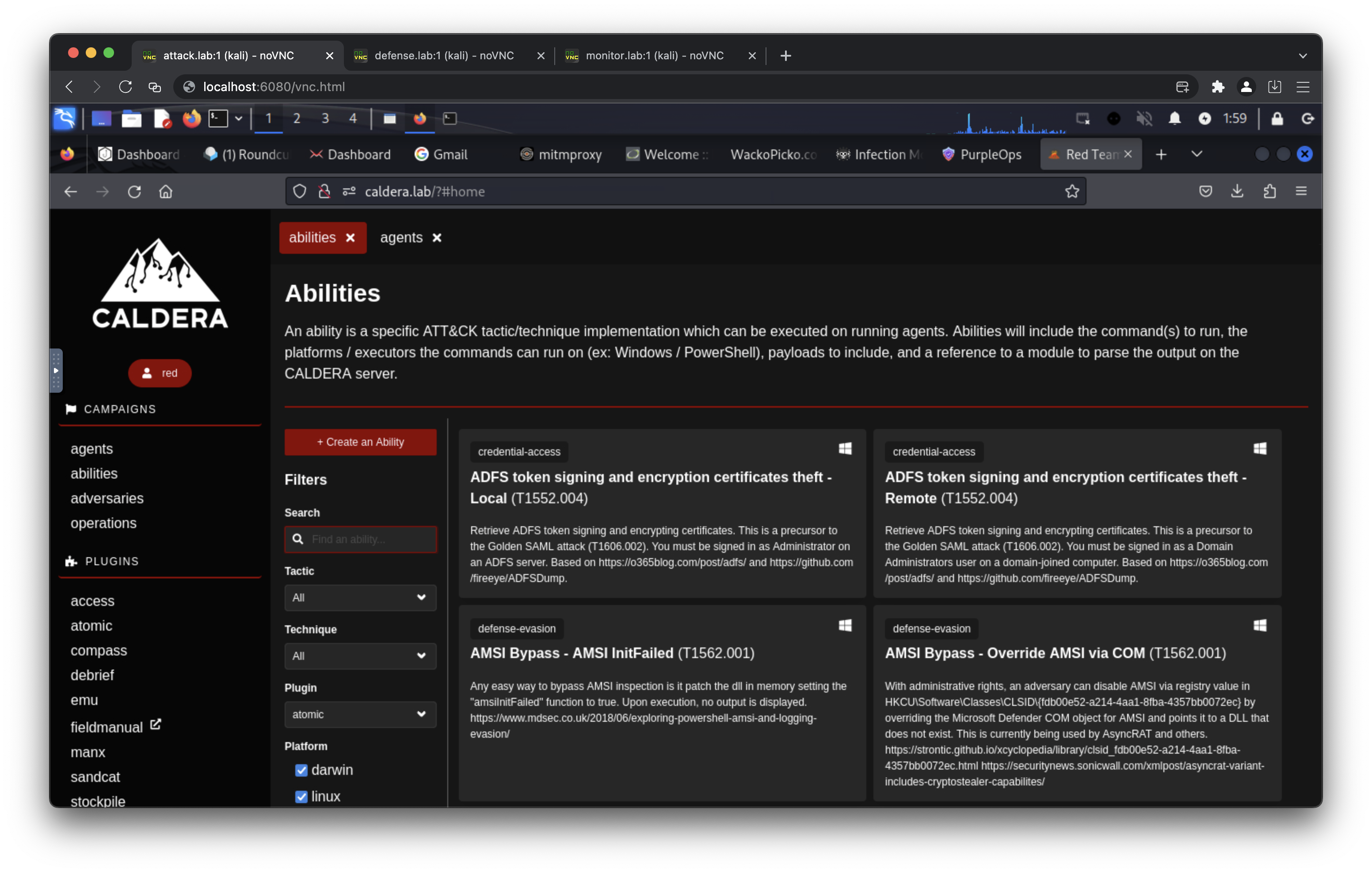
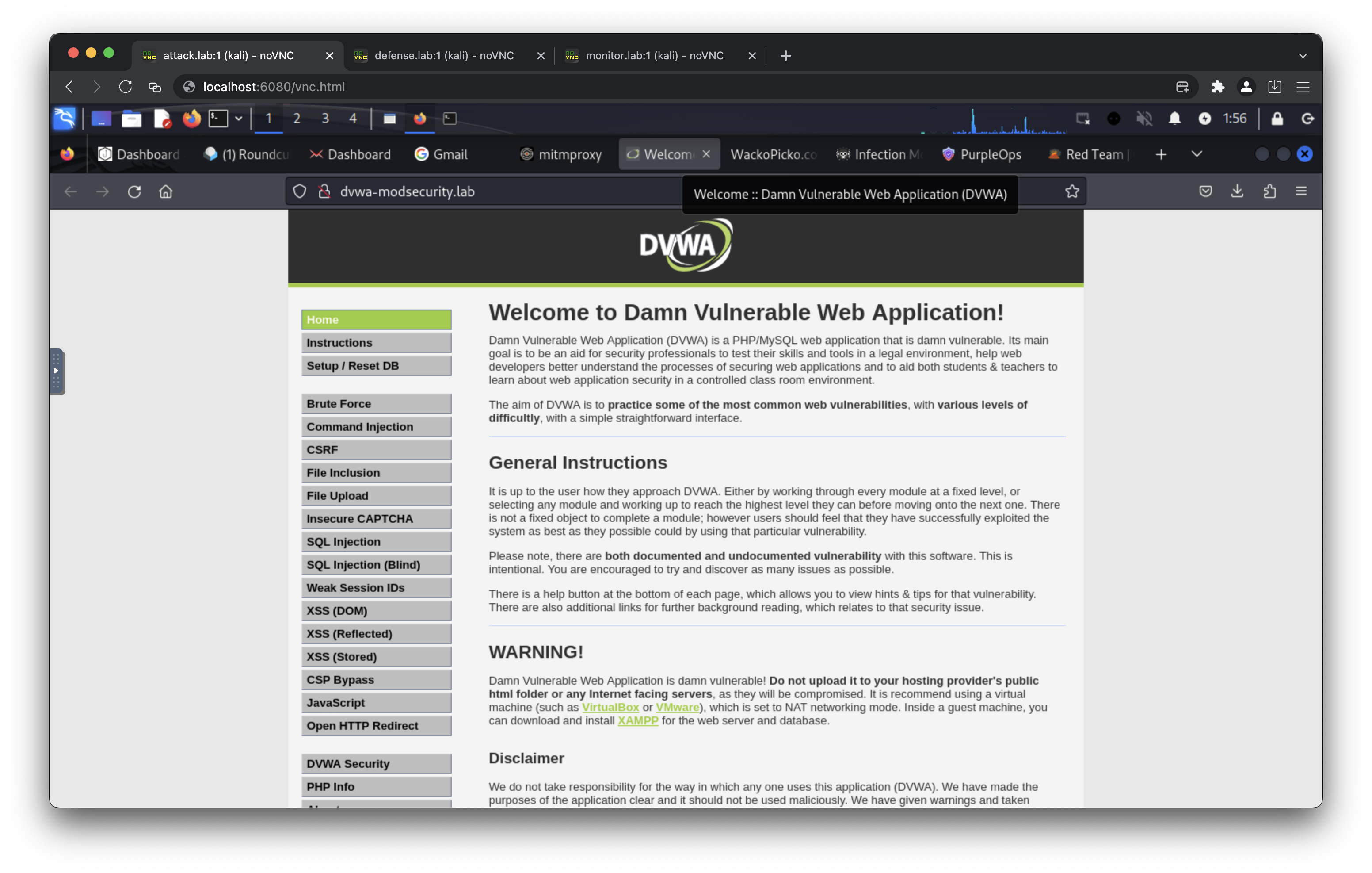
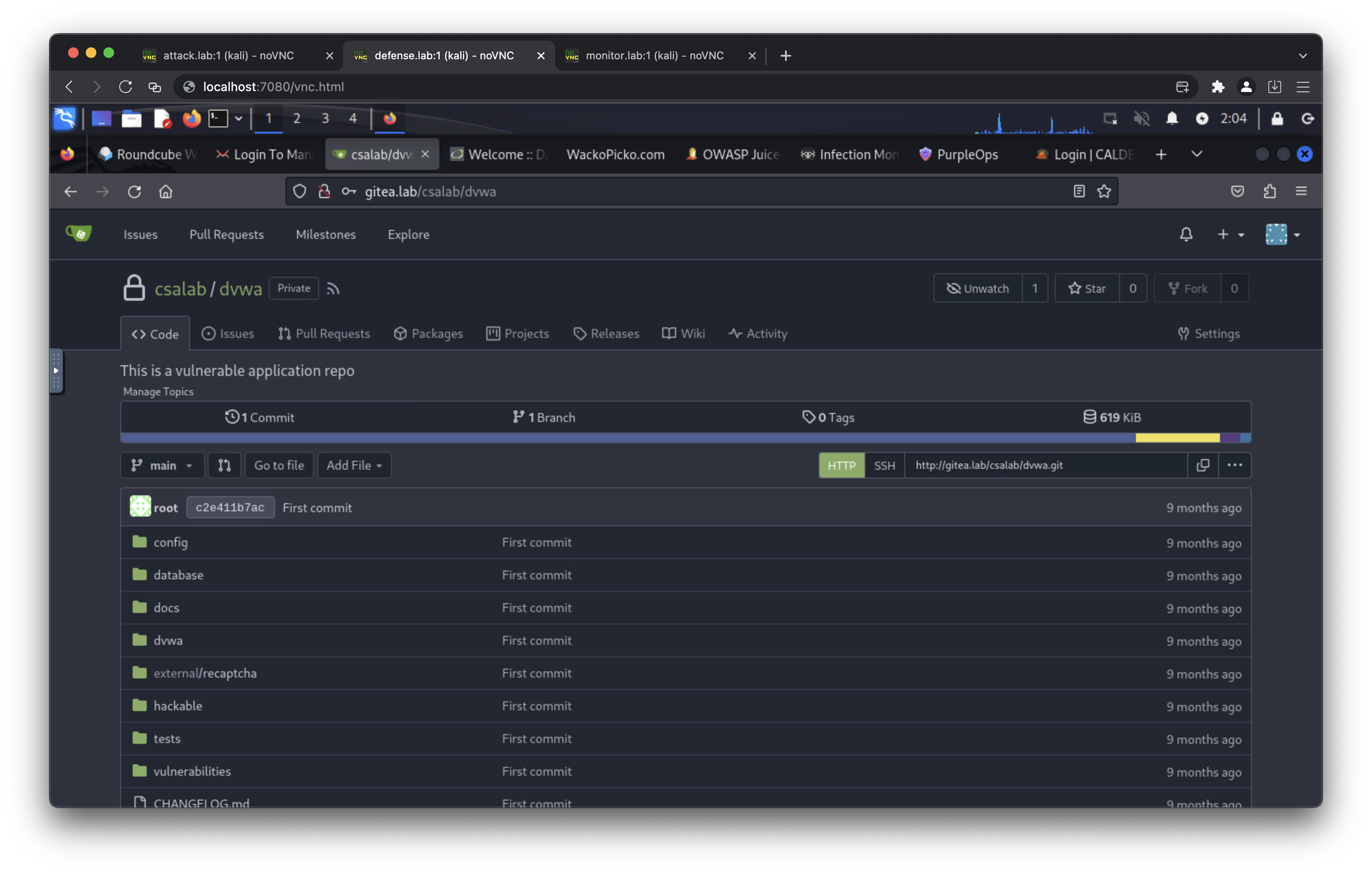
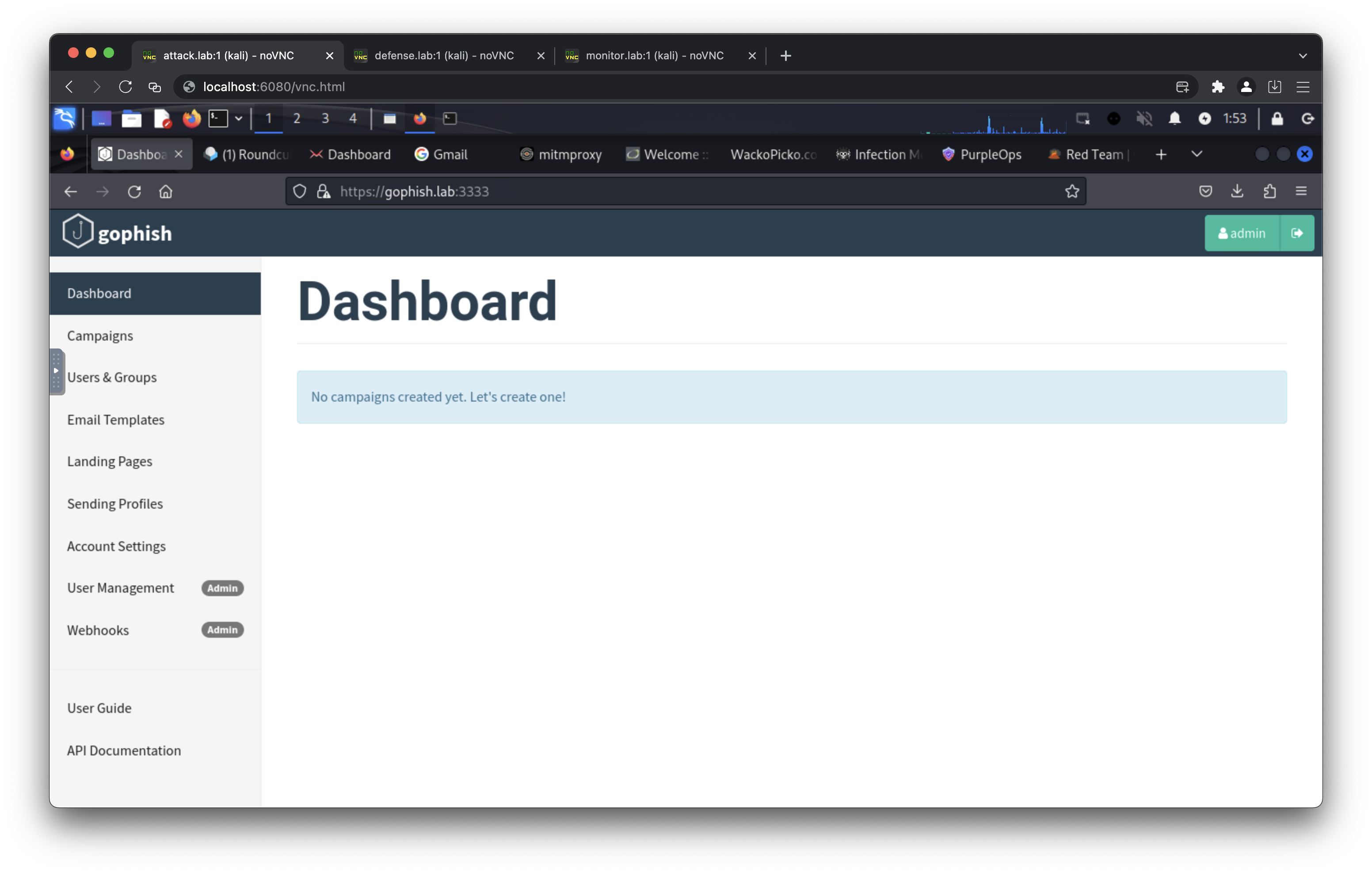
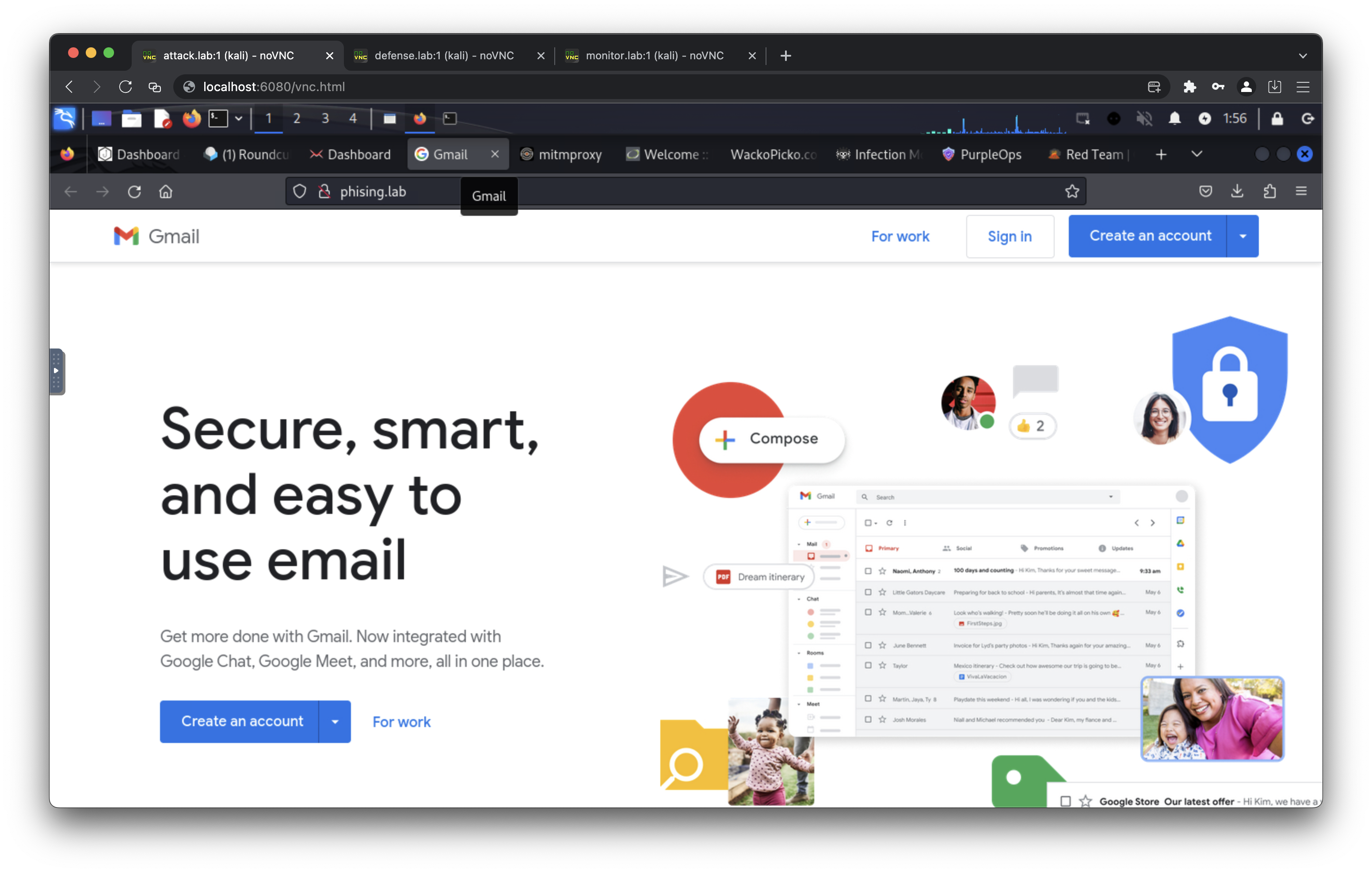
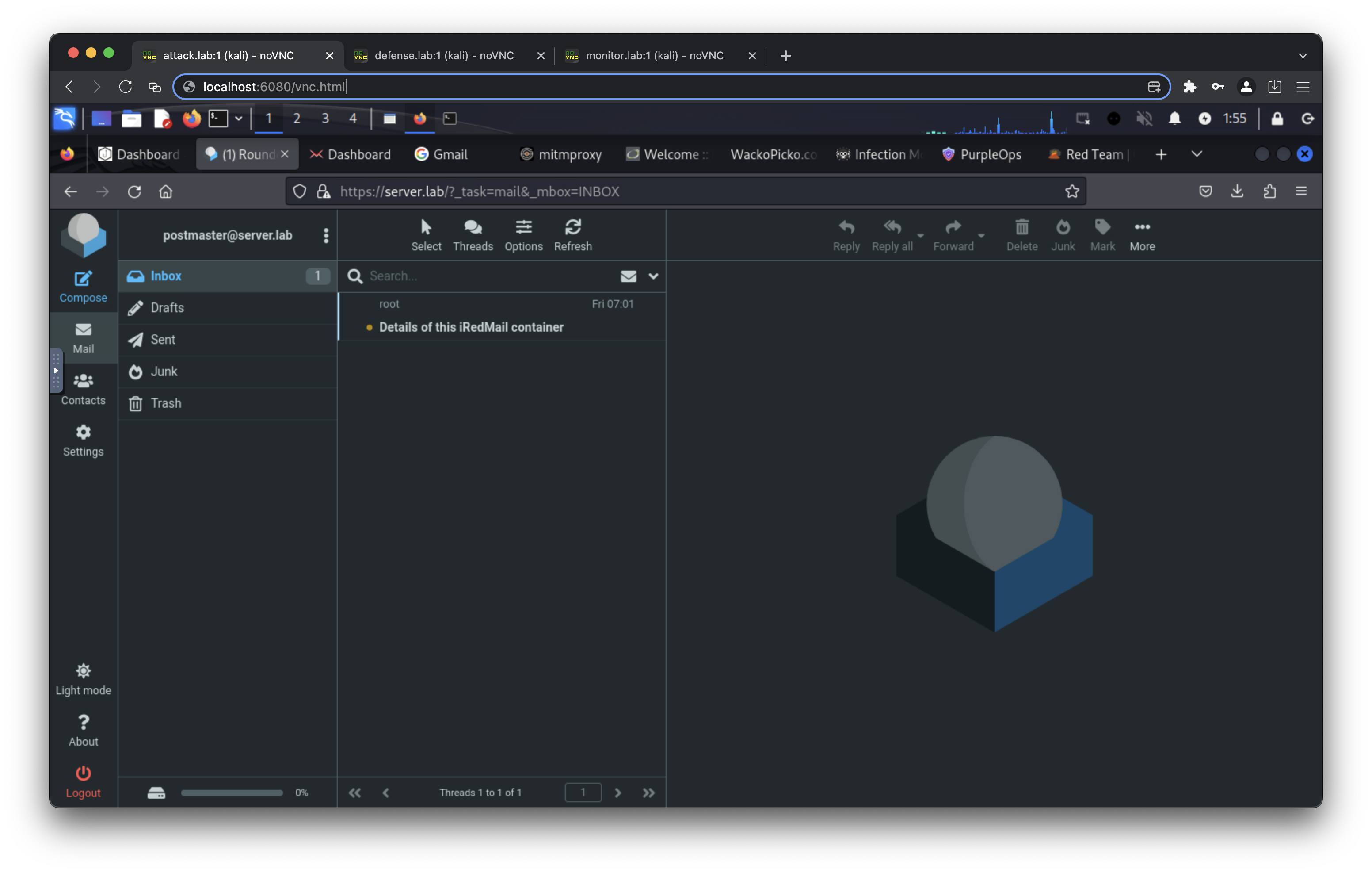
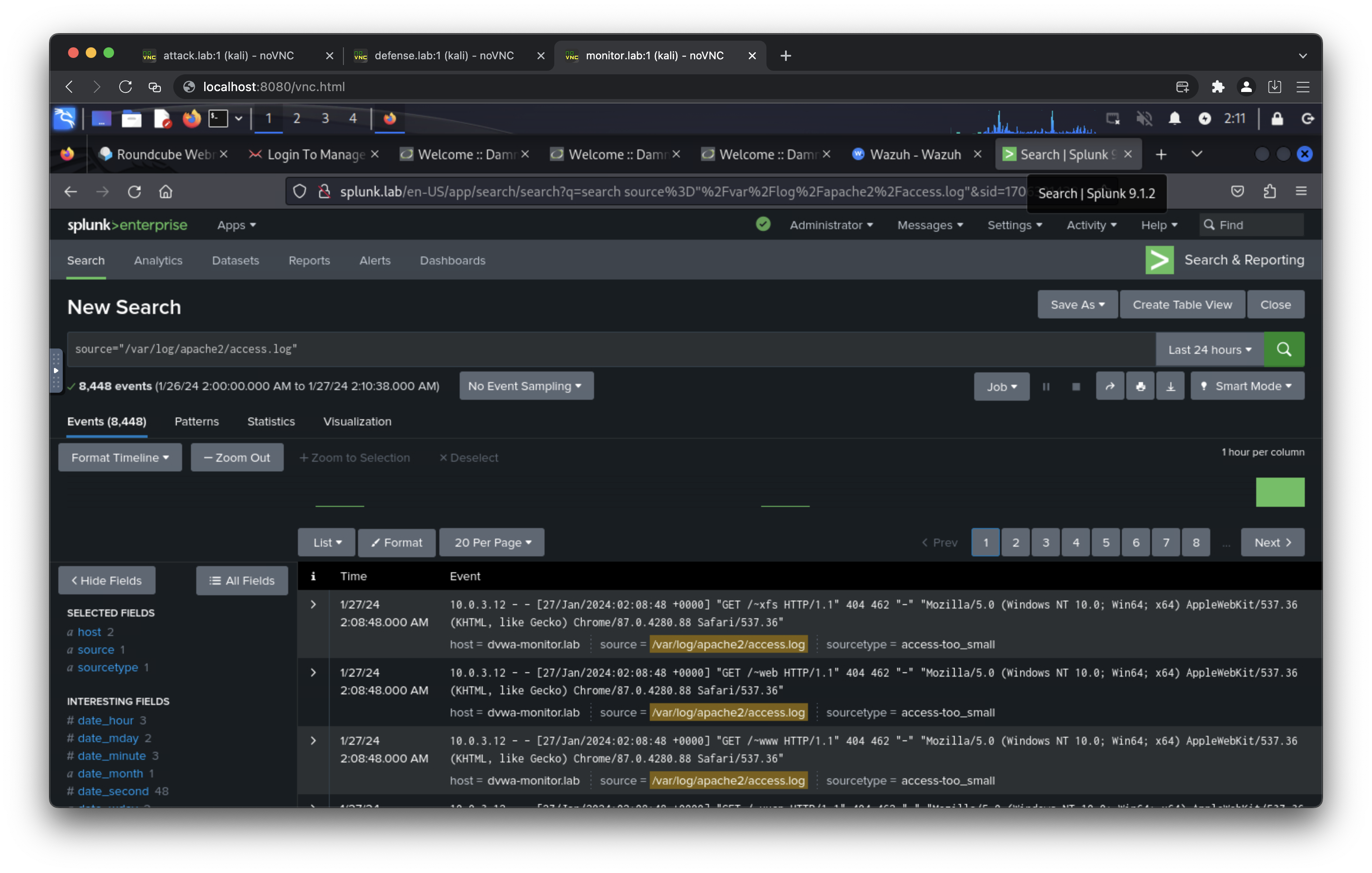
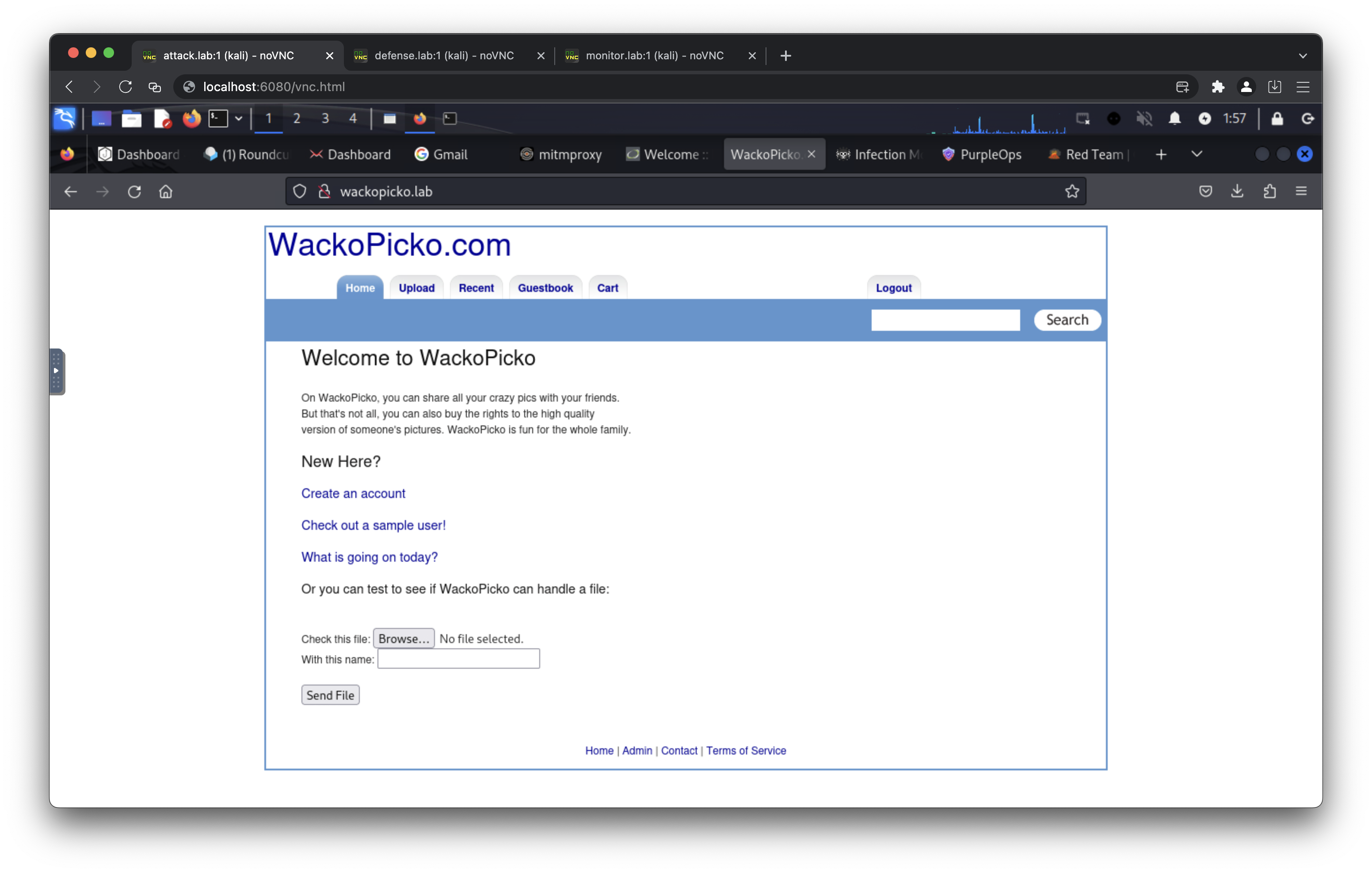
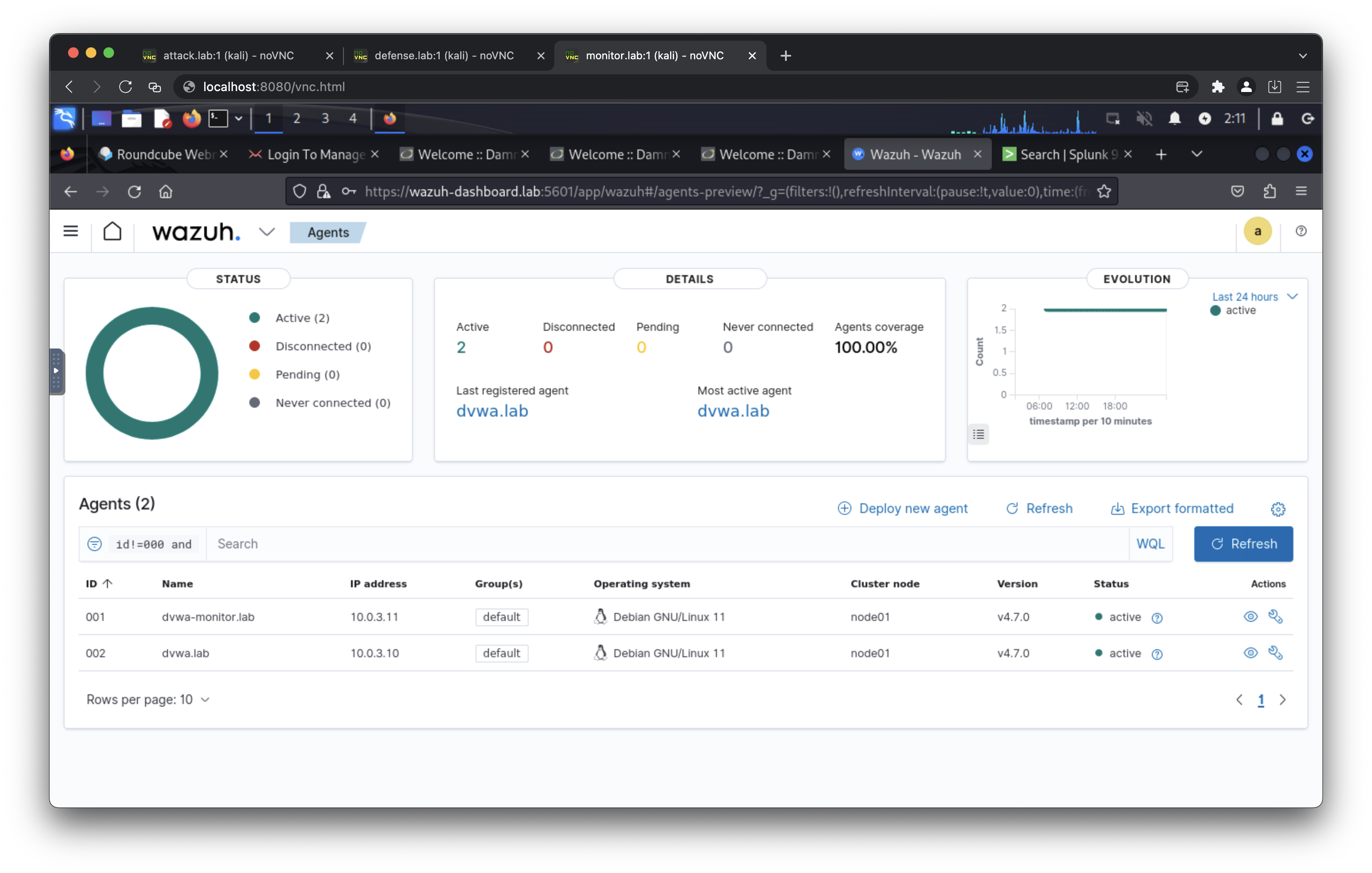
An exposed port can be accessed using a SOCKS5 proxy, SSH client, or HTTP client. Choose one for the best experience.
- Port 6080 (Access to attack network)
- Port 7080 (Access to defense network)
- Port 8080 (Access to monitor network)
- curl --proxy socks5://ipaddress:6080 http://10.0.0.100/vnc.html
- curl --proxy socks5://ipaddress:7080 http://10.0.1.101/vnc.html
- curl --proxy socks5://ipaddress:8080 http://10.0.3.102/vnc.html
- ssh kali@ipaddress -p 6080 (default password: attackpassword)
- ssh kali@ipaddress -p 7080 (default password: defensepassword)
- ssh kali@ipaddress -p 8080 (default password: monitorpassword)
- curl http://ipaddress:6080/vnc.html
- curl http://ipaddress:7080/vnc.html
- curl http://ipaddress:8080/vnc.html
- http://attack.lab/vnc.html (default password: attackpassword)
- http://defense.lab/vnc.html (default password: defensepassword)
- http://monitor.lab/vnc.html (default password: monitorpassword)
- https://gophish.lab/ (default username: admin, default password: gophishpassword)
- https://server.lab/ (default username: postmaster@server.lab, default password: mailpassword)
- https://server.lab/iredadmin/ (default username: postmaster@server.lab, default password: mailpassword)
- https://mail.server.lab/ (default username: postmaster@server.lab, default password: mailpassword)
- https://mail.server.lab/iredadmin/ (default username: postmaster@server.lab, default password: mailpassword)
- http://phishing.lab/
- http://ransomware.lab/
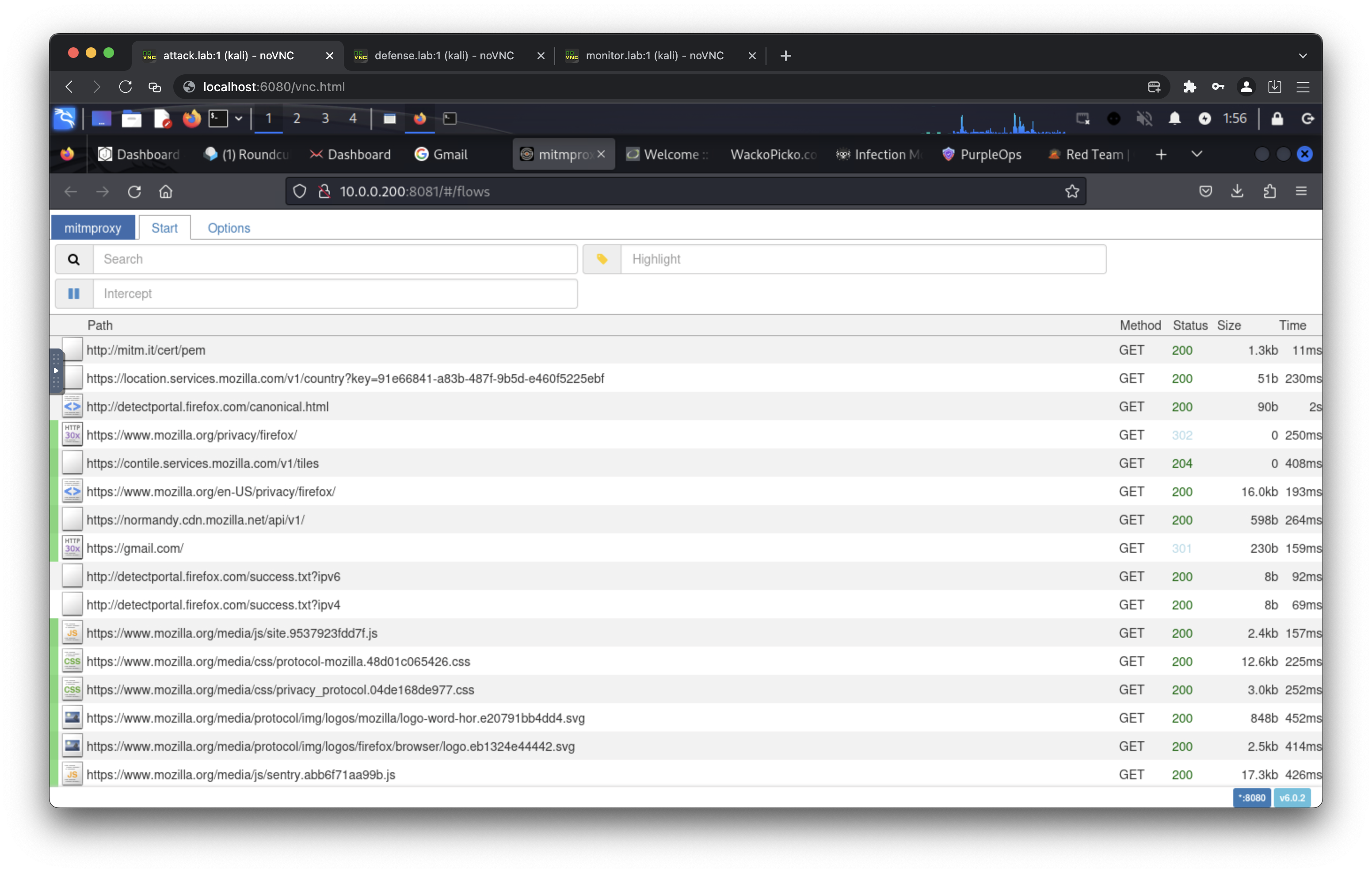
- http://10.0.0.200:8081/
- http://gitea.lab/ (default username: csalab, default password: giteapassword)
- http://dvwa.lab/ (default username: admin, default password: password)
- http://dvwa-monitor.lab/ (default username: admin, default password: password)
- http://dvwa-modsecurity.lab/ (default username: admin, default password: password)
- https://bunkerweb.lab/setup
- http://dvwa-bunkerweb.lab/ (default username: admin, default password: password)
- http://wackopicko-bunkerweb.lab/
- http://juiceshop-bunkerweb.lab/
- http://wackopicko.lab/
- http://juiceshop.lab/
- https://wazuh-indexer.lab:9200/ (default username: admin, default password: SecretPassword)
- https://wazuh-manager.lab/
- https://wazuh-dashboard.lab/ (default username: admin, default password: SecretPassword)
- http://splunk.lab/ (default username: admin, default password: splunkpassword)
- https://velociraptor.lab/ (default username: admin, default password: veloxpassword)
- https://infectionmonkey.lab:5000/
- http://caldera.lab/ (default username: red/blue, default password: calderapassword)
- 10.0.0.100 attack.lab
- 10.0.0.200 phishing.lab
- 10.0.0.201 server.lab
- 10.0.0.201 mail.server.lab
- 10.0.0.202 gophish.lab
- 10.0.0.203 ransomware.lab
- 10.0.0.110 infectionmonkey.lab
- 10.0.0.111 mongodb.lab
- 10.0.0.113 caldera.lab
- 10.0.1.101 defense.lab
- 10.0.1.10 dvwa.lab
- 10.0.1.13 wackopicko.lab
- 10.0.1.14 juiceshop.lab
- 10.0.1.20 gitea.lab
- 10.0.1.21 bunkerweb.lab
- 10.0.1.21 dvwa-bunkerweb.lab
- 10.0.1.21 wackopicko-bunkerweb.lab
- 10.0.1.21 juiceshop-bunkerweb.lab
- 10.0.1.110 infectionmonkey.lab
- 10.0.1.113 caldera.lab
- 10.0.1.203 ransomware.lab
- 10.0.3.201 server.lab
- 10.0.3.201 mail.server.lab
- 10.0.3.203 ransomware.lab
- 10.0.3.9 mariadb.lab
- 10.0.3.10 dvwa.lab
- 10.0.3.11 dvwa-monitor.lab
- 10.0.3.12 dvwa-modsecurity.lab
- 10.0.3.21 bunkerweb.lab
- 10.0.3.21 dvwa-bunkerweb.lab
- 10.0.3.21 wackopicko-bunkerweb.lab
- 10.0.3.21 juiceshop-bunkerweb.lab
- 10.0.3.102 monitor.lab
- 10.0.3.30 wazuh-manager.lab
- 10.0.3.31 wazuh-indexer.lab
- 10.0.3.32 wazuh-dashboard.lab
- 10.0.3.40 splunk.lab
- 10.0.3.41 velociraptor.lab
- 10.0.2.101 defense.lab
- 10.0.2.13 wackopicko.lab
- 10.0.4.102 monitor.lab
- 10.0.4.30 wazuh-manager.lab
- 10.0.4.32 wazuh-dashboard.lab
- 10.0.4.40 splunk.lab
- 10.0.4.41 velociraptor.lab
- 10.0.5.100 attack.lab
- 10.0.5.12 dvwa-modsecurity.lab
- 10.0.5.13 wackopicko.lab
- 10.0.5.21 bunkerweb.lab
- 10.0.5.21 dvwa-bunkerweb.lab
- 10.0.5.21 wackopicko-bunkerweb.lab
- 10.0.5.21 juiceshop-bunkerweb.lab
This Docker Compose application is released under the MIT License. See the LICENSE file for details.
This project is intended for educational and lab use only. Do not expose any provided services directly to the internet or production environments without hardening and independent security validation. You are solely responsible for complying with applicable laws, regulations, and organizational policies when deploying or using this project.
