



Technical analysis signal visualization tool for stocks. Fetches historical data from Yahoo Finance and renders interactive charts with configurable technical signals.
Quick tip: Not sure whether to buy a stock? Generate a chart, take a screenshot, and send it to any LLM (ChatGPT, Claude, Gemini, etc.) with a question like "Based on these technical signals, is it a good time to buy? What are the key levels to watch?" — you'll get an instant analysis without needing to read the chart yourself.
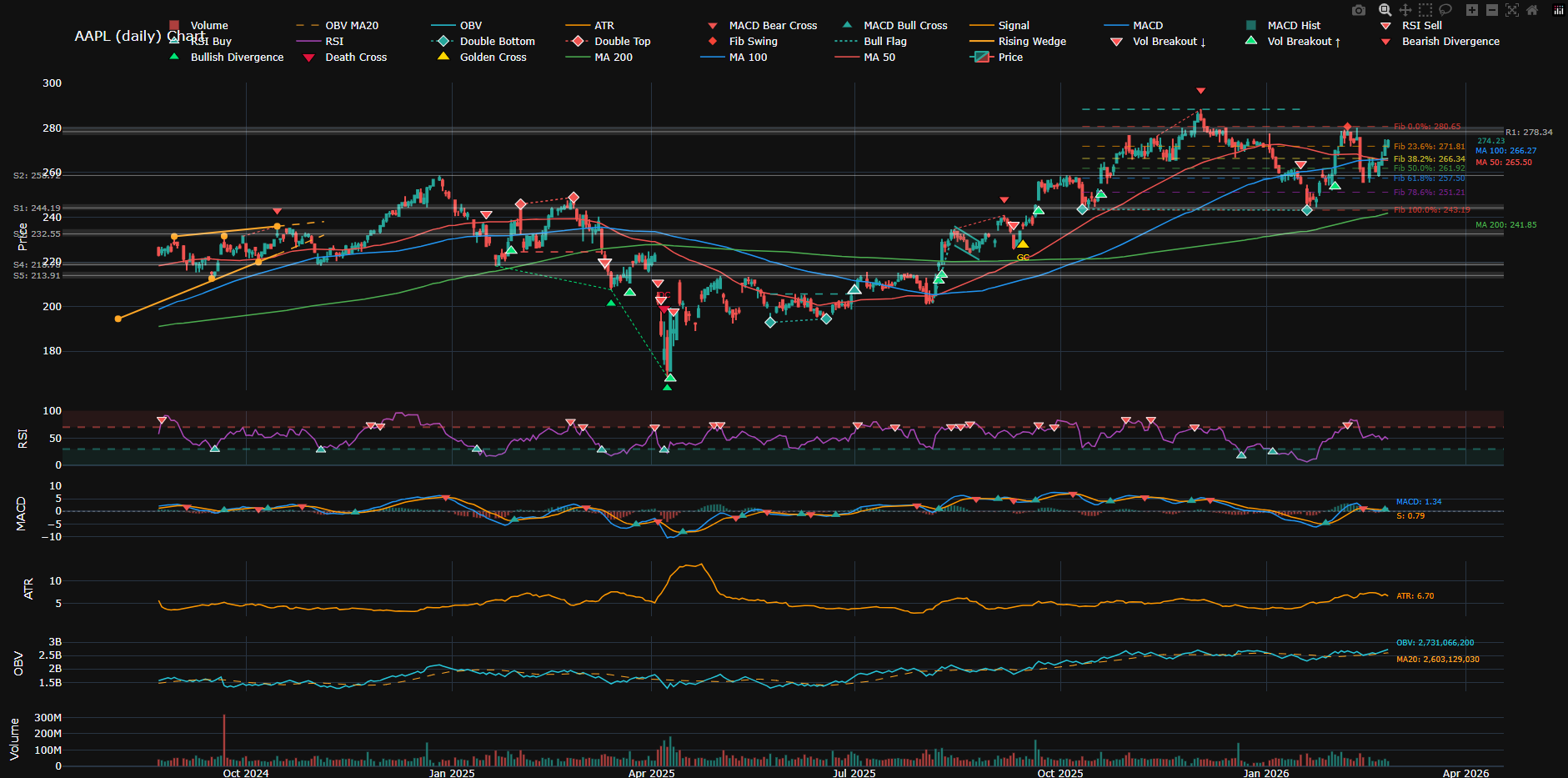
| Signal | Description | Default |
|---|---|---|
| Moving Averages | MA 50 / 100 / 200 (configurable periods) | On |
| MA Crossover | Golden Cross & Death Cross detection | On |
| RSI | Relative Strength Index with overbought/oversold zones | On |
| RSI Divergence | Bullish/bearish divergence between price and RSI | On |
| Support / Resistance | Pivot-based S/R level detection with clustering | On |
| Volume Breakout | S/R breakout confirmed by above-average volume | On |
| Wedge | Rising and falling wedge pattern detection | On |
| Flag & Pennant | Flagpole + parallel channel or converging triangle | On |
| Double Top/Bottom | Double top (bearish) and double bottom (bullish) reversal patterns | On |
| Bollinger Bands | Volatility envelope around a 20-period SMA (±2 std dev) | Off |
| MACD | Moving Average Convergence Divergence (12, 26, 9) with crossover signals | On |
| ATR | Average True Range — 14-period volatility measure | On |
| OBV | On-Balance Volume with 20-period MA overlay | On |
| Fibonacci Retracement | Key retracement levels from the last major swing | On |
Simple Moving Averages plotted for 50, 100, and 200 periods (configurable). They smooth out price action and help identify the overall trend direction. When the price is above MAs — the trend is bullish; below — bearish.
Detects when the short-term MA (50) crosses the long-term MA (200). A Golden Cross (50 crosses above 200) is a bullish signal, while a Death Cross (50 crosses below 200) is a bearish signal. Markers are plotted at the crossover points.
A momentum oscillator (0–100) that measures the speed and magnitude of price changes over 14 periods. Values above 70 indicate overbought conditions; below 30 — oversold. Displayed on a separate panel with shaded zones.
Detects divergences between price and RSI — when price makes a new high/low but RSI does not confirm. Bullish divergence (price makes lower low, RSI makes higher low) suggests potential reversal up. Bearish divergence is the opposite.
Identifies key horizontal price levels where buying (support) or selling (resistance) pressure has historically clustered. Uses pivot-based detection with configurable tolerance and clustering to avoid duplicate levels.
Flags breakouts through Support/Resistance levels that are confirmed by above-average volume. Higher volume on a breakout increases the probability that the move is genuine rather than a false break.
Detects rising wedges (bearish) and falling wedges (bullish) — converging trendlines where both highs and lows move in the same direction. A breakout from the wedge in the opposite direction is plotted.
Identifies continuation patterns: a sharp move (flagpole) followed by a consolidation (flag = parallel channel, pennant = converging triangle). Patterns are highlighted with trendlines on the chart.
Recognizes classic reversal patterns. A double top occurs when price reaches the same high twice and fails to break through — bearish. A double bottom is the inverse — bullish. Neckline and confirmation levels are plotted.
Three lines plotted around a 20-period SMA: the upper band at +2 standard deviations and the lower band at −2 standard deviations. When the bands contract, volatility is low (squeeze); when they expand, a significant move may follow. Disabled by default.
Calculated as the difference between the 12-period and 26-period EMAs. A 9-period EMA of the MACD line (signal line) and a histogram (MACD − signal) are also plotted. Bullish crossover: MACD crosses above signal. Bearish crossover: MACD crosses below signal. Crossover markers are displayed on the chart.
Measures market volatility as the 14-period rolling average of True Range (the greatest of: High−Low, |High−prevClose|, |Low−prevClose|). Higher ATR = more volatile market. Plotted on a separate panel.
A cumulative volume indicator: volume is added when close > previous close and subtracted when close < previous close. Rising OBV confirms an uptrend; falling OBV confirms a downtrend. A 20-period MA overlay is included for smoothing.
Plots key retracement levels (23.6%, 38.2%, 50%, 61.8%, 78.6%) based on the last major price swing. Traders watch these levels for potential support/resistance during pullbacks.
From PyPI:
pip install fin-pocketFrom source:
git clone git@github.com:canyoupleasecreateanaccount/fin-pocket.git && cd fin-pocket
python -m venv venv
source venv/bin/activate   # Linux/macOS
venv\Scripts\activate      # Windows
pip install -e ".[dev]"fin-pocket AAPLor via module:
python -m fin_pocket AAPLpositional arguments:
ticker Stock ticker symbol (e.g. AAPL, GOOG, MSFT)
options:
-t, --timeframe {daily,hourly} Chart timeframe (default: daily)
-o, --output FILE Save chart to HTML file
--height PIXELS Chart height in pixels (default: 1000)
signals:
--no-ma Disable Moving Averages
--no-ma-cross Disable MA Crossover
--no-rsi Disable RSI
--no-rsi-divergence Disable RSI Divergence
--no-sr Disable Support/Resistance levels
--no-volume-breakout Disable Volume Breakout
--no-wedge Disable Wedge patterns
--no-flag Disable Flag & Pennant patterns
--no-fibonacci Disable Fibonacci Retracement
--no-double Disable Double Top/Bottom
--bb Enable Bollinger Bands (off by default)
--no-macd Disable MACD
--no-atr Disable ATR
--no-obv Disable OBV
# Daily chart for Google with all defaults
fin-pocket GOOG

# Hourly chart for Tesla, no wedges
fin-pocket TSLA --timeframe hourly --no-wedge

# Save to file instead of opening browser
fin-pocket MSFT --output msft_chart.html

# Minimal chart — only price and moving averages
fin-pocket AAPL --no-rsi --no-rsi-divergence --no-sr --no-volume-breakout --no-wedge --no-flag --no-fibonacci --no-double --no-macd --no-atr --no-obvfin-pocket/
├── fin_pocket/
│ ├── __init__.py # Package version
│ ├── __main__.py # python -m fin_pocket
│ ├── cli.py # CLI entry point
│ ├── chart.py # Plotly chart builder
│ ├── data/
│ │ ├── __init__.py
│ │ └── provider.py # Yahoo Finance data provider
│ └── signals/
│ ├── __init__.py
│ ├── base.py # Abstract base signal class
│ ├── moving_averages.py
│ ├── ma_crossover.py
│ ├── rsi.py
│ ├── rsi_divergence.py
│ ├── support_resistance.py
│ ├── volume_breakout.py
│ ├── wedge.py
│ ├── pennant.py # Flag & Pennant
│ ├── double_top_bottom.py
│ ├── bollinger_bands.py
│ ├── macd.py
│ ├── atr.py
│ ├── obv.py
│ └── fibonacci.py # Fibonacci Retracement
├── tests/
│ └── ...
├── pyproject.toml
├── LICENSE
└── README.md
pytest
pytest --cov=fin_pocket- yfinance — historical market data from Yahoo Finance
- pandas — data manipulation
- plotly — interactive charting
- numpy — numerical computations
See CONTRIBUTING.md for how to submit pull requests.
Email: solveme.solutions@gmail.com

Proprietary — for personal use only. See LICENSE.