Tree species list and related assets to support visualization applications. Assets include: simple colors for species, crown and bole shape information, images for complete trees, and images for various tree parts (bark, crown, branch). The intent is to provide an open-source resource that can be used by anyone developing visualzations involving trees.
The initial tree lists came from the Forest Inventory and Analysis (FIA) program and the rSVS R package developed by Jim McCarter with Rayonier. FIA is responsible for the national forest inventory in the United States so their species list represents species that are measured during data collection to support the inventory. Jim's list started with the list from FIA (older version) and added additional species from the USDA Plants Database maintained by the Natural Resources Conservation Service (NRCS) program. The two lists are very similar. Their differences are, most likely, not significant regarding visualization needs. One significant difference is that the rSVS list includes species group codes but the FIA list does not (for the most part). While such group codes seems useful, VisiTrees implements the same capability by providing species group level visualzation assets. A third list from Forest Health Management (FHM) was also consulted and 10 additional species were found that were not in the FIA list.
A subset of the FIA tree list that includes FIA species codes used for plots in CONUS and AK was extracted along with the 10 additional species from the FHM list to serve as the starting point for VisiTrees. The v9-2_2-22-09... files are the FIA lists used as the initial species list. These should not be used for any additional work.
Columns were rearranged and some were deleted to create the MasterSpeciesList.
Beginning with the species list, the database adds fields describing the basic tree form and tree condition. Additional attributes can be used to provide models representing various damage agents or times of year. While this provides a tremendous amount of flexibility, it quickly adds up to lots of tree models and texture images. For the initial database, not all details are needed.
The shape of the crown is generally consistent for a species until the trees reach old age (Van Pelt and Sillett, 2008). For visualization applications, assuming a consistent shape for a species helps viewers recognize the species. While some species may change their appearance over their life span, tracking the shape changes introduces unnecessary complications to the database. An excellent publication by Dr. Kim D. Coder (Coder, 2018) describes tree growth processes and presents the most common overall growth patterns and a set of crown shapes. Basic growth forms are:
- Abcurrent tree forms have an aerial terminal bud and leaves (palm-like).
- Adcurrent tree forms have basal buds and leaves (ground hugging yucca-like).
- Bicurrent tree forms have irregular forked branching usually with thick green stems (catus-like).
- Decurrent (deliquescent) tree forms have many dominant branches with a spreading crown form caused by lateral branches growing at similar rates as the main axis terminal (leader), or the terminal continues to die with lateral branches rebranching continuously (so no one central axis develops, but many spreading branches).
- Excurrent tree form has a single dominant axis (leader) and forms a conical shaped crown as the terminal elongates more annually than lateral branches (a distinct main axis and many short secondary branches. The most common of these are excurrent (conifers) and decurrent (hardwoods).

Given these basic growth forms, Coder defines a series of generalized crown shapes useful for developing tree models. There may be more detail in these shapes than needed for abstract tree models. In addition, many (most?) species exhibit different forms depending on their competative environment, age, and degree of crown damage. Nonetheless, these forms provide a set of terminology useful for our tree database. The basic crown shapes are:
- Pyramidal
- Conical
- Columnar (spindle)
- Fastigate
- Ellisoid
- Ovoid
- Circular (globose)
- Broad
- Vase
- Umbrella
- Irregular
- Weeping

As mentioned above, most tree species have different crown shapes when grown in the open compared to a closed stand. Stand density may be driven by the overall climatic conditions or through managment activites or disturbance. For parts of the country where mositure is the limiting growth factor, open stand conditions are common and trees tend to have longer and wider crowns. In contrast, moister conditions lead to more closed-canopy stands where trees tend to have more foliage near the top of the tree and, overall, narrower crowns. Basic growing condition options are OPEN and CLOSED.
The Stand Visualization System defined four tree forms for each species for use with output from the Forest Vegetation Simulator (FVS) and the fire and fuels extension (FFE): dead due to fire with foliage consumed and downward curled branches, dead due to fire with discolored branches/foliage, dead due to FVS background mortality with orange or brown branches/foliage, live with green branches/foliage. While not perfect, these conditions provide a starting point for a new database. Initial condition options are:
- LIVE
- RECENTDEAD (branches intact, foliage discolored)
- OLDDEAD (most branches gone, no foliage)
- SCORCHED (bole discolored, foliage discolored)
- CONSUMED (bole discolored, branches sparse and discolored, no foliage The latter two conditions are meant for use with fire simulations. The first dead condition is meant to represent natural mortality. The "old dead" condition represents snags and could be the result of natural mortality or fire-related mortality.
Tree and crown damage are mostly intended for damage related to insects and disease. Damage class could also be used for fire-related damage but fire effects are represented in the tree condition options. Adding a full range of damage classes may be difficult given the possible types and severity of damage. This would, most likely, represent too much detail and could require tens of additional images for each species to represent various types and levels of damage. Such images would be nearly impossible to capture in the field so some type of algorithmic manipulation would need to be developed. For the initial database, all species only have records with damage class set to NONE.
Most tree species change their appearance through the course of the year. Most obvious are deciduous trees whose foliage changes color in the fall and is absent in the winter and early spring. However, conifers also have different appearances when actively growing compared to periods of slow or no growth. For the initial database, valid time-of-year values are DORMANT, SUMMER, and FALL. For deciduous broadleaf species, DORMANT would have no foliage SUMMER would have green foliage, and FALL would have foliage with characteristic colors for the species. For conifer species DORMANT and FALL would have uniform green foliage and SUMMER would have a mix of dark and light green foliage with lighter green toward the branch tips.
If we assume that the basic crown shape is consistent for a species, the growth form and crown shape become attributes of the species and do not change regardless of the growing condition, tree condition, damage class, or time of year. The simplified record structure for our database looks like this:

The initial version of the database can have the growing condition, tree condition, damage class, or time of year all set to NULL. A "complete" database, with assests to represent every combination of parameters, would have 144 records (only 72 records if damage class is dropped completely) for each species. While this seems overwhelming, the "complete" database would support nearly all types of visualization. In addition, the database could be populated as needs develop starting with records for LIVE trees only and adding additional attributes as the need arises.
Assets for each tree record would include:
- RGB crown color
- RGB bole color
- Base URL
- Whole tree image URL
- Bark image URL
- Stump image (cut surface) URL
- Crown image URL
- Overhead image URL
All asset URLs in the database are relative to the base URL. However, the base URL is relative to the repository's main branch. GitHub won't serve content directly from the repository but does offer an alternaive URL to access repository content. For this repository, the base URL is: https://raw.githubusercontent.com/bmcgaughey1/VisiTrees/main/. In the current configuration, all assets are stored in the "assets" folder. It might make sense to have assets arranged by species. In this case, records for each species would have a different base URL but still relative to the repository URL. GitHub won't allow you to browse the assets folder (but will serve specific files from the folder like PSME_tree.png).
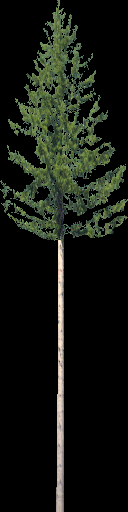
The following images are only examples (Douglas-fir PSME). Alpha channels are not set in any of these so they can't be used directly as texture images.
 Tree |
 Bark |
 Stump |
 Crown |
 Overhead |
|---|
This approach assumes a single level of detail (LOD). I am not familiar with current methods for handling LOD. If separate images are needed to represent various LOD, the database will need to expand.
We can simplify the database using genus and growth form. Starting with the master list of 405 species, there are 123 genera, and 5 growth forms. The simplified lists effectively group species together. For almost all applications, the simplified database based on genus will be adequate. The database grouped by growth forms is even simpler but will still distinguish broadleaf and conifer species.
My intial thought was the the database should be structured as a formal database. However, after thinking through some of the possibilities, it makes sense to have the database stored as a CSV file. CSV files can be queried using SQL but I don't know about how the data should be served. The "complete" database could be delivered via HTTP and the client would do filtering and request specific assets via HTTP. This isn't the most efficient but it makes the server side interaction simple.
Coder, Kim D. 2018. Tree anatomy: Defining trees & forms. Warnell School of Forestry & Natural Resources, University of Georgia, (Outreach Publication WSFNR-19-35)[https://bugwoodcloud.org/resource/files/15277.pdf]. Pp.20.
Van Pelt, R.; Sillett, S.C. Crown development of coastal pseudotsuga menziesii, including a conceptual model for tall conifers. (Ecol. Monogr. 2008, 78, 283–311)[https://esajournals.onlinelibrary.wiley.com/doi/10.1890/07-0158.1].