




When generating meshes for FEM/FVM computations, sometimes your geometry is so simple that you don't need a complex mesh generator (like pygmsh, MeshPy, mshr, pygalmesh, dmsh), but something simple and fast that makes use of the structure of the domain. Enter meshzoo.
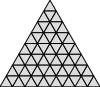
import meshzoo

bary, cells = meshzoo.triangle(8)

# corners = np.array(
#     [
#         [0.0, -0.5 * numpy.sqrt(3.0), +0.5 * numpy.sqrt(3.0)],
#         [1.0, -0.5, -0.5],
#     ]
# )
# points = np.dot(corners, bary).T

# Process the mesh, e.g., write it to a file using meshio
# meshio.write_points_cells("triangle.vtk", points, {"triangle": cells})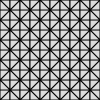 |
 |
import meshzoo
import numpy as np

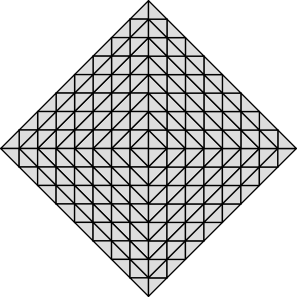
points, cells = meshzoo.rectangle_tri(
    np.linspace(0.0, 1.0, 11),
    np.linspace(0.0, 1.0, 11),
    variant="zigzag",  # or "up", "down", "center"
)

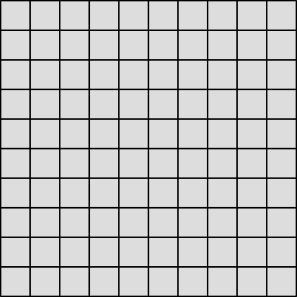
points, cells = meshzoo.rectangle_quad(
    np.linspace(0.0, 1.0, 11),
    np.linspace(0.0, 1.0, 11),
    cell_type="quad4",  # or "quad8", "quad9"
) |
 |
 |
|---|---|---|
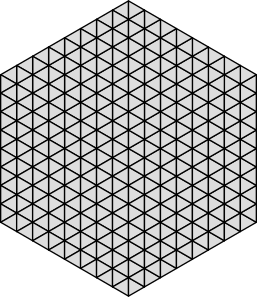
meshzoo.ngon(4, 8) |
meshzoo.ngon(6, 8) |
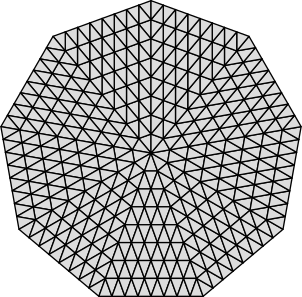
meshzoo.ngon(9, 8) |
import meshzoo

points, cells = meshzoo.ngon(5, 11) |
 |
 |
|---|---|---|
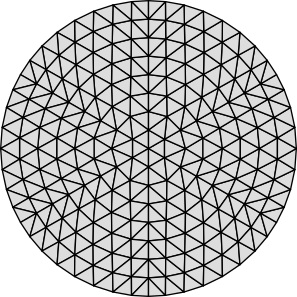
meshzoo.disk(4, 8) |
meshzoo.disk(6, 8) |
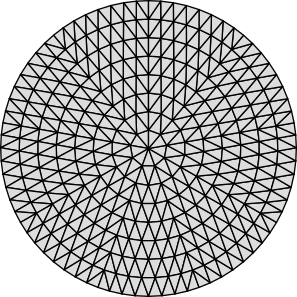
meshzoo.disk(9, 8) |
The disk meshes are inflations of regular polygons.
import meshzoo

points, cells = meshzoo.disk(6, 11)

points, cells = meshzoo.disk_quad(10, cell_type="quad4")  # or "quad8", "quad9"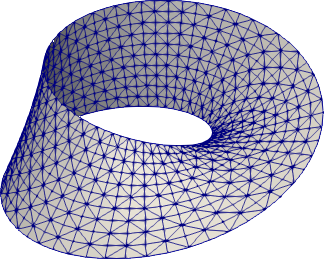
import meshzoo

points, cells = meshzoo.moebius(num_twists=1, nl=60, nw=11)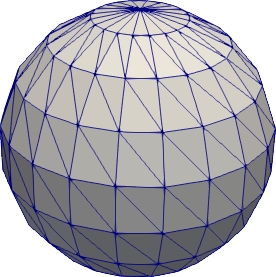 |
 |
|---|
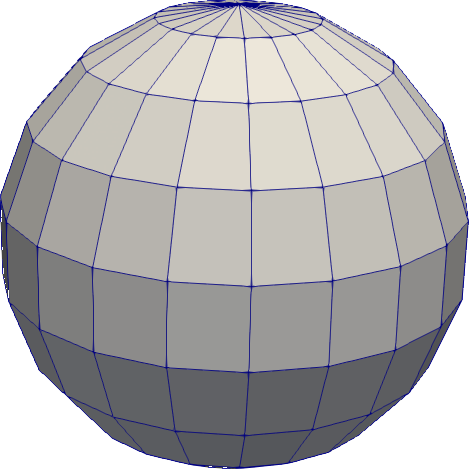
import meshzoo

points, cells = meshzoo.uv_sphere(num_points_per_circle=20, num_circles=10, radius=1.0)
points, tri, quad = meshzoo.geo_sphere(
    num_points_per_circle=20, num_circles=10, radius=1.0
)
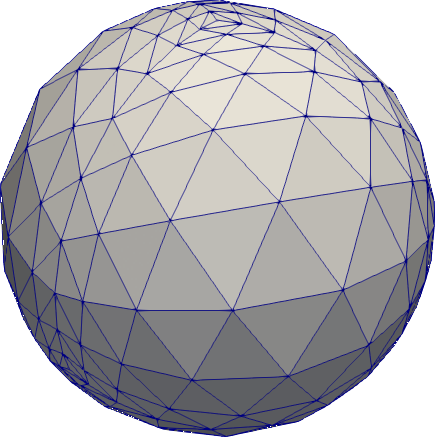
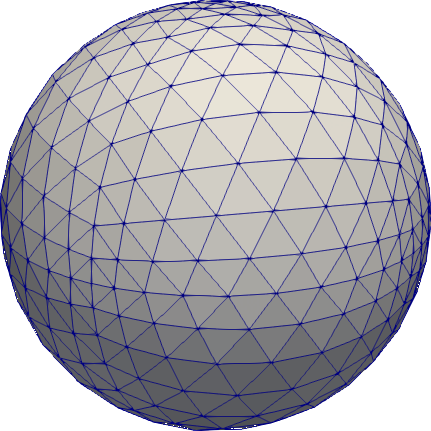
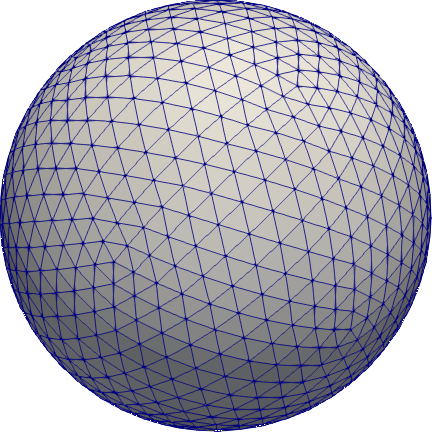
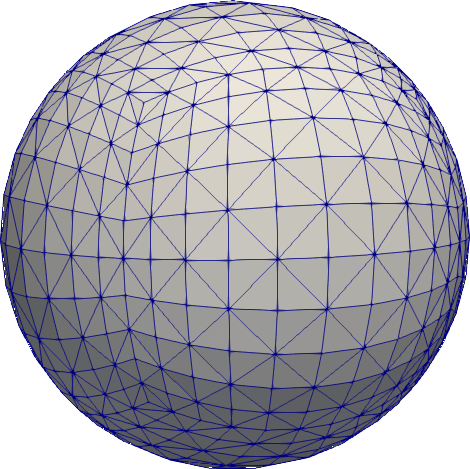
Spheres can also be generated by refining the faces of platonic solids and then "inflating" them. meshzoo implements a few of them. The sphere generated from the icosahedron has the highest-quality (most equilateral) triangles.
All cells are oriented such that its normals point outwards.
 |
 |
 |
|---|---|---|
meshzoo.tetra_sphere(10) |
meshzoo.octa_sphere(10) |
meshzoo.icosa_sphere(10) |
 |
 |
|---|
import meshzoo

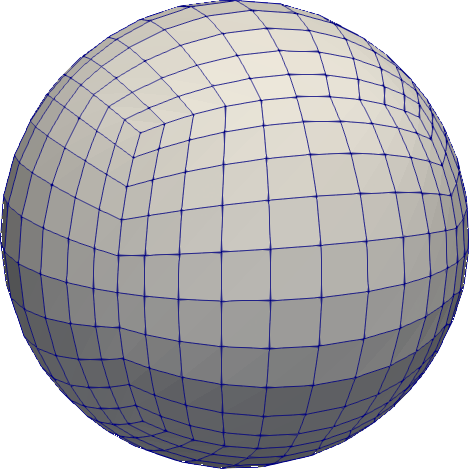
points, cells = meshzoo.ball_tetra(10)
points, cells = meshzoo.ball_hexa(10)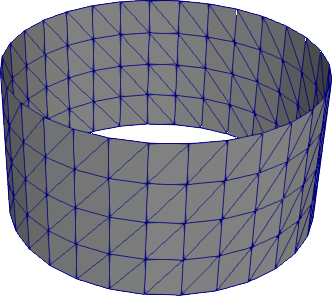
import meshzoo

points, cells = meshzoo.tube(length=1.0, radius=1.0, n=30)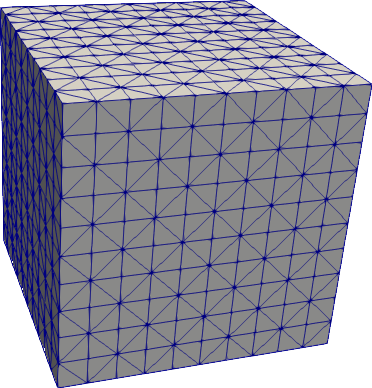 |
 |
|---|
import meshzoo
import numpy as np

points, cells = meshzoo.cube_tetra(
    np.linspace(0.0, 1.0, 11), np.linspace(0.0, 1.0, 11), np.linspace(0.0, 1.0, 11)
)
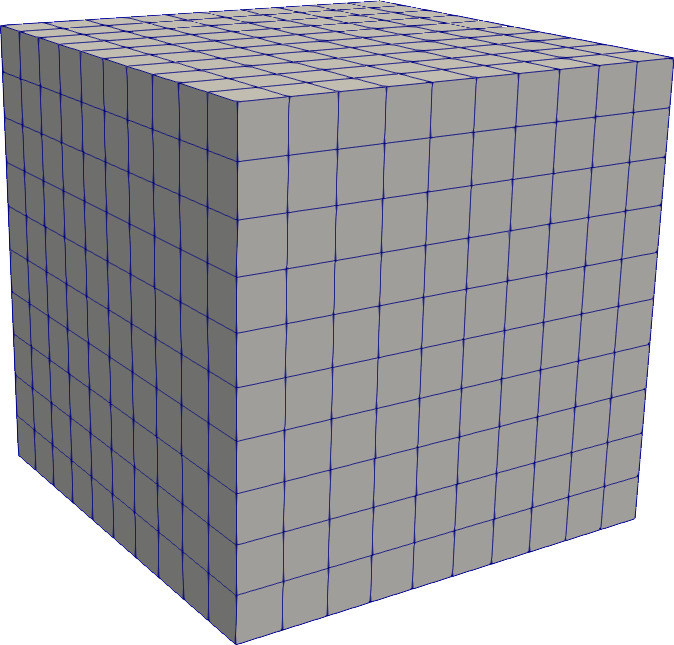
points, cells = meshzoo.cube_hexa(
    np.linspace(0.0, 1.0, 11), np.linspace(0.0, 1.0, 11), np.linspace(0.0, 1.0, 11)
)