GPDR Compliance System
Project : https://dark-cockroach-f61.notion.site/Examen-TP-ING3-444c3e5e00b74a06b14e408e89dbf1fd
compliance-system 1.0
Usage: compliance-system [options]

  -u, --uid       <uid>          User id. Required if not read
  -a, --action    <action>       Action. Required if not read
  -i, --hdfsIP    <hdfsIP>       Custom hdfs ip, default : 192.168.1.2
  -p, --hdfsPath  <hdfsPath>     Custom data path, default : compliance_system/datacsv
  -f, --filename  <filename>     Custom filename without extension
  -r, --read      <read>         Read data
  -t, --fileType  <fileType>     File type -> {CSV (Default) | PARQUET}
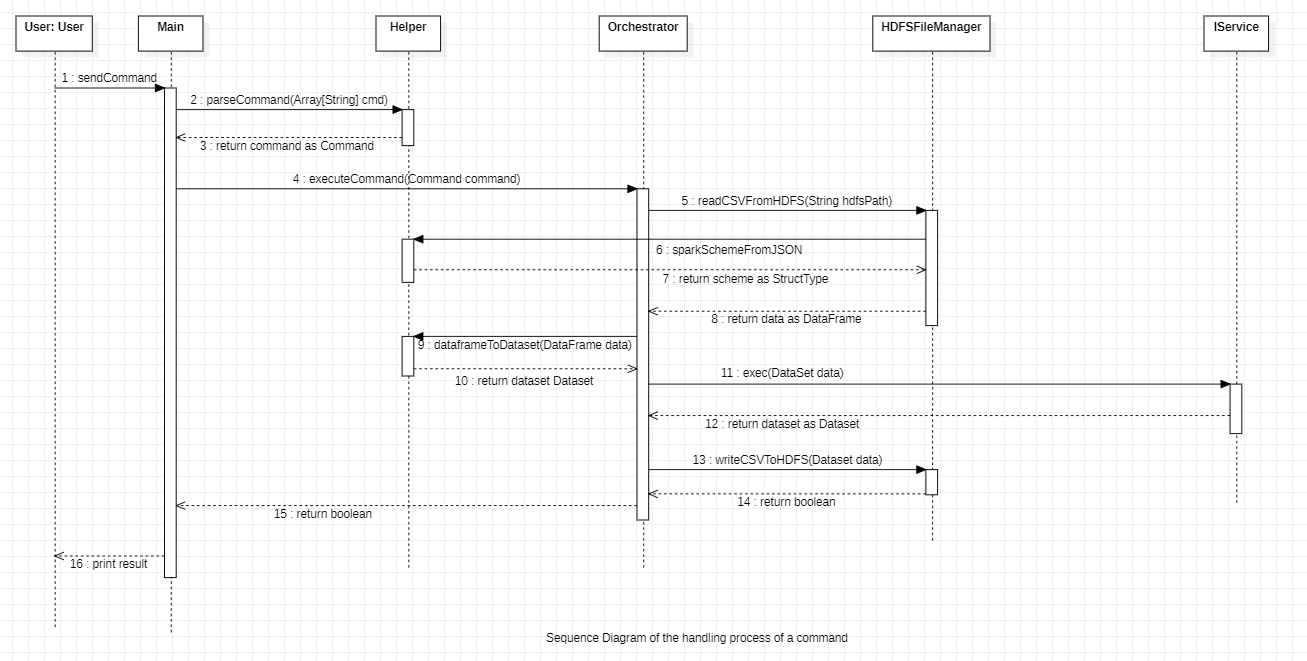
Two Modes of usage: reading and executing
It reads the data from a file or a folder. The execution of an action (delete, hash) is only possible on one uid at a time for now.
sbt "run -r true [-i <hdfs_ip>] [-p <hdfs_path>] [-f <filename>] [-t <filetype>]"
sbt "run -a <delete | hash> -u <long> [-i <hdfs_ip>] [-p <hdfs_path>] [-f <filename>] [-t <filetype>]"
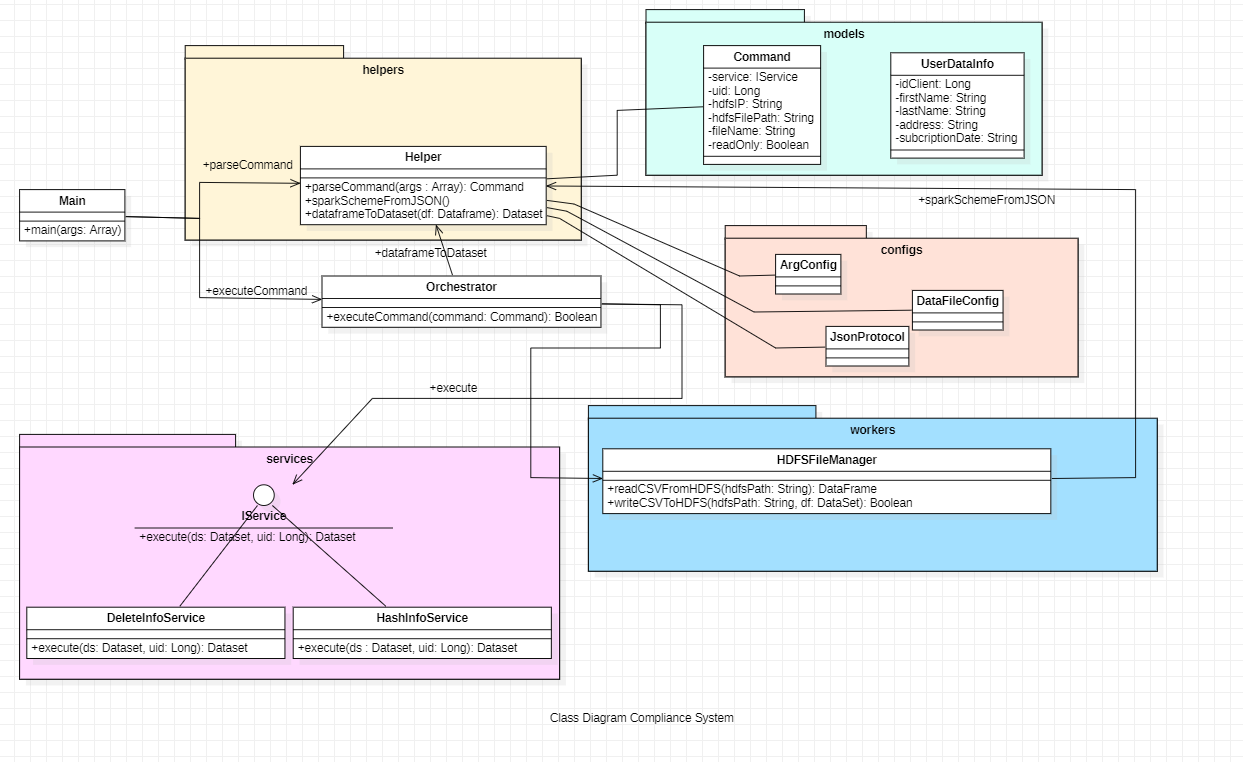
Below, a few explications about the configuration classes implemented
The argument parsed by scopt will be mapped into an object of this class. Here we define the default values for each argument.
case class ArgConfig(uid: Long = -1,
                     action: String = "",
                     hdfsIP: String = "192.168.1.2",
                     hdfsPath: String = "compliance_system/datacsv",
                     filename: String = "",
                     fileType: String = "csv",
                     read: Boolean = false)
The Config JSON file parsed by spray-json will be mapped into an object of this class. This class is used to provide the format in which the json string should be processed
object JsonProtocol extends DefaultJsonProtocol {
  implicit val configElement: RootJsonFormat[ConfigElement] = jsonFormat2(ConfigElement.apply)
  implicit def dataFileConfig[ConfigElement : JsonFormat]: RootJsonFormat[DataFileConfig[ConfigElement]] = jsonFormat1(DataFileConfig.apply[ConfigElement])
}
After parsing the JSON, the data will be mapped into an object of this DataFileConfig class. These classes will be used later to create a StructType Schema to validate the data when reading files from HDFS with Spark.
case class DataFileConfig[ConfigElement](columns : List[ConfigElement])

case class ConfigElement(name : String, typeOf : String)