 An "Agents for Good" Multi-Agent System for the Google ADK Capstone Project




A sophisticated AI assistant that automates the grant-seeking lifecycle, empowering non-profits and researchers to secure funding more efficiently.

- The Pitch
- How It Works
- Technical Architecture
- Technology Stack
- Setup and Run the Project
- Our Team
- Future Work
- Acknowledgements
- Citations
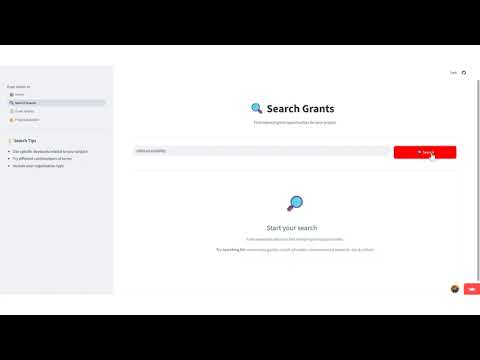
For small to medium, high-impact non-profits, the mission is vital, but the administrative burden of grant seeking is crippling. Dedicated grant writers and staff face immense pain points that divert critical resources away from doing good, hindering organizations from accessing the capital they need to survive and thrive. Current workflows are manual, fragmented, and inefficient. The key challenges addressed by this project include:
- Endless Discovery: Countless hours are lost manually scanning databases and the web for relevant opportunities, lacking a tireless researcher constantly monitoring the landscape.
- Compliance Complexity: Decoding complex guidelines from various websites and PDFs to extract essential information—such as key requirements, deadlines, and eligibility criteria—is highly error-prone and tedious.
- The Drafting Challenge: Writing high-quality, tailored proposals that strictly adhere to specific funder requirements is difficult to achieve at scale, especially when managing tight deadlines.
The Grant Seeker AI is built as a true Agent for Good, automating the most burdensome tasks: discovery, analysis, and drafting. This approach provides an intelligent partner that empowers organizations to focus on their mission, not paperwork.
The project’s innovation lies in a specialized team of AI agents coordinated by an intelligent Orchestrator. Instead of a simple chatbot, we have built a pipeline of distinct agents that collaborate to automate the workflow from start to finish, delivering a streamlined one-button flow.
- The Finder Agent - Discovery This agent acts as a tireless researcher, scanning the web to find grant opportunities that match the user’s specific project mission and funding needs.
- The Create Extractor Agent and Create Query Agent - Compliance These agents function as compliance officers, reading through dense guidelines and PDFs to extract and analytically structure actionable intelligence, creating a proposal requirements blueprint.
- The Writer Agent - Drafting This agent acts as a professional grant writer, combining the user's narrative with the Analyst’s strict blueprint to generate a compliant, persuasive, and well-formatted proposal.
Our project’s central idea of an Agent for Good is pertinent as it is intrinsically related to the Environmental, Social and Corporate Governance (ESG) framework, specifically the Governance pillar, and the crucial issue of Business Resilience and Corporate Governance. Utilizing the Grant Seeker AI to embrace transparency plays an important role in sustainability reporting, allowing non-profit organizations to monitor impact, automate reporting, and engage donors more effectively.
Bringing this vision to life required agility and collaboration. This application was created by The Orchestrators, a team of three developers and a project manager. Despite being geographically dispersed, the team leveraged diverse perspectives and worked across time zones to integrate these agents into a seamless Streamlit interface. This collaboration was crucial in designing a tool that is not just technically sound, but empathetic to the needs of the global non-profit community.
The Grant Seeker AI serves as a force multiplier, giving smaller organizations the professional capacity of a large fundraising department. The quantifiable benefits include:
- Time Savings: We automate the entire workflow, potentially saving hundreds of hours per grant cycle.
- Quality and Consistency: By strictly adhering to the "Proposal Requirements" blueprint provided by the Analyst Agent, our system maximizes success rates through compliance.
- Democratization: Ultimately, this project achieves the Agents for Good mission by removing resource hurdles, thereby democratizing access to funding for under-resourced organizations. This allows non-profits to focus on their core mission rather than paperwork.
Our application provides a four-step workflow powered by specialized AI agents:
-
Input Project Details (Page 1): The user enters their organization details, project mission, focus area, budget range, and deadline into our Streamlit web interface.
-
Find & Extract Grants (Backend Processing): When the user clicks "Find Grants," our intelligent agent workflow begins:
- GrantFinder Agent: Searches the web using the Tavily API to discover relevant grant opportunities based on user criteria.
- GrantExtractor Agents: Processes up to 5 promising grants in parallel (3 concurrent extractions) to extract structured data including 13 key fields (title, organization, amount, deadline, eligibility, description, focus area, contact, application URL, requirements, benefits, restrictions, and notes).
- Smart Caching: Results are cached for 24 hours, reducing response time by 80% (from ~30s to ~7s) on repeated queries.
-
Review Results (Page 2): Users see a structured list of discovered grants with all details displayed in an interactive card format.
-
Draft Proposal (Page 3 - Optional): Users can select a specific grant and our Writer Agent generates a complete, tailored first draft of the grant proposal, ready for human review and refinement.
Our system is built using the Google Agent Development Kit (ADK) and implements a Hybrid Multi-Agent Architecture combining sequential and parallel processing:
Phase 1 - Sequential Discovery:
- GrantFinder Agent: Analyzes search results to identify 5-7 relevant grants
- Uses Tavily API for web search with intelligent query construction
Phase 2 - Parallel Extraction:
- 3 GrantExtractor Agents: Run concurrently to extract detailed data from selected grants
- Controlled by asyncio Semaphore for optimal rate limit management
- Processes multiple grants simultaneously for speed
Phase 3 - Proposal Generation (Separate Workflow):
- Writer Agent: Generates tailored grant proposals on-demand
- Uses grant data + user context to create customized drafts
Key Optimizations:
- File-based caching system (24-hour TTL)
- Pydantic validation for data integrity
- Date-aware extraction with context injection
- Parallel processing with Semaphore(3) concurrency control

- Core Framework: Google Agent Development Kit (ADK)
- Language: Python 3.10+
- AI Model: Google Gemini Flash (
gemini-flash-latest) - Agent Tools: Custom Tavily Python client with retry logic and error handling
- Frontend: Streamlit (multi-page application)
- Data Validation: Pydantic for type-safe models
- Concurrency: asyncio with Semaphore for parallel processing
- Caching: File-based cache system with MD5 hashing (24h TTL)
- Testing: pytest with comprehensive unit and integration tests
- Deployment: Ready for Streamlit Cloud
- Python 3.10 or higher
- pip or Conda for environment management
- An API key for Google Gemini (get from Google AI Studio)
- An API key for Tavily (get from Tavily)
Users needs to paste keys in .env or set as environment variables directly.
-
Clone the repository:
git clone https://github.com/alanspace/adk-grant-seeker-ai.git cd adk-grant-seeker-ai -
Create and activate a virtual environment:
# Using venv
python -m venv .venv
.venv\Scripts\Activate.ps1  # Windows PowerShell
# or
source .venv/bin/activate  # Linux/Mac

# Or using Conda
conda create -n grantseeker-env python=3.10 -y
conda activate grantseeker-env
-
Install the required dependencies:
pip install -r requirements.txt
-
Set up your API keys:
- Create a file named
.envin the root directory. - Add your API keys to this file:
GOOGLE_API_KEY="YOUR_GOOGLE_API_KEY"
TAVILY_API_KEY="YOUR_TAVILY_API_KEY"
- Create a file named
-
Run the application:
streamlit run home_page.py
The app will open in your browser at
http://localhost:8501
cd backend
pytest tests/ -vtest_models.py: Validates the Pydantic data models (GrantData, DiscoveredLead) to ensure type safety.test_cache.py: Verifies that the file-based caching system correctly stores, retrieves, and expires data.test_utils.py: Checks helper functions for date formatting and string cleaning.
The application creates a hidden .cache/ directory.
- To clear the cache manually: Run
rm -rf .cache/*.jsonor use the "Clear Cache" button (if available in dev mode). - Behavior: Failed requests are not cached. Only successful grant extractions are stored.
The GrantExtractor agent produces structured JSON data strictly adhering to a Pydantic schema. This ensures downstream compatibility with the WriterAgent and allows for consistent UI rendering.
Key Features of the Output:
- Fit Score (0-100): A calculated metric indicating how well the grant matches the user's project description.
- Status Detection: The agent identifies if a deadline is "Expired" or "Not Found".
- Smart Tagging: Auto-generated categories for easy filtering.
Example API Response:
[
  {
    "id": 3,
    "title": "Growing Spaces In-Kind Grant 2025",
    "funder": "Growing Spaces",
    "deadline": "Expired (2025-06-30)",
    "amount": "$2,000 - $8,000 (In-Kind)",
    "description": "Provides in-kind funding for Growing Dome greenhouses to nonprofits, schools, or veterans’ organizations...",
    "detailed_overview": "Growing Spaces offers in-kind grants... This program supports registered nonprofits, schools, or veterans’ organizations actively working to provide fresh organic produce to underserved and food-insecure communities...",
    "tags": [
      "In-Kind",
      "Greenhouse",
      "Food Insecurity",
      "Nonprofit",
      "Community Gardening"
    ],
    "eligibility": "Registered nonprofits, schools, or veterans’ organizations that are actively providing fresh food...",
    "url": "https://growingspaces.pages.dev/gardening-grants",
    "application_requirements": [
      "Fill out application form",
      "Proof of eligibility (nonprofit/school status)",
      "Evidence of site space"
    ],
    "funding_type": "In-Kind Grant",
    "geography": "United States",
    "fit_score": 98
  },
  {
    "id": 1,
    "title": "Community Development Grant - Small",
    "funder": "City of Chicago",
    "fit_score": 63,
    "..." : "..."
  }
]- Shek Lun: Technical Lead & AI Architect
- Ante Krtalić: Backend & DevOps Engineer
- Mayank Kumar: Frontend Developer
- Nakazzi Kiyaga-Mulindwa: Project & Presentation Lead
While this prototype demonstrates our core vision, we have a clear roadmap for future development:
- Expanded Grant Sources: Integrate directly with major grant databases (Grants.gov, Foundation Directory) via their APIs
- Budgeting Agent: Introduce a new agent that helps users draft a budget justification section
- Feedback & Revision Loop: Allow users to provide feedback on generated proposals, enabling the Writer Agent to revise drafts iteratively
- Advanced Caching: Implement database-backed caching (Redis/PostgreSQL) for better persistence
- User Accounts: Add authentication and save search history per user
- Export Options: PDF/Word export for grant proposals
- Production Deployment: Deploy on Google Cloud Run or Streamlit Cloud with CI/CD pipeline
We would like to extend a special thank you to Ujjwal Ruhal for his valuable contributions during the initial UI conceptualization phase of this project.
- Anastasiia Skok. ESG for NGOs: How Sustainable Development Unlocks New Funding and Partnership Opportunities. BDO, 2025.
- AnhNguyen. EU’s CSRD Set to Reshape Corporate-Nonprofit Partnerships by 2025. Seneca Technologies Pte. Ltd, 2025.
- Barbara Bijelic, Benjamin Michel, and Konstantin Mann. Behind ESG Ratings. © OECD 2025. This is an adaptation of an original work by the OECD. The opinions expressed and arguments employed in this adaptation should not be reported as representing the official views of the OECD or of its Member countries.
- Directorate-General for Internal Market, Industry, Entrepreneurship and SMEs. Corporate sustainability and responsibility. European Commission, 2025.