
abstractPIM: Bridging the Gap Between Processing-In-Memory Technology and Instruction Set Architecture
In order to use abstractPIM, you will need a Linux machine with:
- Python 3.6
- Synopsys DC
- Configure: in the file simple_conf.cfg you will find the following content:
[input_output]
; input_path - write the name of the input file
input_path=full_adder_1bit.v
; to run on a whole dir, set the input_dir variable and run_dir=True
input_dir=EPFL
run_dir=True
; input_format - the allowed values: verilog
input_format=verilog
; output_path - write the desired name of the netlist generated using Synopsys DC
output_path=full_adder_1bit_output

[SIMPLER_Mapping]
; Max_num_gates - write the maximum number of gates the tool allows
Max_num_gates=20000
; ROW_SIZE - write all the desired row sizes (including the cells storing the inputs)
ROW_SIZE=[512,1024]
; generate_json,print_mapping,print_warnings - the allowed values: True/False
generate_json=False
print_mapping=True
print_warnings=True
Change the parameters according to your needs.
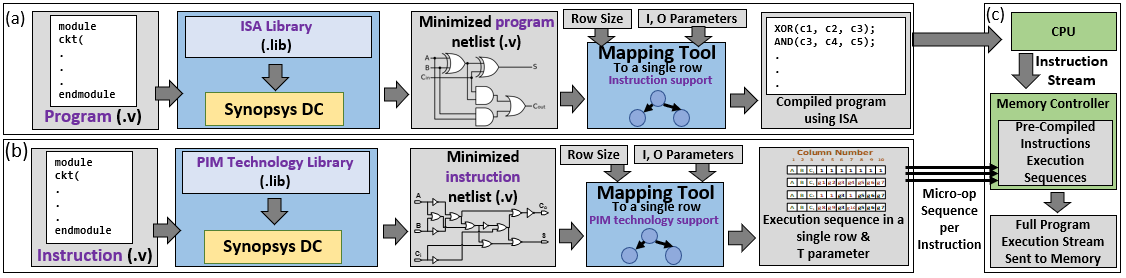 2. To perform step (a) - intermediate representation generation, edit SET0 to contain all your technology-supported commands and their functions.
In SIMPLER_Mapping.py, change the GATE_TIME and GATE_INTERMEDIATE_CALC_CELLS dictionaries according to these commands.
In simpler_main.py, change the used set to set0. Then move on to stage 3 to complete step (a).
To perform stage (b) - microcode generation, edit SET1 to contain all your ISA commands.
In SIMPLER_Mapping.py, change the GATE_TIME and GATE_INTERMEDIATE_CALC_CELLS dictionaries according to these commands.
In simpler_main.py, change the used set to set1. Then move on to stage 3 to complete step (b).
2. To perform step (a) - intermediate representation generation, edit SET0 to contain all your technology-supported commands and their functions.
In SIMPLER_Mapping.py, change the GATE_TIME and GATE_INTERMEDIATE_CALC_CELLS dictionaries according to these commands.
In simpler_main.py, change the used set to set0. Then move on to stage 3 to complete step (a).
To perform stage (b) - microcode generation, edit SET1 to contain all your ISA commands.
In SIMPLER_Mapping.py, change the GATE_TIME and GATE_INTERMEDIATE_CALC_CELLS dictionaries according to these commands.
In simpler_main.py, change the used set to set1. Then move on to stage 3 to complete step (b).
- Run:
python3 simpler_main.py