These are a collection of resources I'm reading, re-reading, or attempting to read. All code included here is my own interpretation unless otherwise stated/linked, and should in no way reflect on the quality of the authors & works used.
I am grateful to all the amazing people who took the time to publish such excellent materials; especially ones using open source standards. I've created this collection so they can provide as much value to the next student as they did to me.

By Stuart Russell & Peter Norvig
The leading textbook in Artificial Intelligence. I was introduced to this text via the Udacity AIND Program and everytime I open it I am fascinated and humbled. No matter what you do, I guarantee there is something in this 1152 page tome that could help you do it smarter. It also comes in multiple flavors for whatever language you enjoy.

By Sam Abrahams et al.
I found out about this book on Reddit! I've always been curious by Tensorflow, especially with its usage of the beautiful TensorBoard capabilities, but I was told its previous iterations weren't quite on the same level as other popular ML packages. However, with a combination of open source principles and the sheer scale and support of Google, it has definitely become a force to be reckoned with. I also love reading the Google Research Blog, and I'm keen to play with the system presumably powering such fascinating insights; I can't wait to see it in action!
Maintained By Torch
A clone of the Torch Tutorials to better understand Torch, one of the most trusted ML framework currently out there. It has the benefits of being built on Lua, a procedural scripting language that can be generally understood in 15 minutes. I discovered this repo by checking out it's cheatsheet, and hope to to start converting these into iTorch notebooks pretty soon.

By Gareth James, Daniela Witten, Trevor Hastie & Robert Tibshirani
A modern classic for understanding machine learning from a statistical perspective. Covers regression, classification, resampling, model selection, tree-based methods, SVMs, and unsupervised learning. The PDF is freely available from the authors.

By Allen Downey (Repurposed from Roger Labbe)
An interactive take on Allen Downey's excellent primer on Bayesian Statistics, using some Python examples. His work is available as a book, a LaTeX file with supporting code in his Github Repository, and for free online. I have borrowed an amazing interactive Jupyter notebook version created by Roger Labbe to append with my own learning as I work through it.

By Joel Grus
A clone of supplemental materials for Data Science from Scratch by Joel Grus. It is part of the venerable "O'Reilly" family, and is a the closest I've come to a Data Science Handbook.

By Matthew A. Russell
A clone of Mining the Social Web, 2nd Edition. Available as a book, a website, and as a [virtual machine.](https://rawgithub.com/ptwobrussell/Mining-the-Social-Web-2nd-Edition/master/ipynb/html/_Appendix A - Virtual Machine Experience.html) Easily some of the most practical recipes for dealing with social data, and the basis for a lot of my scripts for my work in Advertising.

By Aditya Y. Bhargava
A visual introduction to Algorithms! Fun little illustrations of popular algorithms and data structures. Check out the live preview, complete with exercises. I look forward to working through this book.

By Cole Nussbaumer Knaflic
A guide to data visualization for business professionals. Teaches how to go beyond just creating charts to telling compelling stories with data. Covers the fundamentals of context, choosing visuals, eliminating clutter, and crafting narratives that drive action.
Maintained By Donne Martin
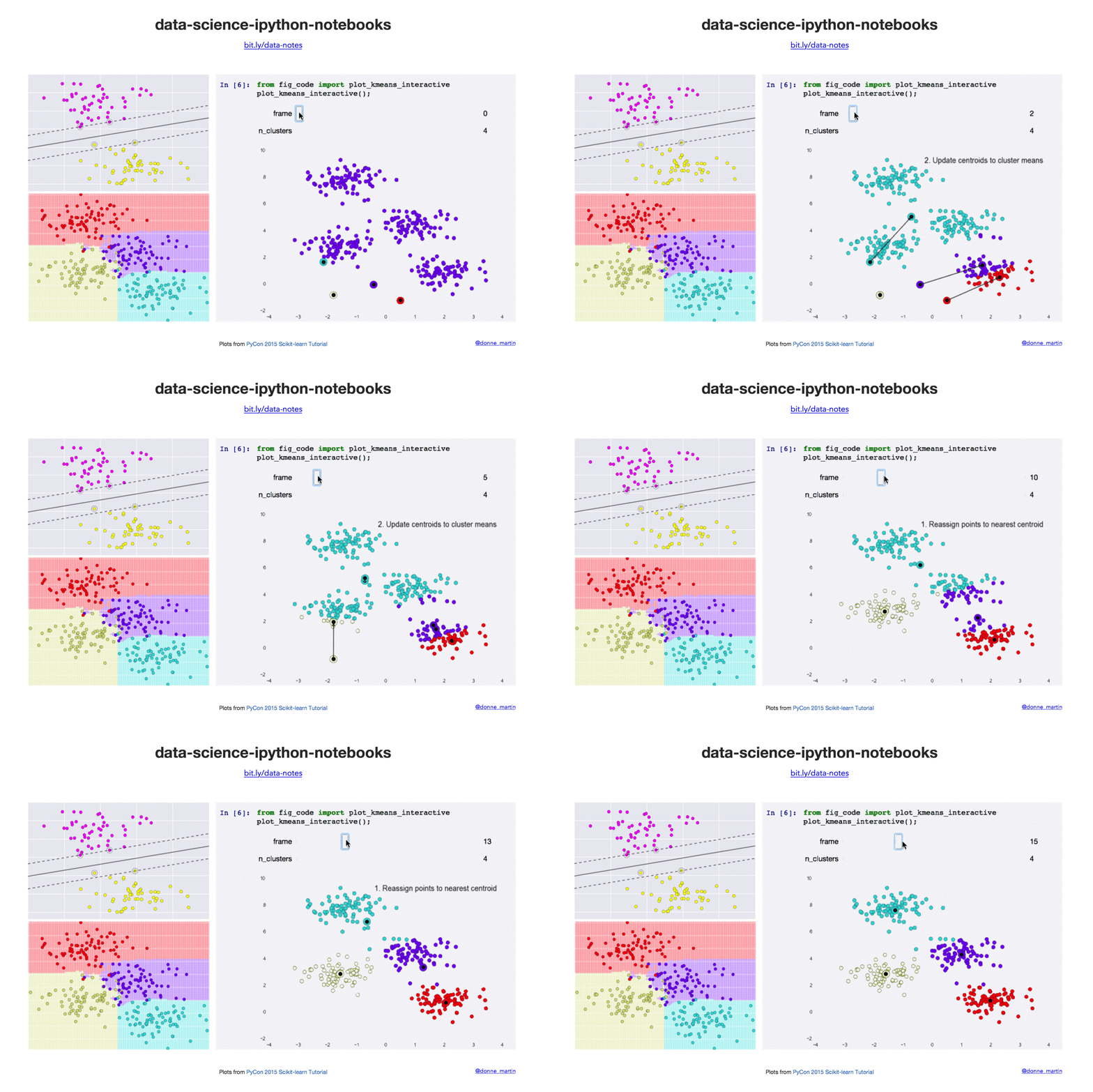
A clone of the Data Science iPython Notebooks Repository. A continually updated collection of iPython/Jupyter notebooks on every subject from scikit-learn to AWS. Chances are if it's related to data science, there's a beautifully maintained notebook about it somewhere in here.
By Matt Harrison
Modern pandas patterns and best practices for data manipulation. A practical guide to writing efficient, idiomatic pandas code for real-world data analysis workflows.

By Beej Jorgensen
A classic, freely available guide to C programming that has helped countless developers learn the language. Beej's approachable writing style and comprehensive coverage make this an essential resource for anyone learning C.

By Brian Kernighan & Dennis Ritchie
The definitive book on C, written by the creators of the language. Known simply as "K&R", this concise classic remains the authoritative reference for C programmers decades after its publication.

By Jens Gustedt
This is a beautiful book, and the fact the author has made it so freely available is truly a miracle of the internet.

By Zed Shaw
Zed Shaw has made a career teaching people how to code. His "Learn Code the Hard Way" set of books have brought in novices and experts alike, and while not everyone agrees with his methods, his comfortable delivery and clear familiarity are a great way to dive into an unfamiliar language.

By Jon Gjengset
An advanced resource for developers who have already mastered Rust fundamentals. Focuses on professional-level programming, covering techniques for building and maintaining larger codebases, creating powerful and flexible applications, and confidently expanding project scope and complexity.

By Al Sweigart
My journey through Al Sweigart's fun and straightforward take on some Python 3. His course is available as a book, a video course on Udemy, and for free online. I'd consider this a 'Python 101' book, with the additional bonus of some very practical examples.

By Muhammad Yasoob Ullah Khalid
Finished "hello world"? How about some name scoping, generators, & functional paradigms?

By Luciano Ramalho
If you 'Mastering Python', I guarantee sooner or later you will run into this book. Heralded by many as one of the best end-to-end Python books around, I honestly cannot wait to get started with this book. Julia and R have become my personal favorites, but there is just no denying the ease of use, modularity, and sheer popularity of Python (especially in regards to Data Science). I have borrowed the actual author's notebook repo to append with my own learning, and I intend to start on this as soon as I can.

By David Kopec
A hands-on approach to learning algorithms and data structures through Python. Covers search algorithms, constraint satisfaction, graph problems, genetic algorithms, and more classic CS fundamentals with practical implementations.
By Christopher Allen & Julie Moronuki
Haskell is a novelty language that eschews OOP paradigms for a purely functional approach. Personally, as a non traditional computer science student with a background in data, functional programming immediately and intuitively seemed like a better way to write code. There are always pros and cons, but so long as Church-Turing holds true, the machine seems generally indifferent. This book is a holistic way to get started.

By Daniel Higginbotham
Clojure headfirst! I've been on a Functional Programming kick lately, and this book has been fuel to the fire. Clojure is one of the best performing and well paying languages on the market, and I'm keen to have a better understanding of it under my toolbelt. I only swum a bit before realizing that learning a LISP while trying to grasp functional programming principles in an amazing production-optimized but functionally-impure playground is not the smartest idea. I have since resolved to learn the pure principles from Haskell, and revisit! As a side note, this book is probably one of the most fun programming books I've read so far.

By Chris Smith
An introductory book on F# that comes highly recommended, and also provides a relatively friendly entry into the mysterious world of functional programming which a friend described to me as 'writing code like you write math'. The repo included here is merely a mirror of the publicly available scripts that follow along side the book, which I am still working through.

By Phil Freeman
A book on PureScript from the guy who helped create it. I've been fascinated with functional languages, and it is quickly becoming my favorite way to style and think about programming. In practice however, a trade-off must often be made between working in a purely functional environment (and therefore forcing everyone else on your team to also learn Haskell) or programming in an popular environment like JavaScript, juicing it's existing functional features, and importing packages like Lodash when possible. PureScript attempts to achieve a happy medium betweeen these approaches, yielding a static, type-safed, GHC based compiler that can also compile down to CommonJS, can call to and from existing NPM packages easily. I look forward to working through these examples and doing more applied functional programming!

By Chris von Csefalvay
An amazing Gitbook on Julia; a young but fascinating technical language built for scientific computing. It exists as a hybrid between OOP (Objected Oriented Programming) and FP (Functional Programming), which allows it "write like Python but run like C" thanks to an incredible number of under-the-hood optimizations from leaders in the field. It suffers slightly from its novelty, especially with regard to package support and availablity of novice-level documenation (which is why many advocate against its use in production environment), but I fell in love with it as soon as I watched this video of it in action, and I couldn't wait to get started. Big shout out to Chris for his amazing repo designed for "people who need to get a job done, not computer scientists". (Not related to Mr. Shaw though)

By Drew Neil
A series of exercises following Practical Vim. Basically a sane flow of arcane commands that let you take advantage of one of the most powerful (and occasionally tempermental) text editors ever designed. I personally prefer using it via it's NeoVim incarnation, and I highly recommend it for macOS users. My experience with Vim so far has been learning to do just a little bit more every day. I know it sounds cheesy, because I've read it everywhere too, but Vim really will make you more effecient if you put up with it's mannerisms. This is the book (and author) that finally showed me how.

By Drew Neil
The hotly anticipated sequel by to Practical Vim, that is worth every cent of it's beta commands. People prefer to use Vim because of it's minimal CLI nature, but as someone who's used Atom, Sublime, Vscode, and other IDEs, you begin to miss certain power features and visual glitter that can brings coding a little closer to 20XX. This the book that takes that attempts to bridge the two worlds, and turn our text editor into an apex editor.

By David Thomas & Andrew Hunt
A timeless classic on software craftsmanship. Filled with practical advice on everything from career development to coding practices. The 20th Anniversary Edition updates the original wisdom for modern development while keeping the core principles that have helped countless programmers become better at their craft.

By Martin J. Osborne
I'm not even going to pretend I'm smart enough to understand what is going on here, but goddamn are the examples fun to read.
This repository is licensed under GNU General Public License v3.0. This may not apply to all works included herein.