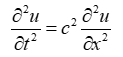
The wave equation describes the propagation of waves under ideal circumstances using the partial differential equation.
The solution is computed using 4 steps:
- Error checking is done to ensure that
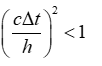 . If that condition is not met, the calulated ratio as well as the acceptable nt value should be provided.
 - Initilize the matrix as well as the boundary values
- Solving for the next column using Euler's method
- If there are insulated boundary conditions, after the interior points of the column has been evaluated, it has to be readjusted to account for the insulated boundary conditions.
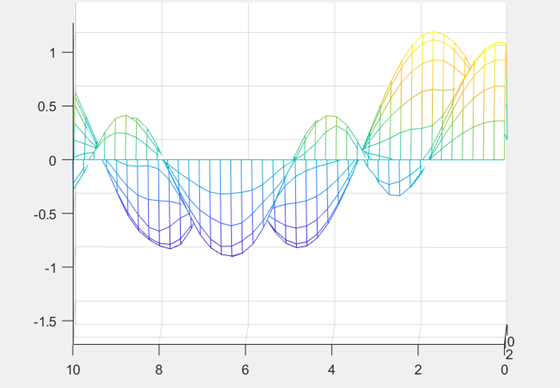
Example: Solving the wave equation using the command [x4a, t4a, U4a] = wave1d( 1, [0, pi], 10, [0, 10], 42, @u4a_init, @du4a_init, @u4a_bndry ) and displaying the solution using mesh( t4a, x4a, U4a )
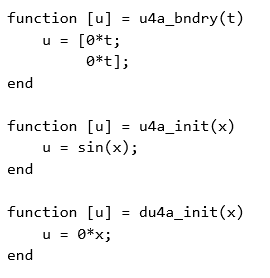
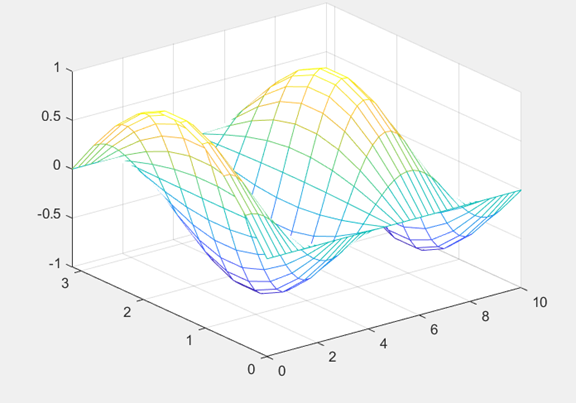
Example: Solving the wave equation using the command [x4a, t4a, U4a] = wave1d( 1, [0,pi], 10, [0, 3*T], n_t, @u4a_init, @du4a_init, @u4a_bndry ) where one of the boundary conditions is insulated.
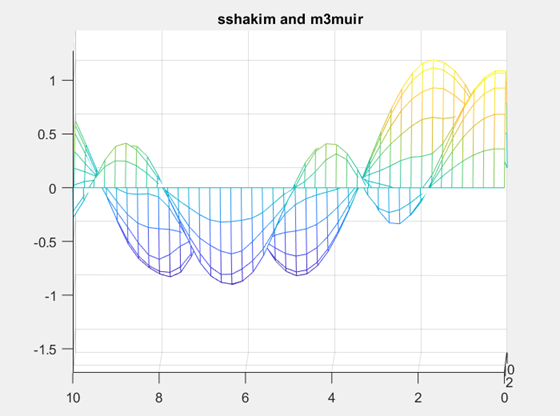
Because there is an insulated boundary at one end, when it gets to that end, the wave will travel in a reflected direction rather than going back in the same direction. The period in both direction is the same however they are shifted due to the insulated boundary.