Amico is a next-generation Autonomous AI Agent Framework designed for embedded AI devices and multi-agent systems.
amico-core: Interfaces and workflows for the Engine Layer.amico-sdk: Interfaces and workflows for the AI Agent and Interaction Layers.amico-mods: Pluggable implementation modules.amico-hal: Hardware Abstraction Layer.
- Model Context Protocol (MCP) Integration: Improves environmental awareness and control.
- Agent Networking: Supports peer-to-peer networking using Web3 technologies.
- WASM Support: Supports WASM-based AI Agent runtime.
Note: This is a prototype version of Amico. Currently, the Amico runtime functions as a command-line chatbot for testing the SDK. The Engine Layer integration is still in progress, while the Agent Layer and Interaction Layer are undergoing refactoring and integration.
git clone https://github.com/AIMOverse/amico.git
cd amicoexport OPENAI_API_KEY=your_api_key
# To configure a custom base URL for OpenAI:
# export OPENAI_BASE_URL=your_base_url
# Use a Helius API key for Solana actions.
# We recommend Helius API for on-chain actions, as the default Solana RPC is unstable.
# More details at https://helius.dev
export HELIUS_API_KEY=your_api_key
cargo run -p amicoThis will create a wallet for the agent. The BIP-39 seed phrase will be saved in agent_wallet.txt.
Once the runtime starts, you'll have access to a command-line chatbot interface. You can develop plugins, extend Amico’s functionality, and test them in this environment.
$ cargo run -p amico
   Compiling amico-sdk v0.0.2 (/home/.../amico/amico-sdk)
   Compiling amico-plugins v0.1.1 (/home/.../amico/amico-plugins)
   Compiling amico v0.0.1 (/home/.../amico/amico)
    Finished `dev` profile [unoptimized + debuginfo] target(s) in 1m 08s
     Running `target/debug/amico`
This is a PROTOTYPE VERSION of Amico.
Check out our docs for more information:
https://www.amico.dev

Found OPENAI_API_KEY
Found OPENAI_BASE_URL
Found HELIUS_API_KEY

Agent wallet addresses:
- Solana: F1t15xYmLqrALX45p9XVpvwxcRsjXKq676xDWEFazUYD
- Ethereum: 0xA7283cb5A2Fc2766674325FA6a9f5711aC8f1b63

Using service plugin: StdInMemoryService
Tools enabled:
- create_asset: Create an NFT on Solana representing yourself
- buy_solana_token: Buy a Solana token
- check_ethereum_balance: Check your ETH balance on Ethereum
- check_solana_balance: Check your SOL balance on Solana
- search_for_jokes: Search for jokes

I'm Amico, your personal AI assistant. How can I assist you today?
--------------------
Enter your message
>
-
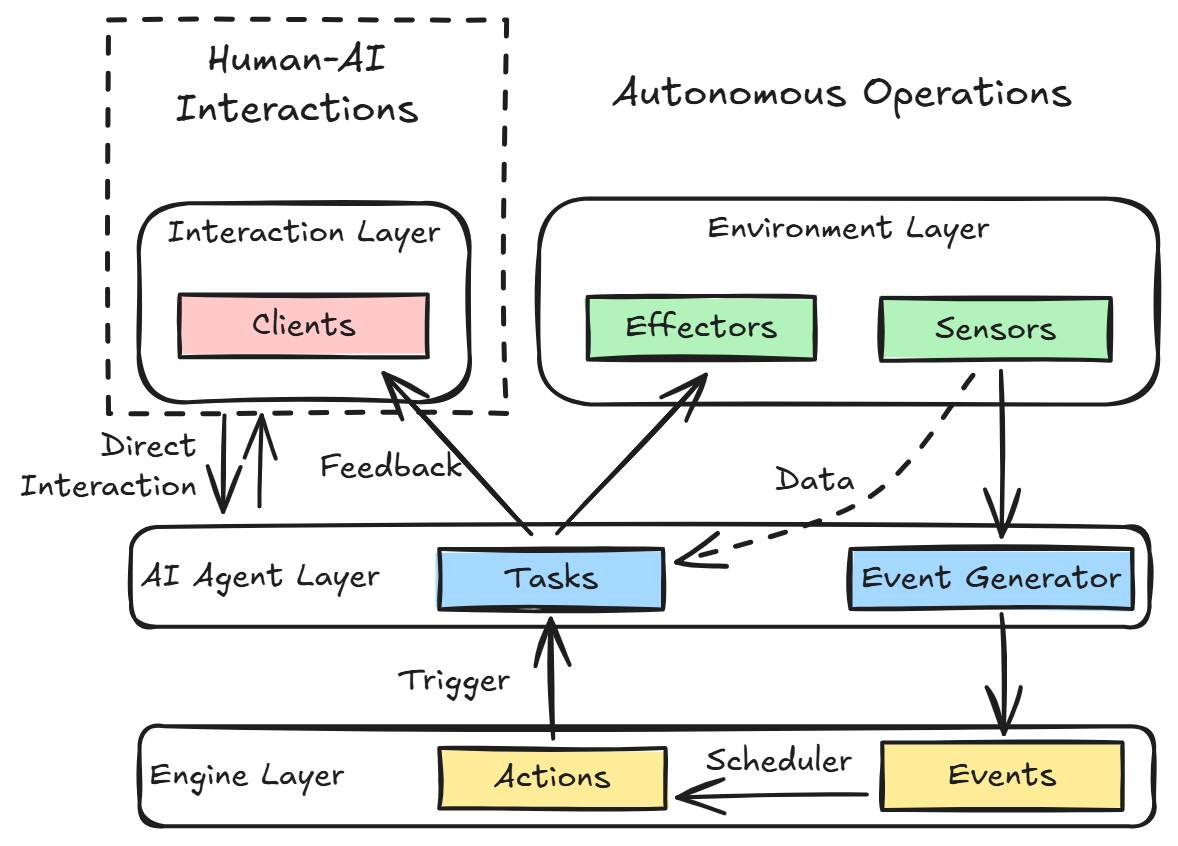
Interaction Layer: Manages communication between agents and the environment. This includes:
- Sensors: Acquire the current state of the environment.
- Effectors: Execute actions.
- The environment can be physical (real-world) or virtual (the Internet, blockchain, etc.).
- Hardware sensor and effector drivers are implemented in the
amico-firmwarecrate. - Future Plans: Decoupling into:
- Environment Layer: Passively receives/responds to environmental inputs.
- Interaction Layer: Actively handles actions and state changes from users and agents.
-
Agent Layer: Encapsulates core agent logic, including state management, decision-making, and action execution. Key components:
- LLM Providers and RAG Systems implemented as plugins.
- Task execution models (see Model-Based Agents below) implemented in
amico-std, with plugin support for custom models.
-
Engine Layer: Handles task scheduling, event generation, and action selection. The default Action Selector is in
amico-std, but custom implementations can be added via plugins.
- LLM Services: Provides content generation, integrating LLM calls, RAG knowledge base, tool calling, etc.
- LLM Providers: API integrations for services like OpenAI, DeepSeek, etc.
- Effectors: Execute actions such as hardware control, transactions, content posting, and messaging.
- Sensors: Capture environmental data, such as sensor readings and social media content.
- Hardware Abstraction: Low-level interface for embedded device interaction.
- RAG Systems: Implements retrieval-augmented generation.
- Task Executors: Provides task execution workflows (e.g., Model-Based Agents).
- Action Selectors: Implements action selection algorithms.
- Event Generators: Generates events based on the current environment state.
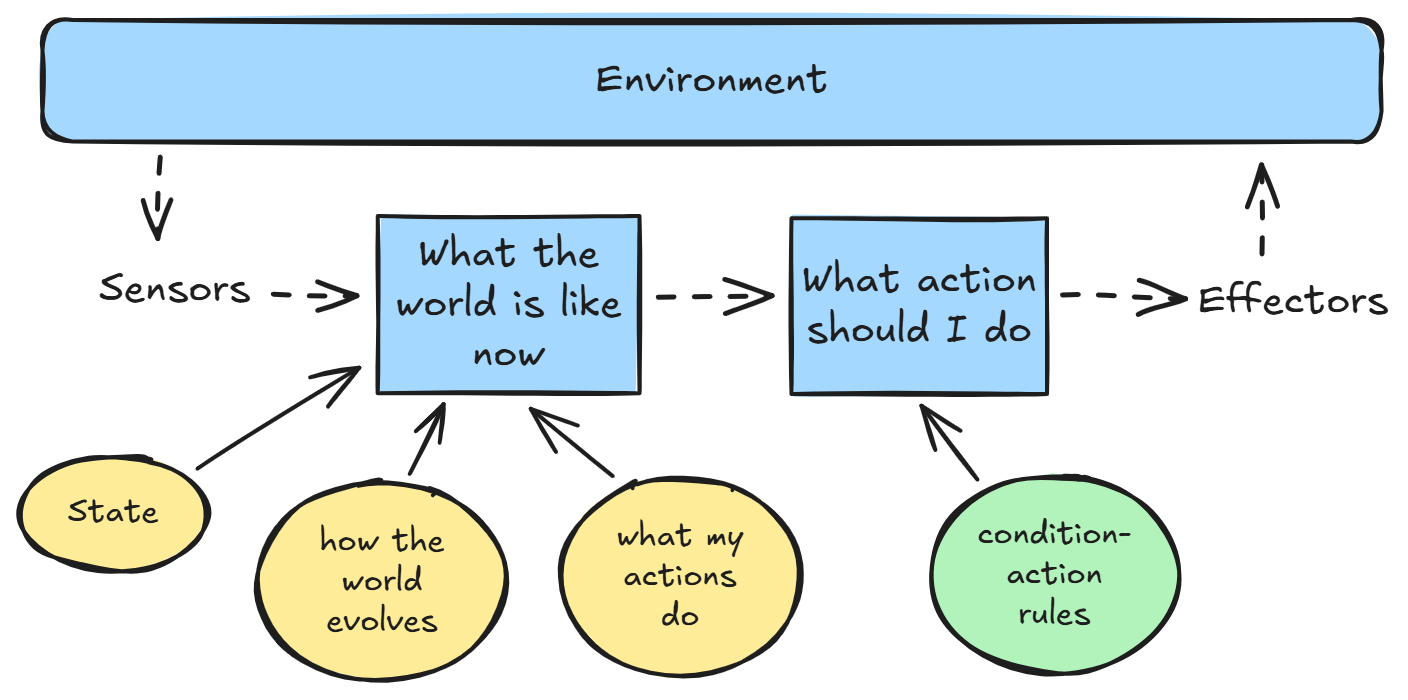
- State Representation: The agent perceives and represents the current environment state.
- World Evolution: Predicts the impact of actions.
- Condition-Action Rules: Guides decision-making.
-
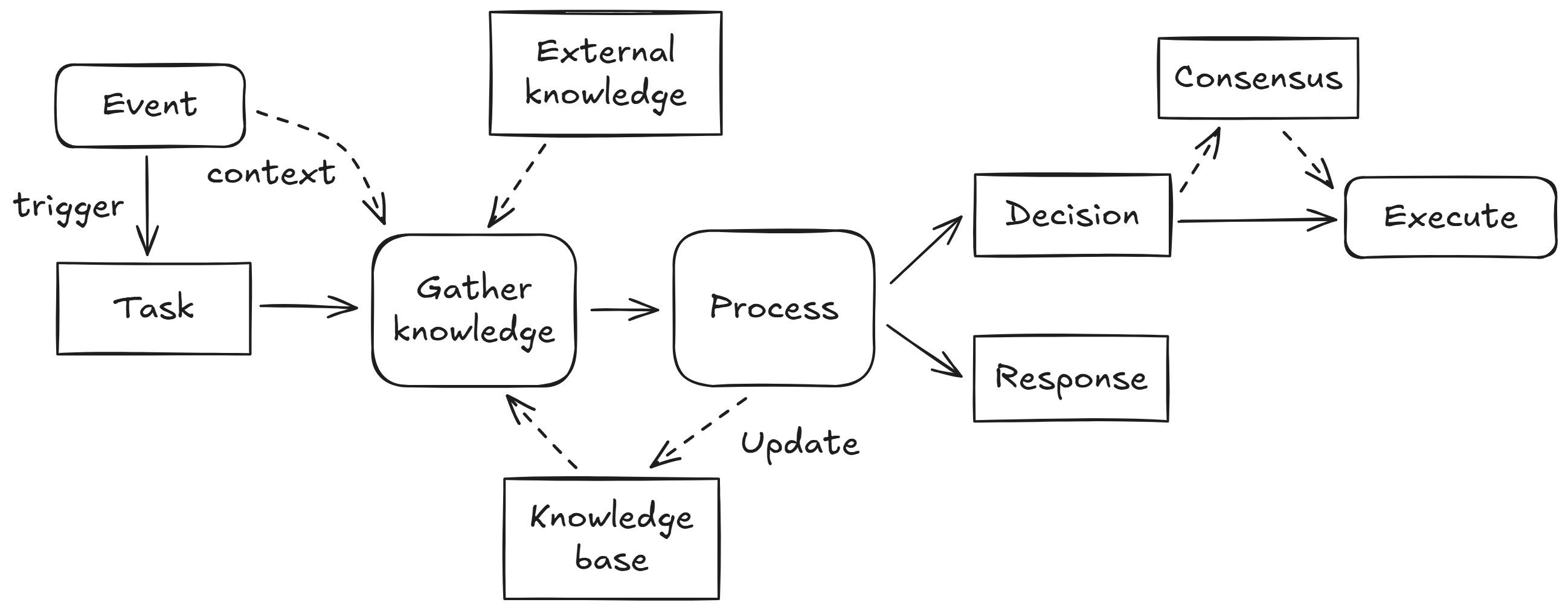
Event-Triggered Tasks
- Tasks initiate based on events (e.g., timers, on-chain/off-chain signals, messages from other agents).
- Each event carries context, providing additional knowledge for decision-making.
-
Knowledge Acquisition
- The agent gathers information from its internal knowledge base and real-time data sources.
- Information is synthesized into a comprehensive report to support decision-making.
-
Decision Making
- The agent evaluates potential actions and selects the most informed response.
- Possible responses include executing a task, responding to a user, or both.
- In SWARM systems, agents may seek consensus before executing critical actions.
-
Execution of Decision
- Actions can range from executing transactions to posting content.
- If required, the agent communicates with other agents before execution.
-
Agent Response
- Provides human-readable feedback after execution.
- Responses may include tool calls for embedded devices (e.g., triggering a motor).
Amico is released under the MIT License.
Contributions are welcome! Please read our contributing guidelines before submitting a pull request.