


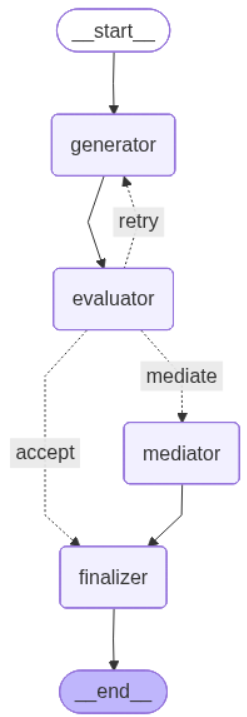
This project implements an agentic pipeline for e-commerce product classification using LangGraph, Pydantic, and LLMs. The system uses Generator, Evaluator, and Mediator agents to propose, review, and finalize product category assignments, ensuring higher accuracy and consistency than single-shot classification, such as the HDBSCAN clustering method.
- Agent-based architecture (Generator → Evaluator → Mediator → Finalizer)
- Schema enforcement with Pydantic to guarantee valid JSON responses
- Chunked classification pipeline for handling large datasets efficiently
- Category knowledge integration for consistent taxonomy-based decisions
- Fallback to mediator agent when Generator and Evaluator disagree
- Confidence scoring for downstream analysis
-
Generator Agent
- Proposes a category for a product.
- Uses taxonomy knowledge and product description.
-
Evaluator Agent
- Accepts or rejects the Generator’s proposal.
- Provides a counterproposal if rejected.
-
Mediator Agent
- Resolves conflicts between Generator and Evaluator.
- Makes the final categorization decision.
-
Finalizer
- Logs and stores the final classification.
| Category | Definition | Example Products |
|---|---|---|
| Home & Kitchen | Household, cooking, or decor items | Cookware sets, wall art, bedding |
| Party Supplies | Products for celebrations | Balloons, banners, party hats |
| Festive Supplies | Seasonal holiday products | Christmas ornaments, Halloween costumes |
| Clothing & Apparel | Wearable items for men, women, and children | T-shirts, jeans, dresses |
| Toys & Games | Play and educational items | Dolls, puzzles, LEGO sets |
| Jewelry & Accessories | Fashion and decorative items | Necklaces, handbags, belts |
| Office Supplies | Products for workplaces and schools | Pens, notebooks, printers |
| Garden & Outdoor | Gardening and outdoor living equipment | Planters, lawn mowers, outdoor lights |
git clone https://github.com/JavieraAlmendrasVilla/Multi-agent-system-product-classification.git
cd Multi-agent-system-product-classificationpython -m venv .venv
source .venv/bin/activate # On Linux/Mac
.venv\Scripts\activate # On Windowspip install -r requirements.txttest_result = agent_classify_sample(final_df, taxonomy, sample_size=30)final_result = run_pipeline_chunked(final_df, taxonomy, chunk_size=50)- LangGraph – stateful agent orchestration
- LangChain – LLM interaction and prompting
- Pydantic v2 – schema validation
- Ollama – LLM inference locally
- Python 3.11
🟢 Generator Agent running for product: "pink paper parasol"
🔎 Evaluator Agent checking product: "pink paper parasol", proposed category: Party Supplies
🤝 Mediator Agent resolving conflict for: "pink paper parasol"
✅ Finalized classification for product: pink paper parasol -> Party Supplies
Final dataframe includes:
- Category → Final category
- Reason → Explanation for decision
- Confidence → Confidence score (0.5–0.7 default)
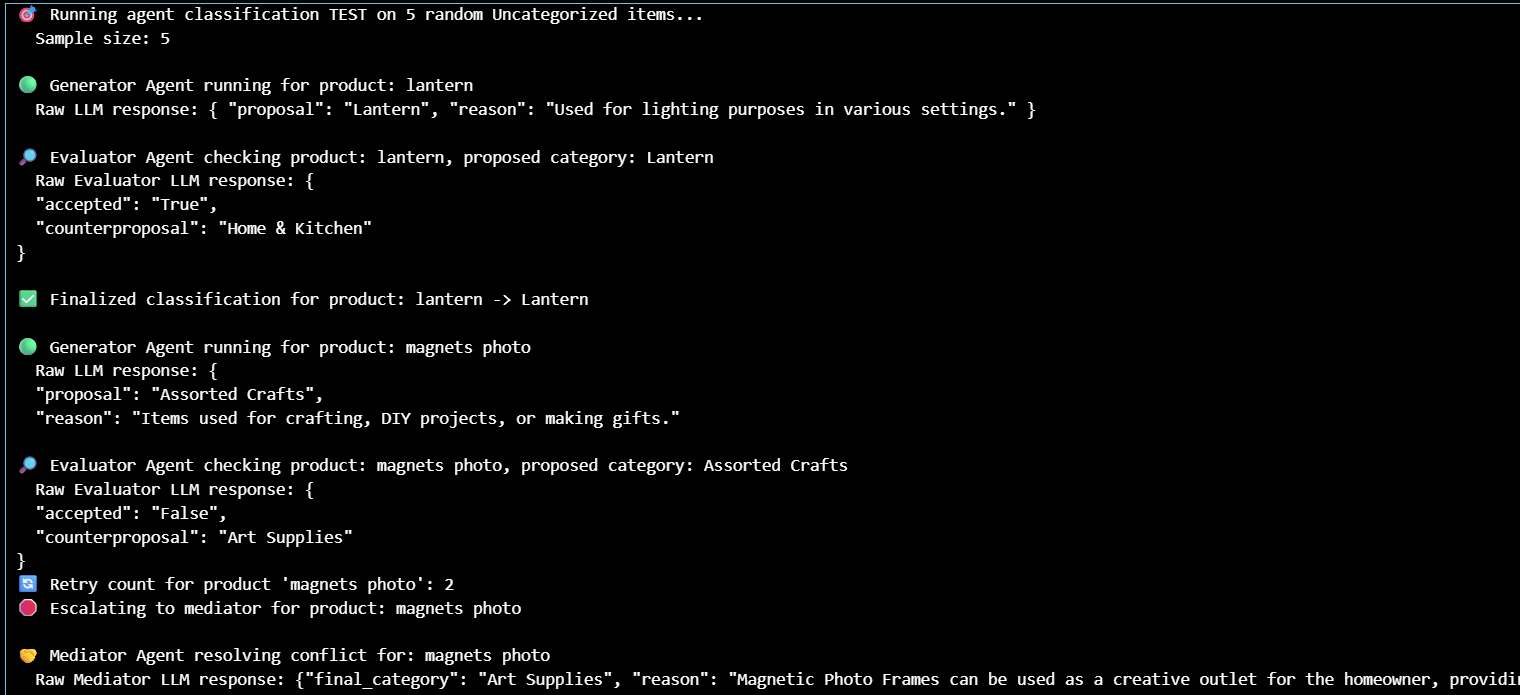
Solution for a random sample of 20 products from the UCI E-commerce dataset
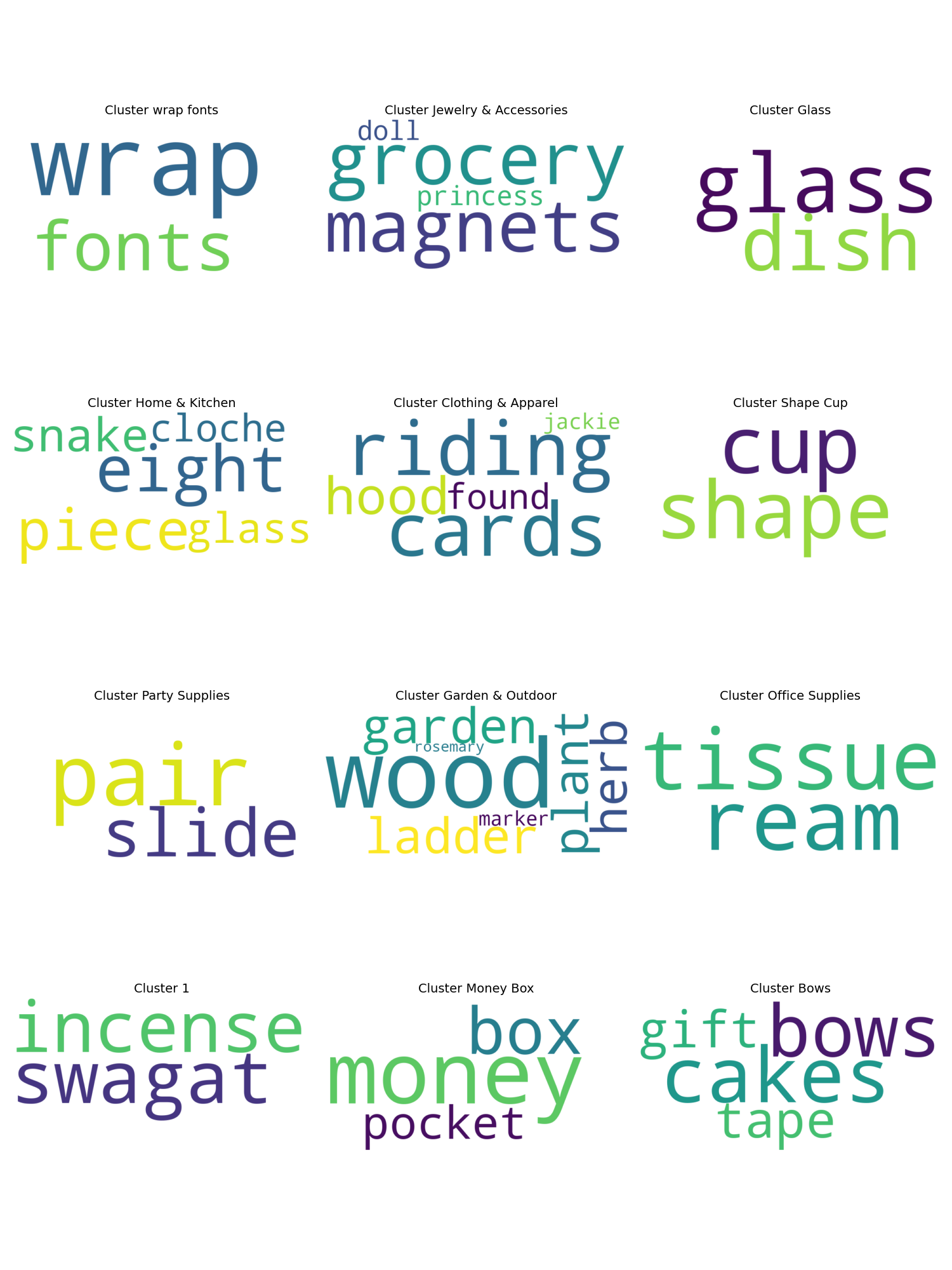
- Improve taxonomy coverage (electronics, automotive, etc.)
- Implement React agents to improve accuracy and avoid overfitting
- Reduce run-time
- Extend with multilingual product classification
Pull requests are welcome! For major changes, open an issue first to discuss what you’d like to add.