
This project demonstrates the development of an unsupervised ML algorithm that segments customers based on lifetime value (LTV) and provides actionable business insights. The goal is to help e-commerce companies identify high-value customers, understand purchasing behavior, and inform personalized marketing strategies.
The platform uses the Online Retail Dataset (UCI Machine Learning Repository) and was developed and deployed as a proof-of-concept in one day.
- Source: UCI Online Retail Dataset
- Features:
| Column | Description |
|---|---|
| InvoiceNo | Unique invoice number |
| StockCode | Unique product code |
| Description | Product description |
| Quantity | Number of items purchased |
| InvoiceDate | Date and time of invoice |
| UnitPrice | Price per unit |
| CustomerID | Unique customer identifier |
| Country | Customer country |
-
Data preprocessing steps:
- Removed rows without
CustomerID - Removed negative
UnitPricerows - Aggregated at customer-level to compute RFM metrics: Recency, Frequency, Monetary (TotalRevenue)
- Removed rows without
-
Customer Segmentation
-
Calculated RFM metrics:
- Recency: Days since last purchase
- Frequency: Number of invoices/orders
- Monetary: Total spend
-
Due to heavy skew in the Monetary and Frequency distributions, standard IQR-based outlier detection was ineffective. Instead, thresholds were set empirically, guided by Elbow and Silhouette analysis, to ensure well-separated, meaningful customer segments.
-
Applied log transformation and standard scaling
-
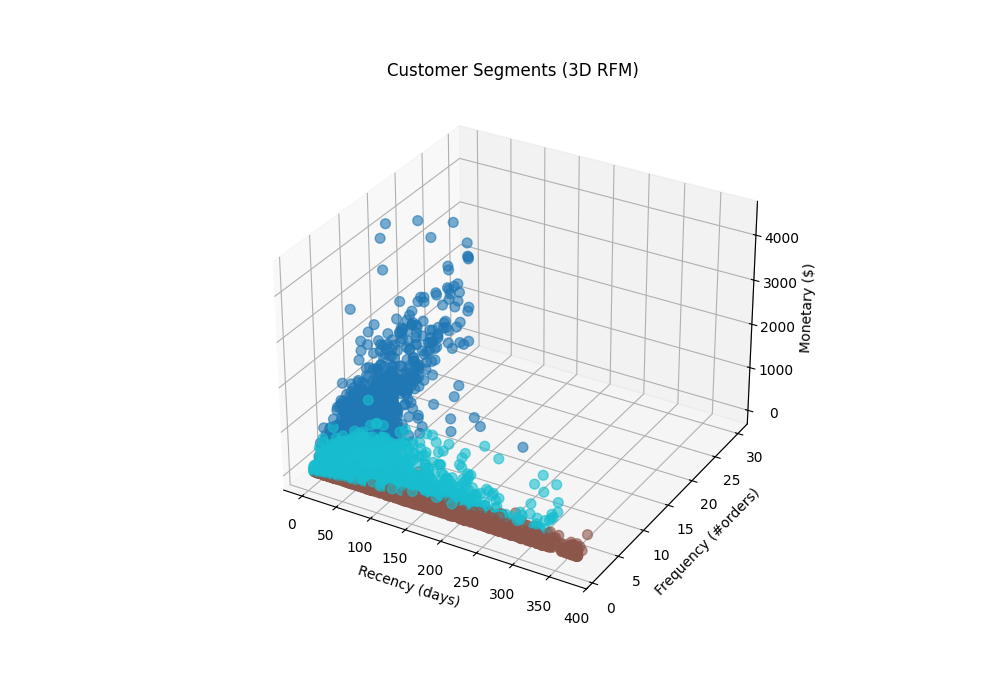
Used KMeans clustering to identify 3 segments:
- VIP (Blue)
- Middle Class (Turquoise)
- Inactive (Brown)
-
-
KPIs Computed per Segment
- Total Revenue per Segment
- Average Order Value (AOV)
- Purchase Frequency
- Recency
- Segment Size
- Revenue Contribution (%)
See the Analytics Dashboard on Tableau
| Segment | % of Customers | % of Revenue | Notes |
|---|---|---|---|
| VIP | 21% | 57% | High frequency, high spend. Most profitable segment. |
| Middle Class | 40% | 35% | Highest AOV, lower frequency than VIP. Opportunity for upselling. |
| Inactive | 39% | 8% | Rarely purchase; low revenue contribution. |
Insights:
- 61% of customers (VIP + Middle Class) generate 92% of total revenue
- Middle Class customers have higher AOV but half the frequency of VIPs
- Targeted campaigns should focus on retention and upsell for VIP and Middle Class customers
- Inactive segment can be targeted with win-back campaigns or cost-efficient marketing strategies
- Clone the repository:
git clone https://github.com/JavieraAlmendrasVilla/Customer-Segmentation.git- Install dependencies:
pip install -r requirements.txt- Run the notebook:
jupyter notebook customer_segmentation.ipynb- Python (pandas, numpy, matplotlib, seaborn, scikit-learn)
- Jupyter Notebook
- KMeans clustering for segmentation
- PCA for visualization
This project demonstrates the ability to:
- Preprocess and clean real-world e-commerce data
- Compute RFM metrics and detect outliers
- Segment customers with unsupervised learning
- Derive actionable business insights
- Visualize results clearly for stakeholders