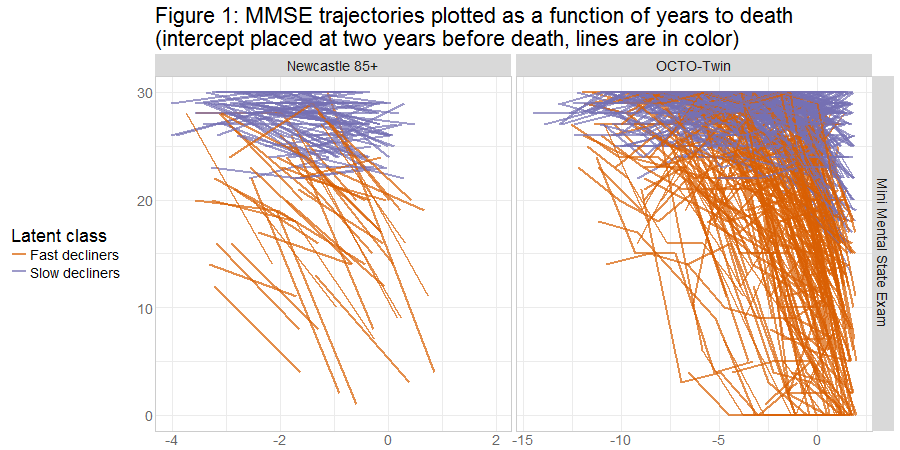
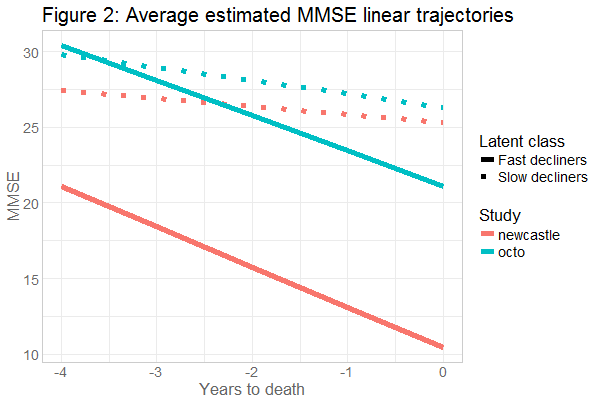
There is substantial literature suggesting a terminal drop prior to the time of death, as described by terminal decline hypothesis. However, there is mixed evidence in demonstrating that this is an inevitable process. In this study, we investigated the heterogeneity in terminal decline in two European longitudinal studies of ageing from Sweden and the UK: the OCTO-Twin and the Newcastle 85+ Study.
In a coordinated but independent analytical approach, we identified unobserved groups of individuals with similar trajectories of terminal decline by fitting Tobit Growth Mixture Models to the Mini-Mental State Examination (MMSE) scores within each cohort, controlling for age at baseline and years to death from study entry, sex, education, social class and dementia incidence.
The current analyses identified two independent trajectories of terminal decline, with one consistently capturing individuals who did not exhibit an ostensible rate of terminal decline, while the other describing a steep terminal decline in measures of global cognition within each study.
Our results showed heterogeneity in terminal decline in similar age populations from two different European countries and suggest that terminal decline is not necessarily a normative process.