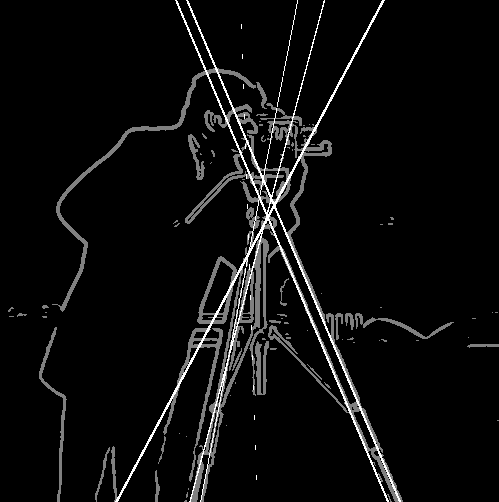
The algorithm is composed of several stages.
-
Preprocessing: image is converted to grayscale and then Gaussian blur is applied which consists of convolving the grayscale image with the following filter:
2/159, 4/159, 5/159, 4/159, 2/159
4/159, 9/159, 12/159, 9/159, 4/159
5/159, 12/159, 15/159, 12/159, 5/159,
4/159, 9/159, 12/159, 9/159, 4/159
2/159, 4/159, 5/159, 4/159, 2/159
-
Edge map: to extract the edge map, the Sobel operator is used.

Then the gradients are computed in the following way:
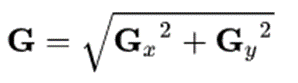
And if the gradients are greater than some preset threshold, then the pixel is an edge pixel.
- Mapping of edge points to the Hough space and storage in an accumulator: For each edge point we convert it to polar coordinates and if it is within the image boundaries, the accumulator for that point is incremented.
- Interpretation of accumulator to generate infinite lines: for each point in the accumulator, we check if it is larger then a preset threshold and if it is a peak in its neighborhood then the polar coordinates representing a line are converted back to cartesian coordinates.
- Drawing the lines: for each point we check if it is on a detected line.
To perform all these steps, multiple transformers are implemented which receive an image and return a transformed image.
Transformers used:
- Convolution and GaussianBlur simply uses a convolution
- GrayScale
- Sobel – uses 2 convolutions (vertical and horizontal Sobel filters) then it computes their gradients – the output is an edge map
- Hough – this takes an edge map, and it outputs the edge map with the infinite lines
In the parallel versions, each thread receives a list of positions in the image, split sequentially and performs some action required by the transformer.
The MPI version operates in a similar manner, only that the input image must be sent to each process at the start.
Implementation is an adapted version of https://github.com/davidchatting/hough_lines/blob/master/HoughTransform.java
Performance
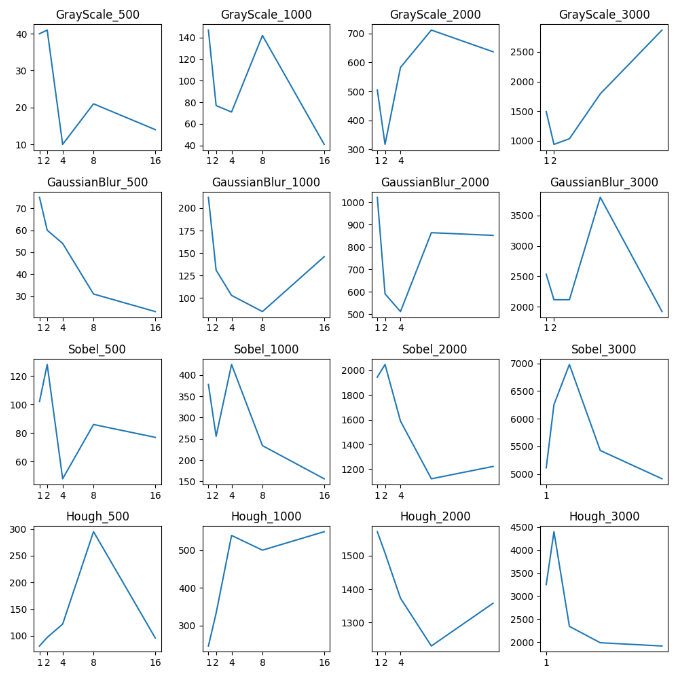
Title of each plot has the following format Transformer_Size of the image
x-axis represents the number of threads
y-axis represents the time in milliseconds