There is one (1.00) ball though.
This Unity demo shows the application of two major OOP strategies:
- Model-View-Presenter approach for UI and logic decoupling.
- Dependency Injection with the Zenject framework.
The initial requirements for a demo scene:
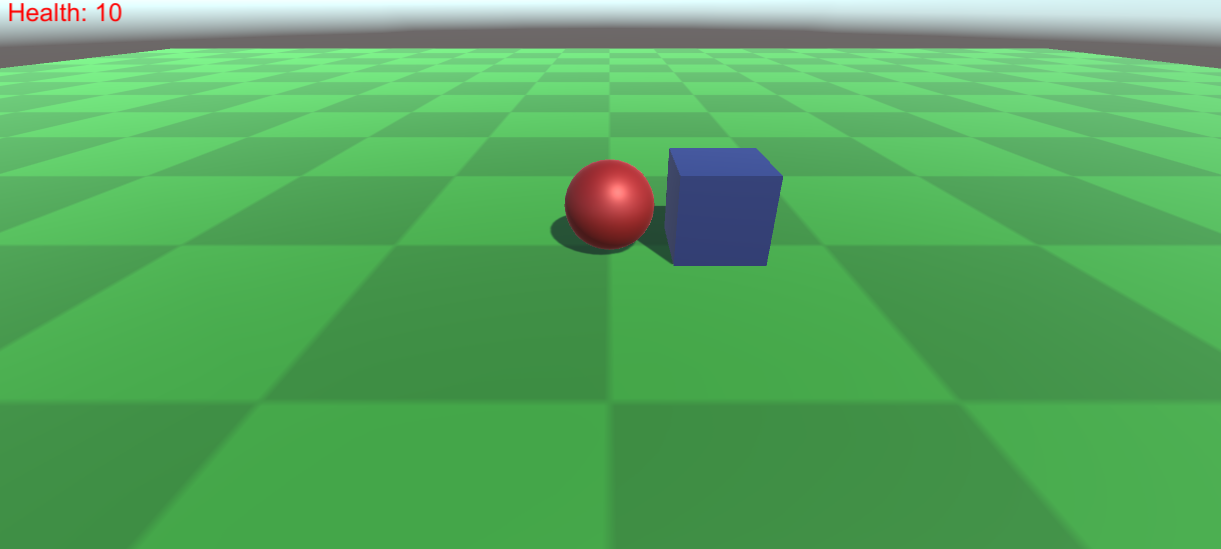
- A red ball that has a health value.
- A blue box (you can move it with mouse in scene view).
- On collision with a box, a ball loses one health point.
- The health is always displayed on screen.
Read about the implementation details below.
This idea is that there are three components:
- View - a component that displays UI.
- Model - an actual data storage that can implement various mechanics. Not visible.
- Presenter - an object that exchanges data between View and Model.
This resembles some sort of a wild combination of Observer and Mediator patterns.
The demo scene has several components.
BallView is a class that displays text directly by adjusting the value of Text object.
For the sake of demonstration, it also checks for collisions.
It has an event that notifies listeners about collision, and it can accept a new health value to display.
BallModel is some sort of inner logic hidden deep in the engine. It can notify listeners about new health values. It also has a method that applies damage to an object (i.e. reduces health).
BallPresenter effectively listens for events from a BallView and then notifies BallModel, and vice versa.
Thus, the order of calls is: View -> Presenter -> Model -> Presenter -> View.
Note that BallModel knows nothing about two other components. BallView doesn't know anything either. This means they've been successfully decoupled.
Also note that BallModel and BallPresenter have to be created somewhere manually.
To allow for even more loose coupling, we can apply dependency injection principle for BallPresenter. This allows to replace models and views with any others that fit the requirement.
BallInjection is a class that inherits Zenject injector MonoInstaller, and is used in SceneContext Game Object (see object hierarchy).
What this object does is instantiating each dependency and injecting them in constructors (when possible) or methods.