



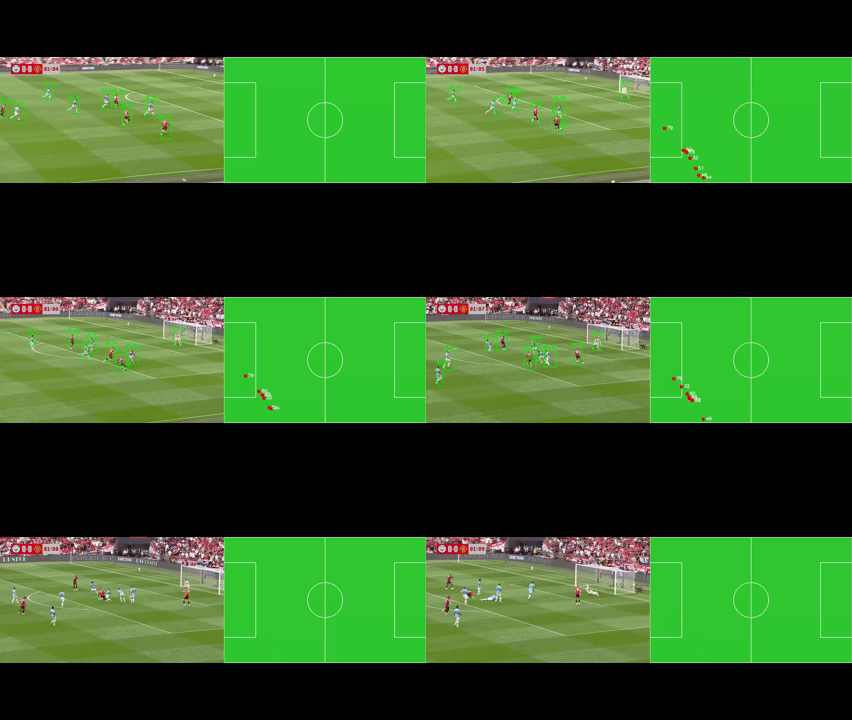
This project tackles the advanced computer vision challenge of player re-identification in sports footage. The system maintains consistent IDs for each player, even through occlusion or when re-entering the frame, by projecting their positions onto a virtual 2D birds-eye view of the field.
- Dual-Model Architecture: Utilizes two specialized YOLOv8 models—one for high-accuracy player detection and another for field geometry segmentation.
- Real-time Field Registration: Calculates a homography matrix on-the-fly in every frame to map player positions from the 2D video to a virtual 2D overhead map.
- Virtual Birds-Eye View: Generates a dynamic, top-down tactical map showing player positions in real-time.
- Robust ID Tracking: Achieves near-perfect player re-identification by tracking stable (X, Y) coordinates on the virtual map, making it resilient to camera motion and player occlusions.
The final implementation uses a powerful, state-of-the-art two-model approach to achieve highly robust player tracking through Field Registration. This technique creates a virtual birds-eye view of the pitch by understanding the field's geometry, allowing for near-perfect re-identification.
The pipeline works as follows:
-
Two Specialized AI Models: Instead of a single, generic model, this solution uses two "expert" models fine-tuned for specific tasks:
- Player Detector: A YOLOv8 model fine-tuned exclusively to be an expert at locating players, goalkeepers, and referees.
- Field Segmenter: A YOLOv8 segmentation model fine-tuned to precisely identify the geometry of the pitch, such as the penalty area.
-
On-the-Fly Homography: In every frame of the video:
- The Field Segmenter detects the visible penalty area and extracts its corners.
- These image points are matched to their known, real-world coordinates on a standard football pitch.
- A Homography Matrix is calculated in real-time. This matrix acts as a "translator" that can convert any pixel coordinate from the video frame into its corresponding (X, Y) coordinate on a 2D map.
-
Virtual Birds-Eye View Projection:
- The Player Detector finds all players in the frame.
- The bottom-center point of each player's bounding box is projected onto the 2D map using the homography matrix.
-
Robust Tracking:
- Player IDs are maintained by tracking the stable (X, Y) coordinates on the 2D virtual map. This is incredibly robust to occlusions and camera motion. The powerful ByteTrack algorithm is used on the initial video to provide stable base IDs that are then projected.
-
Visualization:
- The final output video shows a side-by-side view of the original footage with tracked players and the dynamic, virtual birds-eye map showing their real-time positions.
This project uses Python 3.10+. You can install the required libraries via pip:
pip install ultralytics opencv-python numpy tqdmEnsure your project folder (two_model) has the following structure. All required models and video files are included.
two_model/
|
├── final_training_run/
│   └── regularized_model/
│       └── weights/
│           ├── best.pt               # Field Segmenter Model
│           └── last.pt
│
├── final_training_runs/
│   └── detector_strong_generalizer/
│       └── weights/
│           ├── best.pt               # Player Detector Model
│           └── last.pt
|
├── 15sec_input_720p.mp4
|
└── virtual_tracker.py                # Main script
All logic is contained within a single, powerful script.
- Navigate to the
two_modeldirectory in your terminal. - Run the main script:
python virtual_tracker.py
- The script will start processing the video. A window will pop up showing the live output, and a progress bar will be displayed in the terminal.
- Upon completion, the final annotated video will be saved as
final_virtual_tracker_output.mp4in thetwo_modelfolder.
The final solution was reached after iterative development, exploring multiple state-of-the-art techniques:
-
Initial Approach (IOU Tracker): The first attempt used a simple IOU-based tracker.
- Outcome: Failed significantly. It produced a large number of "ghost boxes" and suffered from constant ID switching.
-
Advanced Tracker (ByteTrack): The next step was to use a professional-grade algorithm like ByteTrack.
- Outcome: Huge improvement. Ghosting was eliminated, and ID stability was much higher, but it still struggled with long occlusions.
-
Human-in-the-Loop Fine-Tuning: An interactive tool was developed to manually correct the base model's failures, and this data was used to fine-tune the detector.
- Outcome: A critical turning point. The fine-tuned detector was significantly more robust but revealed that a single model struggled to learn both player detection and field geometry simultaneously.
-
Final Approach (Two-Model Field Registration): The final, successful approach was to treat this as a system of two "expert" models working together. This provided an expert player detector and an expert field segmenter, enabling the highly robust virtual map projection.
- Overfitting: Initial fine-tuning on small datasets led to overfitting. This was solved by creating more diverse datasets and using strong regularization during training.
- Tracker Logic: The limitations of simple trackers led to the adoption of the more advanced Field Registration technique.
- Homography Stability: Calculating a stable homography requires consistently detecting at least 4 landmarks. The final model, which focuses on detecting large areas like the
penalty_area, proved to be the most reliable solution.
- More Diverse Landmark Detection: Train the field model on more landmark types (corners, center circle) to make the homography calculation even more resilient.
- Advanced 2D Map Tracking: Implement a Kalman Filter on the (X, Y) map coordinates to allow for smoother trajectories and prediction of player movement.