A linked list is a linear data structure where each element is a separate object. Linked list elements are not stored at contiguous location; the elements are linked using pointers.
Each node of a list is made up of two items - the data and a reference to the next node. The last node has a reference to null. The entry point into a linked list is called the head of the list. It should be noted that head is not a separate node, but the reference to the first node. If the list is empty then the head is a null reference.
Current - The Current is a reference of type Node to the node that is currently being looked at. When traversing, you create a new Current variable at the Head to guarantee you are starting from the beginning of the linked list.

Traversal When traversing a linked list, you are not able to use a foreach or for loop. We depend on the Next value in each node to guide us where the next reference is pointing. The Next property is exceptionally important because it will lead us where the next node is and allow us to extract the data appropriately.
Adding a Node
Order of operations is extremely important when it comes to working with a Linked List. What I mean by this is you must be careful that all references to each link/node is properly assigned.
An example can be with adding a node to a linked list. If we want to add a node with an O(1) efficiency, we have to replace the current Head of the linked list with the new node, without losing the reference to the next node in the list.
Linear data structures One characteristic of linked lists is that they are linear data structures, which means that there is a sequence and an order to how they are constructed and traversed
what even is Big O?
Most of us have probably heard the term “Big O Notation”, even if we had no idea what it meant the first time that we heard someone use it. My personal experience with it has always been in the context of designing algorithms (or being asked to evaluate the efficiency of an algorithm). But Big O is really all over and omnipresent within computer science.
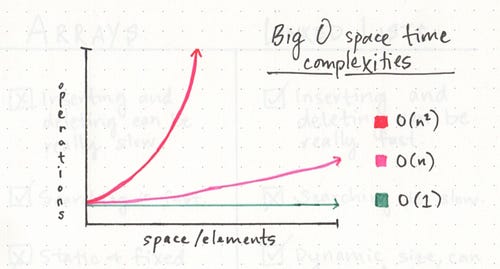
-
n O(1) function takes constant time, which is to say that it doesn’t matter how many elements we have, or how huge our input is: it’ll always take the same amount of time and memory to run our algorithm.
-
An O(n) function is linear, which means that as our input grows (from ten numbers, to ten thousand, to ten million),