When creating a web page, you add tags (known as markup) to the contents of the page. These tags provide extra meaning and allow browsers to show users the appropriate structure for the page.
There is two types of markup
- Structural markup: the elements that you can use to describe both headings and paragraphs
- Semantic markup: which provides extra information.
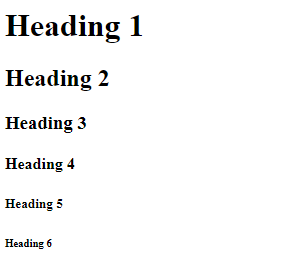
HTML defines six levels of headings. A heading element implies all the font changes, paragraph breaks before and after, and any white space necessary to render the heading. The heading elements are H1, H2, H3, H4, H5, and H6 with H1 being the highest (or most important) level and H6 the least.
represents a paragraph. Paragraphs are usually represented in visual media as blocks of text separated from adjacent blocks by blank lines and/or first-line indentation, but HTML paragraphs can be any structural grouping of related content, such as images or form fields.

By enclosing words in the tags we can make characters appear bold.
By enclosing words in the tags we can make characters appear italic.
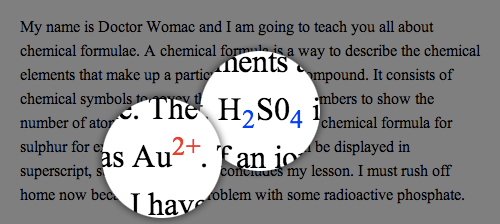
Subscript text appears half a character below the normal line and is sometimes rendered in a smaller font. Subscript text can be used for chemical formulas, like H2O to be written as H2O. Superscript: The tag is used to add a superscript text to the HTML document. The tag defines the superscript text.
(br) the browser will automatically show each new paragraph or heading on a new line.
(hr) To create a break between themes

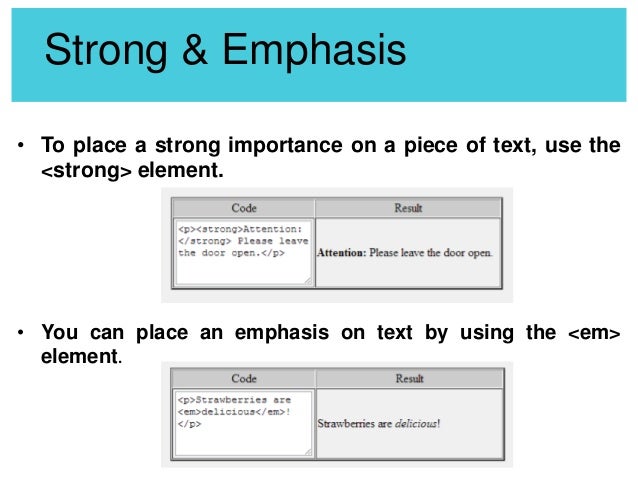
The use of the (strong) element indicates that its content has strong importance.
The (em) element indicates emphasis that subtly changes the meaning of a sentence.
There are two elements commonly used for marking up quotations
- The (blockquote) element is used for longer quotes that take up an entire paragraph.
- The (q) element is used for shorter quotes that sit within a paragraph.

Cascading Style Sheets, fondly referred to as CSS, is a simply designed language intended to simplify the process of making web pages presentable. CSS allows you to apply styles to web pages. More importantly, CSS enables you to do this independent of the HTML that makes up each web page. CSS is easy to learn and understood but it provides powerful control over the presentation of an HTML document.
- CSS saves time : You can write CSS once and reuse same sheet in multiple HTML pages.
- Easy Maintainence : To make a global change simply change the style, and all elements in all the webpages will be updated automatically.
- Search Engines : CSS is considered as clean coding technique, which means search engines won’t have to struggle to “read” its content.
- Superior styles to HTML : CSS has a much wider array of attributes than HTML, so you can give a far better look to your HTML page in comparison to HTML attributes.
- Offline Browsing : CSS can store web applications locally with the help of offline catche.Using of this we can view offline websites.

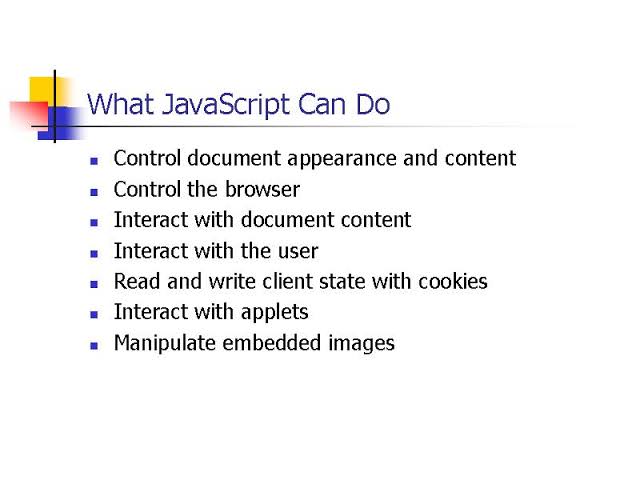
JavaScript is the Programming Language for the Web. JavaScript can update and change both HTML and CSS. JavaScript can calculate, manipulate and validate data.
JavaScript ("JS" for short) is a full-fledged dynamic programming language that can add interactivity to a website. It was invented by Brendan Eich (co-founder of the Mozilla project, the Mozilla Foundation, and the Mozilla Corporation).
Decision Making statements are if, else, elseif and switch these statements are used in making decisions.
if..else statements is used where you want to execute a set of code when a condition is true and another if the condition is not true.
switch statements is used where you want to execute one block of code out of many.

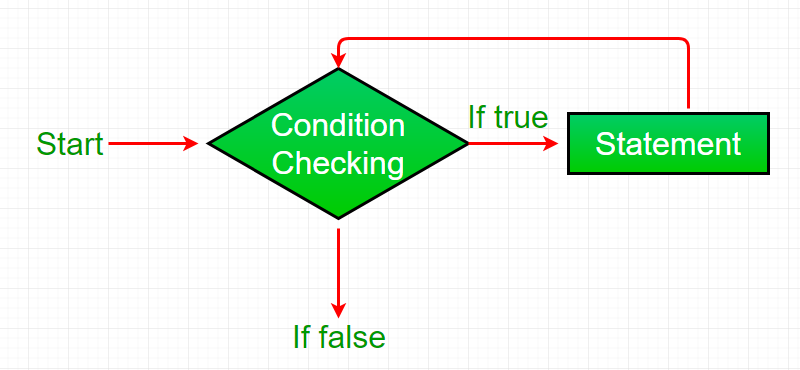
The JavaScript loops are used to iterate the piece of code using for, while, do while or for-in loops. It makes the code compact. It is mostly used in array.
The _______ command is used to save your changes to the local repository.
For more INFO you can visit github profile