Relational Databases RDBMS
databases are table based databases
have standard schema
predefined schema for structured data
vertically scalable
structured query language
examples: MySql, Oracle, Sqlite,
Postgres and MS-SQL
good fit for the complex query
non-relational or distributed database
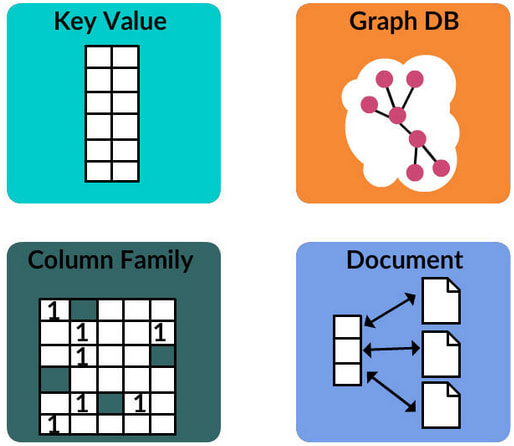
databases are document based, key-value pairs, graph databases or wide-column stores
not have standard schema
dynamic schema for unstructured data.
horizontally scalable
Unstructured Query Language
examples: MongoDB, BigTable
not good fit for complex queries
structured
used by business professionals or program developers for administering, updating, maintaining and manipulating the databases or tables that are used for business decision-making.
unstructured and unrelated data
NoSQL is used for Big data and real-time web apps.
For example, companies like Twitter, Facebook and Google collect terabytes of user data every single day.
as it follows the key-value pair way of storing data similar to JSON data
In most typical situations, SQL databases are vertically scalable. You can manage increasing load by increasing the CPU, RAM, SSD, etc, on a single server.
NoSQL databases are horizontally scalable. You can just add few more servers easily in your NoSQL database infrastructure to handle the large traffic.
Structured Query Language
A relational database stores and organizes data points that are related to one another. Based on the relational database model, a relational database presents data sets as a collection of tables and provides relational operators to manipulate the data in tabular form.

is an outline, diagram, or model. In computing, schemas are often used to describe the structure of different types of data. Two common examples include database and XML schemas.
This tells us about the structural view of the database. It gives us an overall description of the database. A database schema defines how the data is organised using the schema diagram

There are three levels of the schema. The three levels of the database schema are defined according to the three levels of data abstraction.
View Schema
Logical Schema
Physical Schema

databases are flexible, scalable, and highly adaptable to the data management demands of modern businesses.
every item in the DB stands on its own this simple modification means that they're essenntially key-value stores
each item in the DB has only two fields a unique key and value
value can be something like json document containg
if asingle DB server is not enough to store all your data or handle all the queries you can split the workload across two or more severs each server will then be responsible for only part of your DB
data objects are stored as separate documents inside a collection instead of in the traditional columns and rows of a relational database. The documents are stored as binary JSON or BSON objects.
This is an easy one, and a hands down win for MongoDB. The schemaless design of MongoDB documents makes it extremely easy to build and enhance applications over time, without needing to run complex and expensive schema migration processes as you would with a relational database.
With MongoDB, there are more dynamic options for updating the schema of a collection, such as creating new fields based on an aggregation pipeline or updating nested array fields. This benefit is particularly important as databases grow in size. In contrast, larger MySQL databases are slower to migrate schemas and stored procedures that can be dependent on the updated schemas. MongoDB’s flexible design makes this much less of a concern.
1-don’t have the reliability functions which Relational Databases have (basically don’t support ACID(Atomicity, Consistency, Isolation, and Durability).
2-In order to support ACID developers will have to implement their own code, making their systems more complex.
3-This may reduce the number of safe applications that commit transactions, for example bank systems.
4-are very new compared to Relational Databases, which means that are far less stable and may have a lot less functionalities.