AP Economics - Micro
- What are economic models and why are they so important to economists?
- How do three simple models - the production possibly frontier, comparative advantage, and the circular-flow diagram - helps us understand how modern economies work?
- Why is an understanding of the difference between positive economics and normative economics important for the real world application of economic principles?
- Why do economists sometimes disagree?
Model: a simplified representation of a real situation that is used to better understand real-life situation.

-
The PPF is a diagram that shows the combinations of two goods that are possible for a society to produce at full employment.
-
We can use the PPF model to answer questions like:
- How much can we produce?
- What will it cost us to change our mix of production?
- Does it make sense to import the goods from somewhere else?
- Opportunity Cost: what must be given up in order to get a good.
- If Boeing decides to change its production from point A to point B, it will produce 8 more small jets but 6 fewer Dreamliners: each small jet has an opportunity cost of 6 / 8 = 3 / 4 of a Dreamliner.
Two possibilities:
- An increase in factors of production: resources used to produce goods and services.
- Better technology: the technical means for producing goods and services.
- Land includes natural resources, such as mineral deposits, oil, natural gas, water, and actual land acreage.
- Labor is the mental and physical abilities of the workforce.
- Physical capital is manufactured items used to produce other goods and services.
- Human capital is the educational achievements and skills of the labor force (which increase labor productivity).
It makes sense to produce the things you’re especially good at producing… and buy everything else from others.
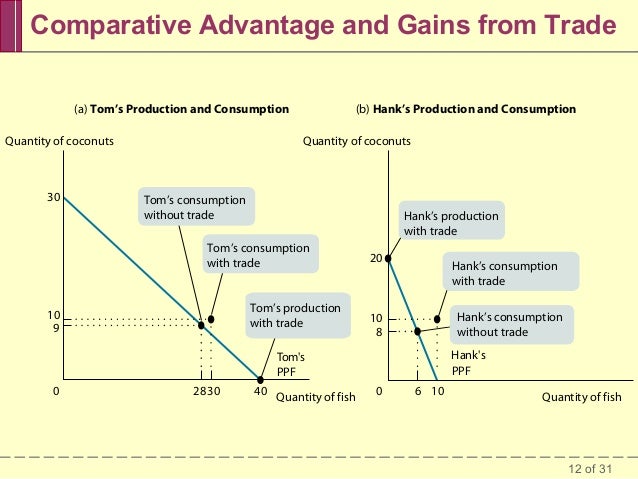
- A country has a comparative advantage in producing a good or service if its opportunity cost of producing the good or service is lower than other countries’.
- An individual has a comparative advantage in producing a good or service if his or her opportunity cost of producing the good or service is lower than for other people.
-
Don’t confuse absolute with comparative advantage.
- Just because the United States can produce more of both goods doesn’t mean we’re better off without trade.
-
Pay attention to opportunity costs:
- If it’s cheaper for Brazil to produce small jets than it is for the United States, the United States will want to import small jets from Brazil.
- Trade takes the form of barter when people directly exchange goods or services that they have for goods or services that they want.
- The circular-flow diagram represents the transactions in an economy by flows around a circle.
- A household is a person or a group of people that share their income.
- A firm is an organization that produces goods and services for sale.