HTML : (Hyper Text Markup Language), it is the standard markup language for creating Web pages and describes the structure of a Web page. HTML consists of a series of elements that tell the browser how to display the content.
<article><aside><details><figcaption><figure><footer><header><main><mark><nav><section><summary><time>
Structure is the information components within an HTML document. For instance: headings, lists and paragraphs.
HTML provides some elements that are strictly "structural" - meaning that they are used to define the structure for a web page, in semantic terms. Structural markup encodes information about an element's role. There are paragraph containers, heading containers, a variety of list containers, containers for creation and organization of tables. There are inline containers that indicate that text should be emphasized and strongly emphasized.
| Tags Name | Tags |
|---|---|
| Header | <H1>,....<H6> |
| Paregraph | <p> |
| Bold | <B> |
| Italic | <i> |
| Line break | <br /> |
| Horizontalrules | <hr /> |
- CSS stands for Cascading Style Sheets
- CSS describes how HTML elements are to be displayed on screen, paper, or in other media
- CSS saves a lot of work. It can control the layout of multiple web pages all at once
- External stylesheets are stored in CSS files
For more information Flash Cards about CSS Selectors 🙂
The advantage of external stylesheets is that it can be created once and the rules applied to multiple web pages. Should you need to make widespread changes to your site design, you can make a single change in the stylesheet and it will be applied to all linked pages, saving time and effort.

JavaScript is high-Level Programming Language often abbreviated as JS can be used in browsers to make websites more interactive,interesting, and user-friendly.

Statement Each individual instruction or step is known as a statement.
Comments You should write it to explain what your code does. They help make your code easier to read and it can help you and others to read your code.
JavaScript includes variables which hold the data value and it can be changed anytime. JavaScript uses reserved keyword var to declare a variable. A variable must have a unique name.
- The name must begin with a letter, ($) or an underscor (_).
- You cannot use keywords or reserved words.
- The name can contain letters,numbers,($), or an underscore (_).
- You must not use a dash(-) or aperiod (.) in a variable name.
Array is a special type of variable. It doesn't just store one value; it stores a list of values.
First, you must declare a variable of the desired array type. Second, you must allocate the memory that will hold the array, using new, and assign it to the array variable. Thus, in Java all arrays are dynamically allocated.
Comparison operators are used in logical statements to determine equality or difference between variables or values:
-
(==) ⟶ equal to
-
(===) ⟶ equal value and equal type
-
(!=) ⟶ not equal
-
(!==) ⟶ not equal value or not equal type
-
(>) ⟶ greater than
-
(<) ⟶ less than
-
(>=) ⟶ greater than or equal to
-
(<=) ⟶ less than or equal to
Logical operators are used to determine the logic between variables or values:
- (&&) ⟶ and
- (||) ⟶ or
- (!) ⟶ not and
- (||) ⟶ or
- (!) ⟶ not
Joining multiple strings together is known as concatenation. The concatenation operator. The concatenation operator (+) concatenates two or more string values together and returns another string which is the union of the two operand strings. The shorthand assignment operator += can also be used to concatenate strings.
Evaluations You can analyze values in your scripts to determine whether or note they match expected results.
Decision Using the results of evaluations, you can decide which path your script should go down.
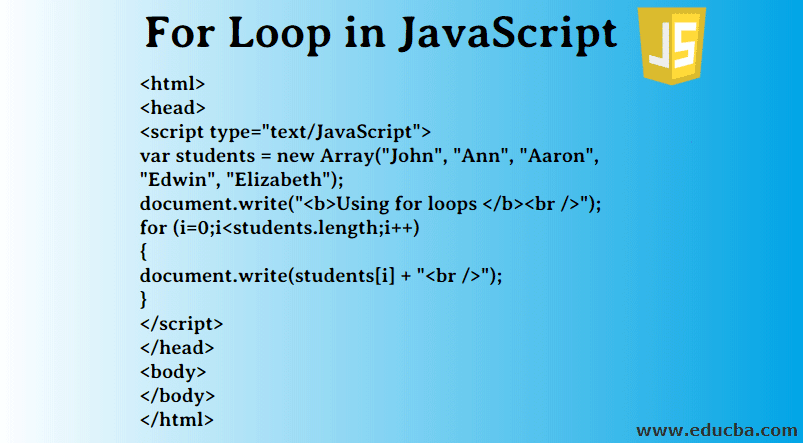
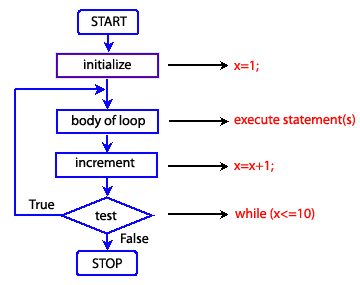
Loops It helps you where you will want to perform the same set of steps repeatedly.
Using For loop:
Using While loop:
© 2021