
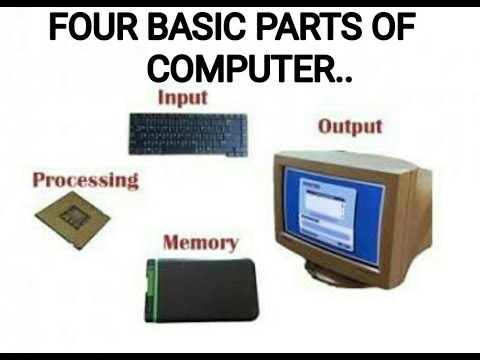
first of all i understaded that all the computers must have the 4 componants of these parts bellow to run :
- Input device
- storage device
- CPU(Central processing Unit)
- output device
- they take in info
- store it as data
- process it
- output the result
Binary data is a type of data that is represented or displayed in the binary numeral system. Binary data is the only category of data that can be directly understood and executed by a computer. It is numerically represented by a combination of zeros and ones.

Binary data is considered the native data/language of a computer and it interacts with the lowest abstraction layer of its hardware. This type of data is produced whenever a process is performed on a computer. The application requesting the process sends instructions in a high-level language that is ultimately converted into binary data to be executed or sent to the processor. All processes, regardless of their type, are converted into binary form before execution. Most binary data can only be read by a computer, not a human.
Combinational logic circuits can be classified as digital logic circuits that do not have any storage elements. We can consider them in many respects to be purely a logic circuit, with an effectively instantaneous output change that reflects the change in inputs. From a modeling perspective, this could be implemented using logic equations, truth tables, lookup tables, or primitive logic gates, but the ultimate effect is the same.
Computer hardware is any physical device used in or with your machine, whereas software is a collection of codes installed onto your computer's hard drive. Word processing software uses the computer processor, memory, and hard drive to generate and save documents. In a computer, hardware is what makes a computer work.
All software uses at least one hardware device to run. Take for example, a video game, which is software; it uses the computer processor (CPU), memory (RAM), hard drive, and video card to work. Word processing software uses the computer processor, memory, and hard drive to generate and save documents.
Most computers require at least a display, hard drive, keyboard, memory, motherboard, processor, power supply, and video card to properly function. if any of these devices are absent or faulty, an error is encountered, or the computer will not start. Adding hardware such as a disc drive (e.g. CD-ROM or DVD), modem, mouse, network card, printer, sound card, or speakers are not required, but give the computer additional functionality.

computer can operate without software being installed. Nevertheless, if an operating system or interpreter is not found on the computer, it either generates an error or doesn’t output any information. Installing programs onto the computer along with an operating system gives the computer supplementary capacities. For example, a word processor is not required, but it allows you to create documents as well as letters.
References for binary & data References for Hardware and software