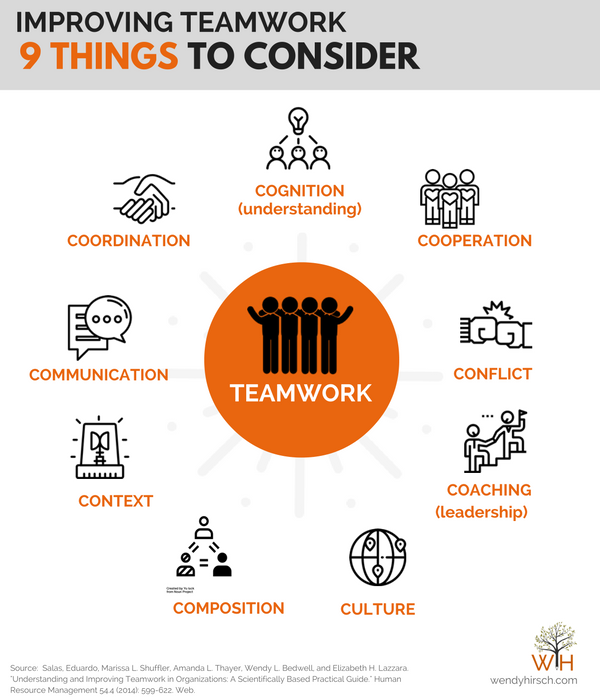
Teams depend on the personalities of the members, as well as the leadership style of managers. ... Having mutual respect, common and aligned goals, open communication, and patience can all help make for a successful team.
- Mutual respect and understanding are in getting to know one another. When conflicts inevitably arise, mutual respect will play a role in collaborative problem-solving.
- The power of a team is the fact that individuals bring their respective skills to the collective.
- An important step in the formula for what makes a team successful is primarily establishing an objective.
- The ability to be adaptable and flexible to make edits along the way is a great characteristic of what makes a good team. Cause of changes and issues are bound to come up in the working together.
- Teams work together and teams fail together. Not one person should take all the praise nor should one person suffer all the blame. (No Scapegoats)
- Mistakes happen. If there’s a setback or something goes wrong, own it and fix it.
- One of the primary traits that people must retain while working in a team is patience.
- Leaders need to be able to delegate tasks and work to their team.(Good teams need a good leader.)
- A competitive spirit helps to promote advancement and innovation. It keeps people consistently trying to be better at every step of the way.
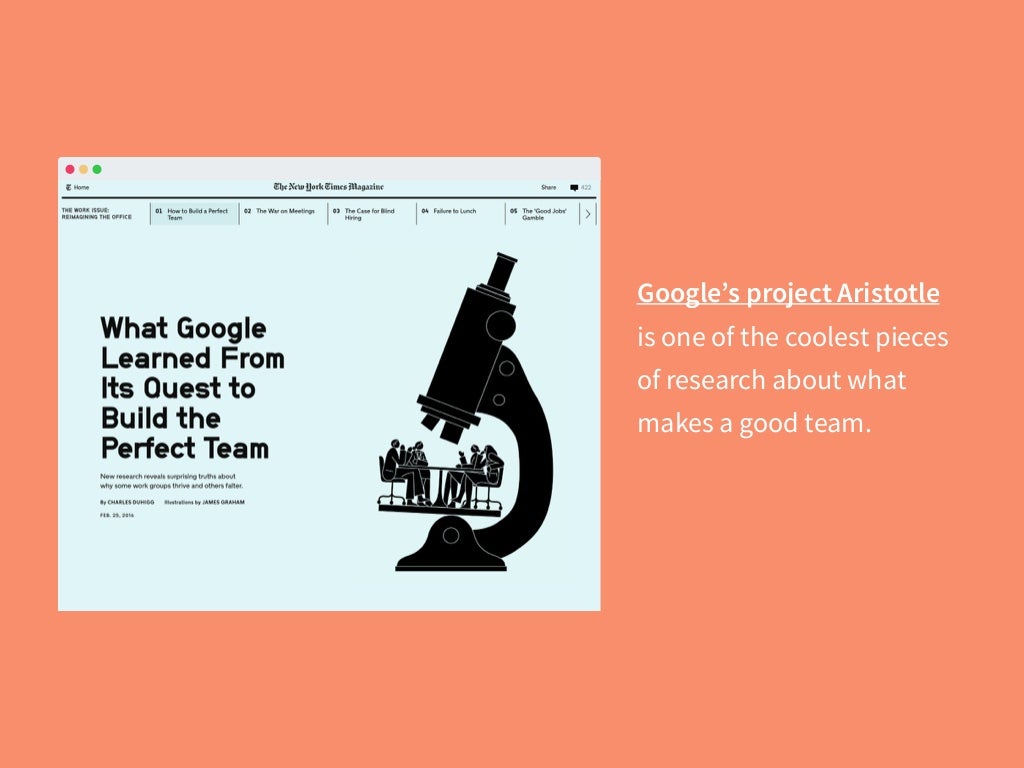
Project Aristotle’s researchers began by reviewing a half-century of academic studies looking at how teams worked. Were the best teams made up of people with similar interests? Or did it matter more whether everyone was motivated by the same kinds of rewards? Based on those studies, the researchers scrutinized the composition of groups inside Google: How often did teammates socialize outside the office? Did they have the same hobbies? Were their educational backgrounds similar? Was it better for all teammates to be outgoing or for all of them to be shy? They drew diagrams showing which teams had overlapping memberships and which groups had exceeded their departments’ goals.

our data-saturated age enables us to examine our work habits and office quirks with a scrutiny that our cubicle-bound forebears could only dream of. Today, on corporate campuses and within university laboratories, psychologists, sociologists and statisticians are devoting themselves to studying everything from team composition to email patterns in order to figure out how to make employees into faster, better and more productive versions of themselves. ‘‘We’re living through a golden age of understanding personal productivity,’’ says Marshall Van Alstyne, a professor at Boston University who studies how people share information. ‘‘All of a sudden, we can pick apart the small choices that all of us make, decisions most of us don’t even notice, and figure out why some people are so much more effective than everyone else.
imagine you have been invited to join one of two groups Team A is composed of people who are all exceptionally smart and successful. When you watch a video of this group working, you see professionals who wait until a topic arises in which they are expert, and then they speak at length, explaining what the group ought to do.