Wireframing is a practice allows you to define and plan the information hierarchy of the design for a website, app, or product.
Without the distractions of colors, typeface choices or text, wireframing lets you plan the layout and interaction of your interface.
The importance of Wireframing with examples in this picture:
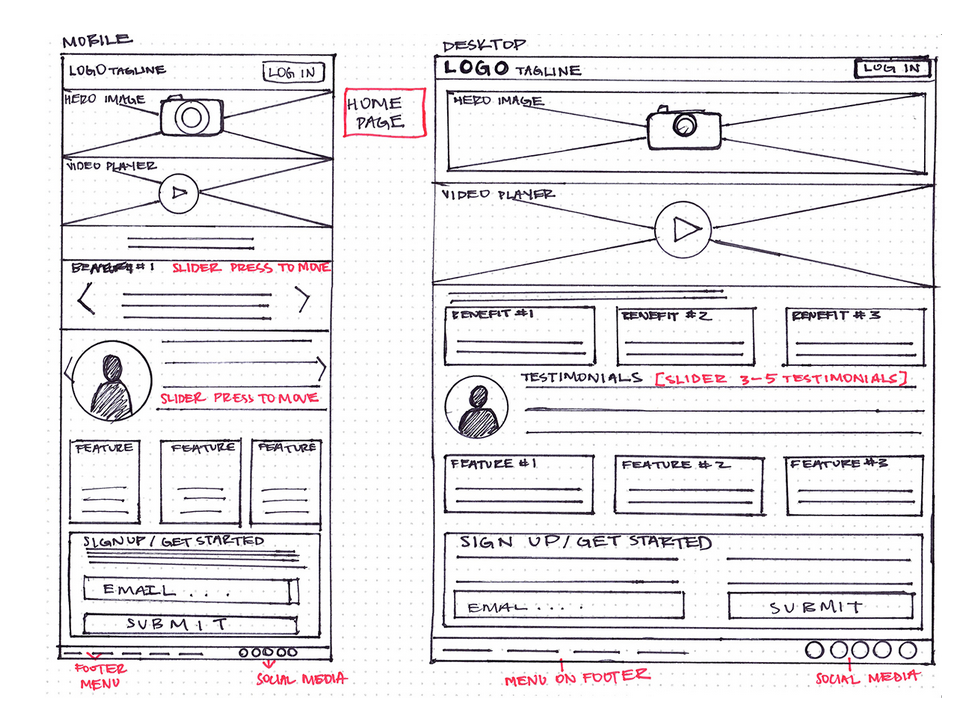
- Do your research
- Prepare your research for quick reference
- Make sure you have your user flow mapped out
- Draft, don’t draw. Sketch, don’t illustrate
- Add some detail and get testing
- Start turning your wireframes into prototypes
-
UXPin: facilitates building responsive clickable prototypes directly in your browser.
-
InVision: InVision allows you to get feedback straight from your team and users. It’s free
-
Wireframe.cc: create wireframes really quickly within your browser, the online version of pen & paper.
HTML (Hypertext Markup Language) is the code that is used to structure a web page and its content. HTML consists of a series of elements
- The opening tag <>
- The closing tag </>
- The content (the text)
- the element (all the parts together)
also can have attribute like this:

You can put elements inside other elements too — this is called nesting.
To structure your website you will use HTML grumpy.
The structure of HTML:

In programming, Semantics refers to the meaning of a piece of code
In JavaScript, consider a function that takes a string parameter, and returns an
In CSS, consider styling a list with li elements representing different types of fruits. Would you know what part of the DOM is being selected with div > ul > li, or .fruits__item?
####Semantics in HTML In HTML, for example, the
element is a semantic element, which gives the text it wraps around the role (or meaning) of "a top level heading on your page."

- Search engines will consider its contents as important keywords to influence the page's search rankings.
- Screen readers can use it as a signpost to help visually impaired users navigate a page.
- Finding blocks of meaningful code is significantly easier than searching through endless divs with or without semantic or namespaced classes.
- Suggests to the developer the type of data that will be populated
- Semantic naming mirrors proper custom element/component naming